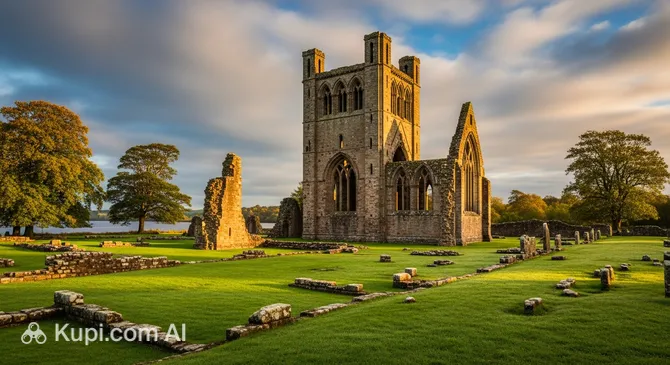
On the picturesque banks of the River Forth, in the shadow of the famous castle, lies Cambuskenneth Abbey—one of the most significant spiritual and historical monuments that Stirling has to offer its guests. This ancient Augustinian abbey, founded in the 12th century, played a key role in the religious and political life of the country for centuries.
Cambuskenneth Abbey. Illustration.
Source: Kupi.com AI
Traveler photos:
Today, this historical complex in Great Britain consists of melancholy and majestic ruins. The main highlight and most well-preserved element is the free-standing bell tower from the 13th century. It is considered a rare and outstanding example of medieval church architecture that has survived to this day almost in its original form.
A visit to the abbey allows you to touch the authentic heritage of Scotland. The site is known as a royal burial place and an arena for important state assemblies, making it a must-see for everyone who appreciates the silence of ancient walls and a deep historical atmosphere.
Contacts
To plan your visit to this historic site, it is useful to have up-to-date information at hand. The property is managed by Historic Environment Scotland.
The main activity for visitors here is exploring the grounds of the ancient monastery complex. You can examine the massive bell tower in detail, which still impresses with its power and the elegance of its stone carvings. A walk along the surviving foundations of the church allows you to imagine the scale of this structure during its heyday.
Photography enthusiasts should definitely stop by for the panoramic views. From the abbey grounds, a unique perspective opens up onto Stirling Castle and the Wallace Monument rising above the horizon. The combination of medieval ruins and green Scottish landscapes creates ideal conditions for atmospheric shots.
The site is also perfect for quiet contemplation. You can read the information plaques detailing the daily lives of the monks and royal ceremonies, or simply relax by the water listening to the sound of the River Forth. Many tourists choose to combine a visit to the abbey with a hike through the surrounding hills, blending cultural enlightenment with outdoor recreation in one walk.
Getting There
Getting to this secluded historical spot is quite simple, as it is located in close proximity to the city center. Cambuskenneth Abbey is located at Ladysneuk Rd, Cambuskenneth, Stirling FK9 5NG. The most scenic route is a walk from the center, which allows you to enjoy views of the River Forth.
If you prefer public transport, you can use local buses heading to the Cambuskenneth area, or take a taxi from the railway station. Traveling by car is also convenient: there are parking spaces near the monastery ruins, from where it is only a short walk to the buildings themselves.
Please note that the abbey is situated on a kind of "peninsula" formed by a bend in the river, so the road to it leads across a bridge. It is recommended to check transport schedules in advance, especially if you plan to visit on weekends or public holidays.
Nearest city: Stirling
History & Facts
The past of this place is inextricably linked with the destinies of Scottish monarchs. Cambuskenneth Abbey served as the final resting place for King James III and his wife, Margaret of Denmark. The fact that the monarch chose this particular location for his burial underscores the monastery's exceptional status in the medieval hierarchy of Scotland.
In addition to its religious role, the abbey was a center of the country's political life. It was here in 1314 and 1326 that Robert the Bruce convened the Scottish Parliament. These gatherings were crucial for strengthening the kingdom's independence, making the monastery ruins not just an architectural monument, but a true cradle of Scottish statehood.
Unfortunately, the period of prosperity ended in the 16th century with the onset of the Scottish Reformation. The monastic community was disbanded, and the magnificent buildings gradually began to fall into decay. Most of the structures were dismantled for building materials for city needs, and only the miraculously preserved bell tower remains today as a reminder of the former greatness of this spiritual center.
Time Needed
A standard tour of the abbey grounds and its famous bell tower usually takes about 1–1.5 hours. This is enough time to take a leisurely stroll among the ancient stones, read the information stands, and take atmospheric photos against the backdrop of the old masonry.
If you are interested in architectural history or plan to have a small picnic in a picturesque spot by the river, you should allow about 2 hours for your visit. Since the site is located in a quiet area, many tourists use a visit to the abbey as an opportunity to take a break from the city bustle before exploring the region's main castle fortifications.
Working Hours
Since Cambuskenneth Abbey is an open-air site, access to its grounds is usually possible throughout daylight hours. However, please note that access inside the bell tower itself may be limited or seasonal.
Before your trip, we strongly recommend checking for up-to-date information on the official Historic Environment Scotland website, as opening hours and access conditions may change depending on ongoing restoration work or weather conditions.
Nearby
A visit to the abbey can easily be turned into a full-day trip, as it is located in the heart of a historic region. Exploring the surroundings will allow you to dive deeper into the atmosphere of medieval Scotland and see famous monuments associated with national heroes.