Support

The History Museum at the Castle

About

Imagine a majestic building with thick stone walls, a tower, and stained-glass windows, appearing as if it was transported from medieval Europe straight onto the streets of a modern American city. This is the History Museum at the Castle — one of the most striking architectural gems Appleton has to offer. Located in Wisconsin, USA, this museum is housed in a former Masonic temple built in the Norman Revival style in the 1920s.
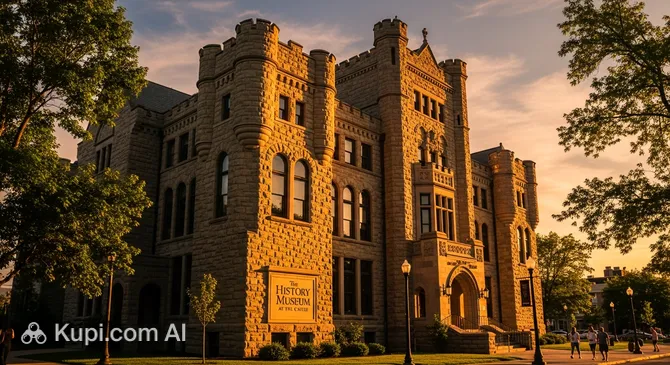
The History Museum at the Castle. Source: Kupi.com AI

The museum is not merely a storehouse for antiquities, but a living narrator of the history of Outagamie County and the Fox River Valley. Inside, you will find three floors of fascinating exhibitions covering everything from the daily lives of Native Americans to the development of a massive paper industry. The building itself is an exhibit: its heavy beams, vaulted ceilings, and rough-hewn stone create a unique atmosphere of mystery and grandeur.

The museum gained particular fame for its connection to the legendary illusionist Harry Houdini, who spent his childhood in this city. It houses a unique collection of the magician's personal items, including his famous locks and handcuffs. Nationally recognized, the museum has been honored with prestigious awards for its educational activities and deep preservation of the region's cultural heritage.

Contacts

To clarify details before your visit, you can use the following information:

Address 330 E College Ave, Appleton, WI 54911, USA
Phone +1 920-735-9370
Official Website http://www.myhistorymuseum.org/

What to Do

The main draw for visitors remains the permanent exhibition dedicated to Harry Houdini. Here, you can not only see the original keys, lock picks, and shackles of the great escape artist but also learn about his childhood in Appleton. Exploring the illusionist's personal belongings and documents turns into a fascinating detective story, revealing the secrets of his phenomenal success.

Across the museum's three floors, a large-scale panorama of local history unfolds. As part of the "Tools of Change" exhibition, you can trace how life in the Fox River Valley changed from the 1840s to the 1950s. On display are artifacts from indigenous peoples, tools of the first settlers, and massive machine parts that once powered local paper mills. A collection of 35,000 historical photographs allows you to literally look into the eyes of people from the past.

Don't forget to take some time for the building itself — examine the massive tower and the interiors of the former Masonic temple. The museum frequently hosts temporary exhibitions dedicated to famous figures of the region, such as Senator Joe McCarthy or the writer Edna Ferber. For those who want to venture beyond the museum walls, walking tours of the city are offered, revealing the architectural and social heritage of Appleton.

Getting There

The museum is located in the heart of the city at 330 E College Ave, right across from the Lawrence University campus. It is easy to find — the Norman Revival building stands out prominently against the urban landscape. If you are traveling by car, parking is available in the city center, and navigation systems will lead you accurately to the main entrance.

For those who prefer public transport, city buses run regularly along College Avenue. The nearest stops are just a few minutes' walk from the museum. If you are in the downtown area, walking or cycling is a great way to reach the site while enjoying the atmosphere of the old city.

Tourists arriving via Appleton International Airport (ATW) can reach the museum in about 15–20 minutes by taxi or rental car. The airport is located just 10 miles from the center. It is also convenient to reach from neighboring cities: Green Bay is 30 miles away, and Oshkosh is 20 miles from Appleton.

History & Facts

The history of this remarkable building began in 1923–1924, when it was constructed as a Masonic Temple for Waverly Lodge No. 51. The Norman Revival architectural style was chosen deliberately to emphasize majesty and the steadfastness of tradition. However, by the mid-1980s, the maintenance of the building became too costly for the Masons, and in 1985, it was transferred to the ownership of the Outagamie County Historical Society (OCHS).

The Historical Society itself has even deeper roots, having been founded in 1872. Over the decades, the museum changed names several times, including a period as the "Houdini Historical Center," before taking its current name. Today, the building is officially listed on the U.S. National Register of Historic Places, serving not just as a repository for exhibits but as a valuable architectural monument in its own right.

The museum's collection covers the region's development since the 1840s. It houses more than 35,000 unique photographs, as well as documents, diaries, and personal belongings of Fox River Valley residents. The museum in detail documents the transformation of a wild frontier into a powerful industrial center for paper and timber, paying special attention to the roles of immigrants and indigenous peoples in this process.

In 2018, the institution received the highest recognition in its field — the National Medal for Museum and Library Service. This award highlights the museum's exceptional contribution to the local community and its educational role. A special place in the museum's history is dedicated to studying the lives of illusionist Harry Houdini and Senator Joe McCarthy, whose destinies are closely linked to this region.

Time Needed

For a standard tour of all three floors of exhibits, most guests need 1 to 2 hours. This is sufficient time to leisurely explore the main halls, admire the architectural details of the building, and discover the legendary secrets of Harry Houdini.

If you are a true history buff, plan to study the archival photographs in detail, or want to take part in one of the walking tours organized by the museum, it is better to budget 2–3 hours for your visit. This will allow you to fully immerse yourself in the atmosphere of the Fox River Valley's past without feeling rushed.

Working Hours

The museum typically welcomes guests daily from 10:00 AM to 4:00 PM. This schedule is in effect throughout the week, from Monday to Sunday, making it easy to fit a visit into any travel itinerary.

Please note that operating hours may change on holidays or during special events. It is recommended to check the museum's official website or call ahead to confirm current status before your trip.

Nearby

After immersing yourself in the region's history within the castle walls, you can continue exploring the city's cultural landscape. Scouring the surroundings will allow you to feel the spirit of the place even more deeply, as many historical markers and iconic locations are within walking distance.

Along the Fox River and on the adjacent university grounds, you will find sites that tell the story of the birth of the electric power industry, the industrial past, and the city's prominent residents. Here are some interesting places located nearby:

Attraction Distance (km)
Main Hall 0.2
Wisconsin State Historical Marker 554: The Merging of Milwaukee Downer and Lawrence Colleges 0.4
Historic Fox River Mills Apartments 0.5
Wisconsin State Historical Marker 556: Vulcan Street Plant Replica 0.6
Historical Marker 57 First Electric Street Car 0.8
Appleton Lock #3 0.9
Appleton Lock #2 0.9
Wisconsin State Historical Marker 581: Henry James and Cremora Rogers Residence 1.4
Fish Cave LLC 2.4
Draft Gastropub 3.3

Reached the end of the page?

That means the route is fully explored