Support

Battery Point Lighthouse and Museum/Crescent City Lighthouse

About

Perched on a rocky islet that reveals a pedestrian path to its doors for only a few hours a day, the Battery Point Lighthouse and Museum stands tall. This unique historic Cape Cod-style structure is located off the shores of Crescent City in Northern California. As one of the oldest lighthouses on the West Coast of the USA, it is not just a navigational aid, but a true symbol of the region's resilience and maritime history.
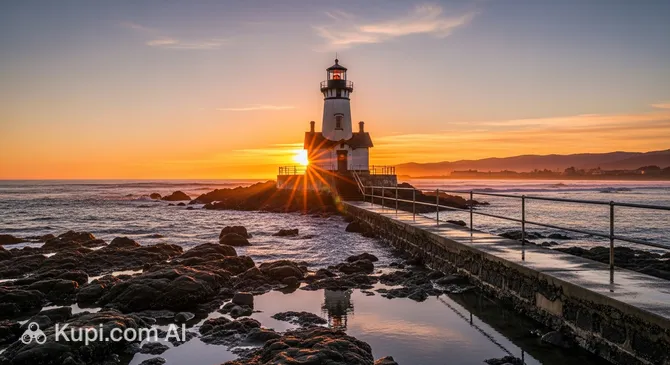
Battery Point Lighthouse and Museum. Source: Kupi.com AI

The uniqueness of this location lies in its geography: twice a day during high tide, the lighthouse is completely cut off from the mainland, turning into an inaccessible fortress amidst the waves of the Pacific Ocean. When the water recedes, a rocky isthmus is revealed to travelers, allowing them to reach the historic building on foot. This turns every visit into a small adventure, dependent on the whims of nature.

Today, Battery Point is listed on the National Register of Historic Places and recognized as a California Historical Landmark. Despite its venerable age, the lighthouse remains active—it functions as a private aid to navigation while simultaneously opening its doors to tourists as a fascinating museum managed by the local Historical Society.

Contacts

To contact the museum administration and obtain up-to-date information on tide conditions, you can use the following contact details.

Address 235 Lighthouse Way, Crescent City, CA 95531, USA
Phone +1 707-464-3089
Official Website https://delnortehistory.org/battery-point-lighthouse/
Managing Organization Del Norte County Historical Society

What to Do

The main highlight for tourists here is the opportunity to take an interactive tour of the lighthouse's interior. You can climb the narrow staircase into the tower itself, which offers a breathtaking bird's-eye panorama of the vast ocean and the rugged coastline. The heart of the lighthouse is a rare fifth-order Fresnel lens (Drumm lens), which has guided ships for a century and a half.

Inside the museum, the atmosphere of the 1850s has been recreated. Visitors can peek into the private living quarters where the lightkeepers once lived with their families. Original furniture, personal belongings, vintage photographs, and documents allow you to literally touch the harsh daily life of the people who dedicated their lives to maritime service. Here, you will learn about the fates of many generations of keepers and the challenges they had to overcome in isolation on the rock.

Beyond the historical exhibits, this site is ideal for nature observation. During the walk to the lighthouse, you can find starfish, crabs, and other ocean dwellers in the tide pools, and from the island itself, you can often spot sea lions and whales during their migration period.

Getting There

The lighthouse is located at the westernmost point of Crescent City in Northern California, just 30 kilometers from the Oregon state border. To get there, you need to drive to the end of A Street, where Lighthouse Way begins. If you are staying in the city center, you can easily reach the site by taxi or private car in just a few minutes.

It is important to remember that the Battery Point Lighthouse and Museum sits on a rocky island connected to the mainland only by a narrow isthmus. This path becomes accessible exclusively during low tide. Therefore, before setting out, be sure to check the local tide schedule so you don't find yourself cut off from the shore or find the path underwater.

Public transportation in the area is limited, so most tourists prefer to drive to the parking lot at the trailhead and then take a short walk across the exposed ocean floor directly to the gates of the historic complex.

History & Facts

The history of this site began in 1856, when the U.S. Congress appropriated $15,000 for its construction. The lighthouse was built using massive granite blocks transported from the central states. Its first signal lights were lit on December 10, 1856, under the supervision of the first keeper, Theophilus Magruder.

During the Gold Rush era, the lighthouse played a critical role, serving as a landmark for ships delivering prospectors, food, and building materials to the growing coastal towns. The lantern's light was visible for up to 14 miles, ensuring safe entry into the Crescent City harbor, which served as the gateway to the gold mines of Southern Oregon.

One of the most dramatic moments in the site's history was the 1964 tsunami, triggered by a powerful earthquake in Alaska. The lighthouse keepers were trapped on the island and watched helplessly as giant waves wiped out entire city blocks. Despite the destructive power of the disaster, the lighthouse building itself miraculously survived without serious damage.

Interestingly, after automation in 1953, the lighthouse was briefly decommissioned. However, in 1982, it was relit, and today it holds the status of a private aid to navigation, continuing to officially serve mariners while welcoming tourists as a museum.

Time Needed

To leisurely explore the Battery Point Lighthouse and Museum, see the exhibits, and climb the tower, most visitors need between 1 and 2 hours. This is enough time to take beautiful photos and listen to the guides' stories.

However, when planning your visit, it is critical to take tide conditions into account. Sometimes tourists have to wait for the right moment to cross to the island, which can increase the total time spent in the area. We recommend building some extra time into your schedule to enjoy the ocean views while waiting for the path to "open."

Working Hours

The museum welcomes guests on a seasonal schedule. From April to September, the lighthouse is open daily from 10:00 AM to 4:00 PM. During the colder months, from October to March, visits are only possible on weekends (Saturday and Sunday) during the same hours — from 10:00 AM to 4:00 PM.

Important Warning: Actual operating hours are directly dependent on tide conditions. If the water level is too high, access to the island is closed for safety reasons. We strongly recommend checking the tide forecast on the official website or by phone before heading out.

Nearby

A visit to the lighthouse can easily be combined with exploring other interesting spots around the harbor. The area near the Crescent City waterfront offers guests both historical landmarks and cozy places to relax after a walk along the ocean shore.

Attraction Type Distance (km)
California Historical Landmark 951: Battery Point Lighthouse Historic site 0
SeaQuake Brewing Brewery / Restaurant 0.7
Billy Boone Square Square / Park 0.8
SS Emidio Historical Marker Historical marker 0.9
Lighthouse Jetty Pier / Promenade 1
Brother Jonathan Cemetery Historic cemetery 1
Enoteca Wine bar 1.1
Ocean World Aquarium 1.5
Chart Room Restaurant Restaurant 1.8
Port O'Pints Brewing Co. Brewery 2.6

Reached the end of the page?

That means the route is fully explored