Support

Travis Air Force Base

About the Airport

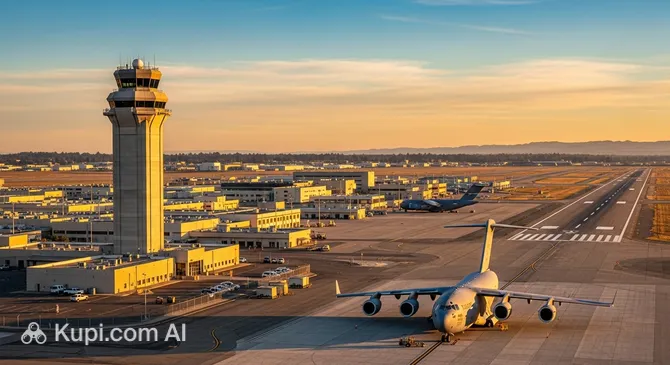
Travis Air Force Base. Source: Kupi.com Binoculars

Travis Air Force Base is not merely a transport hub, but the strategic "Gateway to the Pacific", where the travel atmosphere differs radically from the usual hustle and bustle of civil airport terminals. Instead of advertising banners, you are greeted here by strict military discipline and views of the taking off giants C-5 Galaxy and C-17 Globemaster III, inspiring awe with their power. This airport serves as a starting point for unique missions and flights, offering authorised passengers the opportunity to touch a completely different, more serious level of aviation.

IATA Code SUU
ICAO Code KSUU
City Fairfield
Distance to Centre ~8 km
Status Military (restricted access)
Passengers per Year ~30,000 (military transit only)
Schedule On request (Roll Call 72h)

Airport Features and Advantages

Since Travis Air Force Base is a key hub for the Air Mobility Command (AMC), the experience here has unique features worth considering when planning your trip.

  • Exclusivity of Access: The main feature is that this airport is not accessible to the general public. Only active duty service members, veterans, their family members, and other categories of citizens eligible for flights under the Space-A programme can use it. This creates a "private club" atmosphere inside the terminal, where all passengers are somehow connected to the service.
  • High Level of Security: Being on an active military facility, travellers can be absolutely calm about their safety and the security of their luggage. Perimeter and terminal security is carried out here according to the strictest standards, and car parking is considered one of the most reliable.
  • Waiting Comfort: Despite the spartan conditions of military flights, an excellent USO (United Service Organizations) centre operates in the terminal. Here, passengers are offered complimentary snacks, drinks, comfortable chairs for rest, books, and Wi-Fi access, making the hours of waiting for "Roll Call" much more pleasant.
  • Unique Aircraft Fleet: For aviation enthusiasts, Travis is a true place of power. The opportunity to see up close and even fly on military transport aircraft, such as the legendary "Galaxy", is a rare experience that cannot be obtained at a regular commercial airport.

Contact Information

Since Travis Air Force Base is an active military facility, contact information differs from standard civil airports. Most services are intended for service members and authorised passengers (for example, under the Space-A programme). Below are the main publicly available contacts.

  • Official Website: Current information and news can be found on the base's official website: www.travis.af.mil.
  • Help Desk Phone: For general questions, you can call the base's main switchboard at (707) 424-1110. For passenger transport questions, please contact the passenger terminal at (707) 424-1854.
  • Airport Address: Travis Air Force Base, Fairfield, CA 94535, USA. Remember that a permit is required for access to the territory.
  • Email: There is no direct general email for passengers. To contact Public Affairs, you can use the address: 60amwpa@us.af.mil.
  • Social Media: News and updates can be followed on the official base page on Facebook.
  • Lost Luggage Information: For issues related to lost items within the passenger terminal, please contact terminal support at (707) 424-1854.
  • Passenger Support Contacts: Support for passengers travelling through the base (mainly under the Space-Available programme) is provided by passenger terminal staff. Contact phone: (707) 424-1854.

How to Get to the Airport

When planning a trip to Travis Air Force Base (Travis AFB), it is important to remember that this is an active military facility, not an ordinary civil airport. Access to the territory is strictly controlled. The base is located in the city of Fairfield, USA, and you can get there in several ways, each with its own security-related peculiarities.

Public Transport is the most budget-friendly option. The local bus service, Fairfield and Suisun Transit (FAST), operates routes passing near the base. For example, bus No. 7 goes to the Main Gate. From there, you will likely need to contact your sponsor on the base for further movement. A bus ride from the city centre will take about 20-30 minutes and will cost just a few dollars. Amtrak trains stop at the Suisun-Fairfield station, from where you will have to get to the base by taxi or bus.

Taxis and Ridesharing Services, such as Uber and Lyft, are a convenient way to get to the airbase gates. A trip from the centre of Fairfield will take 10-15 minutes, and its cost will be approximately 15-25 dollars. It is important to understand: drivers without a special permit cannot drive onto the base territory. You will be dropped off at the gate or at the Visitor Control Center, where you will need to undergo a document check.

Car Rental provides maximum flexibility, especially if you plan to travel around the surrounding area. To enter the base in a rental car, you will need to present a driving licence, rental agreement, and insurance at the checkpoint. Be prepared for a possible vehicle inspection. Parking on the base territory is allowed in designated areas; guest parking is usually provided for visitors. Follow the signs and instructions of the security staff.

For most civilian travellers heading to this region, the main air gateways are large international airports. The nearest ones are Sacramento International Airport (SMF), Oakland International Airport (OAK), and San Francisco International Airport (SFO). From these airports, it is most convenient to get to Fairfield and Travis AFB by rental car or pre-booked shuttle. The trip will take from one to one and a half hours, depending on the arrival airport and traffic conditions.

Terminals and Map

The airport at Travis Air Force Base (SUU) functions not as a typical civil airport, but as a hub for military transport under the management of Air Mobility Command (AMC). All passenger activity is concentrated in one main building, which significantly simplifies navigation.

The airport structure includes one passenger terminal, designed to serve service members, their families, and other authorised passengers travelling on official business or under the Space-Available (Space-A) programme. Due to the presence of only one terminal, the issue of transfers between them is irrelevant. The building has a simple and clear layout: upon entry, you find yourself in a general area with check-in counters, followed by a security checkpoint and the departure waiting area.

Departure and arrival zones are clearly separated. After check-in and passing security control, passengers enter a comfortable waiting hall. There are usually seats, information boards, and basic amenities such as toilets and possibly a small buffet or vending machines with snacks here. The arrival zone is a separate sector where passengers go after the aircraft lands to collect luggage and exit the terminal.

The time required to complete all procedures can vary greatly. Unlike commercial flights, military transport, especially under the Space-A programme, may require its own rules, including long waits and participation in so-called "roll calls". It is recommended to arrive at the terminal in advance — at least 2-4 hours before the estimated departure time, and always check the latest information provided by the AMC Travis terminal, for example, on their official social media page.

To navigate the terminal, simply follow the signs. The building is small, so getting lost is practically impossible. The most important thing is to listen carefully to announcements over the public address system and monitor information on screens, as the schedule and status of flights may change. The main focus should be not so much on navigating the building, but on understanding the specific procedures of military air transport.

Airport History

The history of Travis Air Force Base, located in the city of Fairfield, is a chronicle of strategic importance and humanitarian missions spanning several decades. The base was founded in 1942 during World War II under the name Fairfield-Suisun Army Air Base. Its main task was servicing bombers and transport aircraft operating in the Pacific theatre of operations, which immediately determined its key role in logistics.

After the war, the base came under the command of the Strategic Air Command (SAC). A tragic event determined its modern name: in 1951, the base was renamed in honour of Brigadier General Robert F. Travis, who died in a B-29 plane crash a year earlier. During the Cold War years, including the Korean and Vietnam Wars, Travis became the main transit hub for moving troops, equipment, and cargo across the Pacific Ocean, securing the unofficial title "Gateway to the Pacific".

One of the most iconic pages in the base's history was its humanitarian operations. It was here in 1973, as part of Operation "Homecoming", that American prisoners of war returned from Vietnam. In 1975, the base played a central role in Operation "Babylift" — the evacuation of more than 2,000 orphans from South Vietnam. These events forever inscribed Travis in history not only as a military facility but also as a symbol of hope and reunion.

Today, Travis Air Force Base is the largest base of the Air Mobility Command of the USA Air Force and one of the busiest in the country. Giant transport aircraft are based here, such as the C-5M Super Galaxy and C-17 Globemaster III, which continue to perform logistical and humanitarian missions around the world. An interesting fact: the Jimmy Doolittle Air and Space Museum is located on the base territory, where you can learn about the rich history of this unique place.

Services and Amenities

The passenger terminal at Travis Air Force Base (SUU) primarily serves service members, their family members, and other persons eligible for flights under the Space-A (Space-Available) programme. The level of services here differs from commercial airports, but everything necessary for comfortably waiting for a flight is available.

Dining and Shopping. Basic snack options are available in the terminal. As a rule, this is a small snack bar or vending machines. The main centre of attraction for passengers is the USO lounge, where complimentary snacks, drinks, and a more comfortable environment for relaxation are often offered. Not far from the terminal on the base territory, you can find small shops (Shoppette/Express) with essential goods.

Waiting Halls and Wi-Fi. The main waiting hall is equipped with seats. For a more comfortable rest, it is worth visiting the USO lounge, which offers comfortable chairs, televisions, and a quiet atmosphere. Free Wi-Fi is available within the terminal territory, especially in the USO zone, as well as charging stations for electronic devices.

Financial and Medical Services. ATMs are usually available in the terminal or on the base territory. Currency exchange services are generally not provided, as this is not an international commercial airport. Emergency medical assistance is available on the base, but for routine consultations, one should contact civilian medical facilities.

Services for Passengers with Children and Special Needs. The terminal is equipped with mother and child rooms or changing tables in the restrooms. The building complies with accessibility standards (ADA), ensuring convenience for passengers with reduced mobility. Terminal staff can provide necessary assistance during boarding and disembarking.

Accommodation and Business Services. There is a hotel for the military and their families on the Travis base territory (for example, Westwind Inn), however, places must be booked in advance. Many hotels for civilians are located in the nearby city of Fairfield. There are no specialised conference rooms or business centres for transit passengers in the terminal.

Where to Eat

When planning a trip through Travis Air Force Base (SUU), it is important to understand that this is an active military base, not a civilian commercial airport. In this regard, the choice of dining establishments here is specific and oriented primarily towards service members, their families, and authorised passengers. The range and number of cafes and restaurants are significantly more modest than in large international airports.

The main dining opportunities are usually concentrated in the passenger terminal building (Air Mobility Command Passenger Terminal) and in the food court on the base territory (Base Exchange). As a rule, you can find standard American fast-food chains here — burger joints, sandwich bars (e.g., Subway), or chicken cafes (e.g., Popeyes). These establishments are the main option for both a quick snack and a more substantial lunch. Prices here are moderate and correspond to the standard cost of fast food in the USA.

Inside the terminal, there may also be small coffee shops or kiosks offering coffee, pastries, and packaged snacks. Additionally, small 24-hour convenience stores (Shoppette) often operate on the base territory, where you can purchase drinks, snacks, and ready-made sandwiches. This is a convenient option if you are arriving or departing at odd hours.

Finding specialised dietary meals, such as vegan, gluten-free, or halal dishes, will be very difficult here. The opening hours of establishments may be limited and not always round-the-clock, so it is recommended to have a small supply of food with you. Access to the Base Exchange food court outside the terminal may require an escort or possession of the appropriate ID.

Traveller Tips

Travelling through the Air Mobility Command (AMC) terminal at Travis Air Force Base is a unique experience that differs greatly from flying from civil airports. To ensure your trip from the city of Fairfield goes smoothly, it is important to understand the specifics of military air transport and be prepared for a flexible schedule.

Flexibility is Your Main Ally: Unlike commercial flights, flights from a military base, especially under the Space-Available (Space-A) programme, do not have a strict schedule. Military missions are always the priority, so flights may be delayed, rescheduled, or cancelled at the last minute. The key to success is being prepared for long waits and having a backup plan.

"Roll Call" Procedure: Forget about standard check-in. The "roll call" system operates here. You register in the system in advance, and then arrive at the terminal to mark your presence. Shortly before departure, staff announce the roll call, during which available seats are distributed among passengers according to their category and registration time. It is important to be personally present during this process, otherwise your seat may be given to another person.

Documents and Security: To access the base and check in for a flight, you will need not only a passport but also a valid military ID or other documents authorising flights through the AMC system. Security procedures here are strict. Standard TSA (Transportation Security Administration of the USA) rules apply, but be prepared for a more thorough inspection.

Limited Services and Hand Luggage: The passenger terminal on the military base offers a minimal set of amenities. Do not expect a large selection of shops or restaurants. It is recommended to bring books, portable chargers, snacks, and water with you. Be sure to pack all essentials in your hand luggage in case of delays: medicines, a change of clothes, and toiletries.

What to Expect Onboard: Seats on the plane are assigned by staff, and you will not have the opportunity to choose them. The aircraft themselves are, as a rule, military transport planes (for example, C-5 Galaxy or C-17 Globemaster III), so conditions on board can be ascetic: mesh bench seats, noise, and a lack of entertainment systems. Perceive this as part of the adventure.

Reached the end of the page?

That means the route is fully explored