Support

Fort Irwin/Barstow (Bicycle Lake AAF)

About the Airport

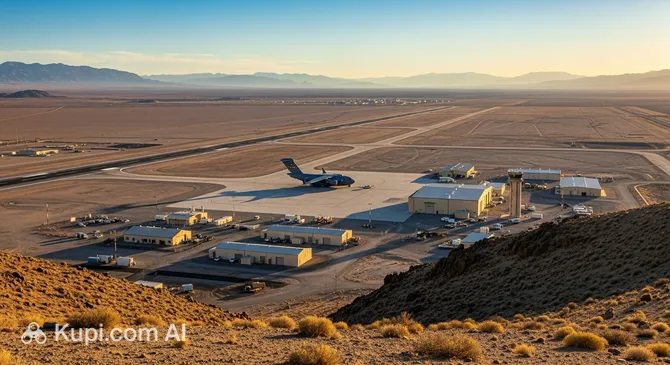
Fort Irwin/Barstow (Bicycle Lake Army Airfield). Source: Kupi.com Binoculars

Fort Irwin/Barstow Airport, also known as Bicycle Lake Army Airfield, is a unique aviation facility located directly on a dry lakebed in the Mojave Desert. Unlike typical civilian terminals with shops and cafes, this airfield serves as a rugged air gateway for the US Army National Training Center. Its runways, laid out on the natural soil of the lakebed, are capable of receiving heavy transport aircraft, creating an impressive spectacle against the backdrop of the endless California sands.

Flight timetable is available here.

IATA Code BYS
ICAO Code KBYS
City Fort Irwin
Distance to city centre ~5 km
Status Military
Annual Passengers Closed to civilian airlines

Airport Features and Purpose

Bicycle Lake Airfield possesses a number of characteristics that make it an outstanding engineering and logistical facility:

Unique Runway Surface. The main feature of the airfield is the use of the surface of the dry Bicycle Lake as a natural airfield pavement. The dense soil allows for the landing of heavy military transport aircraft, such as the C-17 Globemaster III, which deliver equipment and personnel for training exercises.

Strategic Location. The airfield is located in the very heart of the Mojave Desert, approximately 60 km from the city of Barstow. It is a key transport hub for the National Training Center (NTC), ensuring the rapid deployment of troops and equipment from anywhere in the country directly to the training zone.

Challenging Operating Conditions. Pilots working here face difficult challenges: strong desert winds and dust storms can significantly limit visibility. The specific nature of landing on a dirt strip requires high skill, especially when operating large aircraft.

Contact Information

  • Official Airport Website: home.army.mil/irwin (Official website of the Fort Irwin garrison, as the airfield does not have a separate site).
  • Inquiry Desk Phone: +1 (760) 380-4320 (Airfield Operations / Base Operations). Please note: this is a military number intended for flight coordination.
  • Airport Address: Bicycle Lake Army Airfield, Fort Irwin, CA 92310, USA.
  • Email: There is no public email address for civilian inquiries. It is recommended to use telephone communication or contact forms on the garrison website.
  • Social Media: Facebook, Instagram (Official pages of the National Training Center Fort Irwin).
  • Lost Luggage Information: Since the airfield is a military facility and closed to commercial airlines, a classic Lost & Found service is not available. Service members should contact the Transportation Office regarding property issues at +1 (760) 380-5331.
  • Passenger Support Contacts: A 24-hour line is available for arriving personnel (NTC Replacement Detachment): +1 (760) 380-4747.

How to Get to the Airport

It is important to understand that Bicycle Lake Army Airfield is a closed military facility. Civilian airlines do not fly here, and it is impossible to reach it directly on a regular scheduled flight. Most visitors and service members arrive via major civilian airports in neighbouring cities and then proceed to Fort Irwin by ground transport.

Below are the main options for getting to the base and airfield, taking into account the specific access control regime.

Nearest Civilian Airports

Since there are no direct flights, travellers usually use one of the following hubs, renting a car or booking a transfer there:

Car and Rental

A personal or rented car is the most reliable way to get to Fort Irwin. The route from almost all airports lies through the city of Barstow via the Interstate I-15 highway.

From Barstow, Fort Irwin Road leads to the main gates of Fort Irwin. The distance is about 60 km, and the travel time is 40-50 minutes. The road passes through the desert, so ensure you have enough fuel and water. There are no petrol stations on this section.

Access Details (Important!):

  • There is a checkpoint (Main Gate) at the entrance.
  • The driver is required to present a valid driving licence, vehicle registration, and proof of insurance.
  • If you do not have a military ID (DoD ID), you must stop at the Visitor Center before the gates to obtain a temporary pass.

Public Transport (Bus)

Public transport options are extremely limited as the facility is located far from residential zones.

The only regular carrier is the Victor Valley Transit Authority (VVTA). Route No. 118 runs between the city of Barstow and Fort Irwin.

  • Departure: From Barstow City Hall or the library.
  • Cost: Standard fare is about $2-3, but tariffs may change. Passes are available.
  • Schedule: Flights are oriented mainly towards the work schedule of base personnel, so intervals may be long.

Taxi and Transfer

You can take a taxi or use Uber/Lyft services from Barstow, however, there are serious restrictions:

  • Most taxi drivers do not have the right to enter the base territory. They will only be able to take you to the Visitor Center at the main gates. From there, you will have to make your own way or call an internal taxi (if available).
  • The cost of a trip from Barstow to the Fort Irwin gates will be approximately $80–120 one way.
  • A taxi ride directly from Ontario or Las Vegas airports will be very expensive (from $250-300) and is not recommended.

Parking

Parking on the territory of the garrison itself and near the Bicycle Lake airfield is free for authorised vehicles. However, there are no special secure long-term car parks "like in civilian airports" here. Cars park in designated areas near administrative buildings or barracks.

Terminals and Map

Structure and Terminals

Since Bicycle Lake Army Airfield (BYS) is an active military facility, its structure differs radically from familiar civilian airports. You will not find multiple terminals, jet bridges, or confusing walkways here. The airfield functions as a single compact logistical hub, designed for maximum efficiency in the deployment of troops and cargo.

Passenger Terminal

The airfield operates one main terminal (Passenger Terminal / PAX Shed), which handles all incoming and outgoing personnel flow. This is not a classic glass and concrete building, but a strictly utilitarian hangar-type structure.

Key features of the terminal:

  • Waiting Area: A spacious hall with minimalist seating (often simple metal benches or rows of chairs), designed to accommodate large groups of service members (up to a battalion) before boarding.
  • Absence of Commercial Zone: There are no Duty Free shops, restaurants, or business lounges here. Vending machines with water and snacks may be installed in the waiting area, and basic sanitary facilities are equipped.
  • Information Provision: There are no flight boards. All departure information is communicated by unit commanders or via the PA system by the terminal duty officer.

Airfield Map and Navigation

Navigation around the airfield territory is extremely simple and strictly regulated. The movement scheme is divided into "dirty" (access roads) and "clean" (airfield) zones.

Departure and Arrival Zones:

  • Departure Zone (Staging Area): This is the area in front of the terminal or inside the hangar where units assemble, gear checks take place, and loading awaits. Boarding is done on foot: aircraft park in immediate proximity to the exit, and passengers proceed to them in formation across the concrete apron or ground.
  • Arrival Zone: Arriving aircraft, often landing directly on the hard surface of the dry lake, taxi to the unloading area. Passengers disembark via the aircraft ramp and immediately head to the assembly area for briefing and further transport to the residential zone of Fort Irwin.

Registration and Screening Procedures

The check-in process here takes much longer than in civilian airports and has its own specifics.

Registration (Manifest Check):

  • The concept of "online check-in" does not exist. Passenger lists (manifests) are compiled in advance by military command.
  • Arrival Time: Personnel usually arrive at the airfield 3–6 hours before departure. This time is necessary for weighing cargo, assigning seats, and undergoing safety briefings.

Screening and Security:

  • Classic metal detector frames and shoe scanners, as in TSA, may not be present here in the usual form, however, control is stricter. Military ID cards and compliance of equipment with regulations are checked.
  • Particular attention is paid to checking weapons: they must be unloaded and put on safety before loading on board.
  • The K-9 unit regularly checks luggage and cargo before loading.

Navigation Recommendations

For those who find themselves on the territory of Bicycle Lake Army Airfield, strict rules of conduct apply:

  • Follow Orders: Free movement on the airfield is categorically prohibited. You may only leave your group with the permission of a superior.
  • Caution, Desert: Since the airfield is on a dry lakebed, the surface can be dusty and slippery. Be careful when exiting the aircraft, especially at night (lighting may be tactical, i.e., minimal).
  • Protect Documents: Keep your ID card in an easily accessible pocket. It may be checked at several stages: upon entering the terminal, before going out onto the field, and directly at the aircraft ramp.

Airport History

The history of Bicycle Lake Airfield (BYS) is inextricably linked with military activity in the Mojave Desert. This place has undergone an amazing journey from a wild range for anti-aircraft artillery to a high-tech logistical hub capable of receiving the heaviest aircraft in the world directly on the ground.

Founding and Early Years

The official starting point of the aviation history of this area is considered to be 1940. It was then that by decree of President Franklin Roosevelt, the Mojave Anti-Aircraft Range zone was created. In those times, there were no familiar terminals or concrete strips. Pilots used a unique natural feature — the perfectly flat and hard bottom of the dry lakebed. The hard clay crust proved so strong that it withstood the weight of liaison and observation aircraft without any engineering preparation.

Birth of the National Training Center (1980s)

A key moment in the development of the airfield was 1981, when the Fort Irwin garrison was chosen as the base for the National Training Center (NTC). This decision radically changed the status of the field airfield:

  • Massive Expansion: From an auxiliary site, the facility turned into a critically important hub for the deployment of thousands of soldiers and heavy armoured vehicles from all over the country to participate in realistic war games.
  • Infrastructure: The first permanent structures for servicing aircraft were built, navigation systems were modernised, and zones for unloading massive transporters were created.

Space Era and Cooperation with NASA

One of the most exciting pages in the history of Bicycle Lake is its connection with space. Thanks to the huge area and hardness of the surface, the airfield was certified by NASA as an emergency landing site for Space Shuttles (Space Shuttle contingency landing site). Although the shuttles never had to make an emergency landing here, the airfield was constantly maintained in readiness to receive a spacecraft in case of problems during de-orbiting over California.

Modern Modernisation

In the 21st century, the airfield continues to evolve, adapting to the requirements of modern warfare and logistics:

  • 2010s: Reconstruction of taxiways and aprons was carried out. Despite the fact that takeoff and landing are still carried out on the lake soil, parking zones were reinforced with concrete to service modern aviation.
  • Drone Base: In recent years, Bicycle Lake has become home to a company of unmanned aerial vehicles. A modern complex for the control and maintenance of MQ-1C Gray Eagle drones has been erected here, opening a digital chapter in the base's history.

Records and Interesting Facts

Over decades of operation, this desert airfield has accumulated quite a few unique achievements:

  • Receiving Giants: This is one of the few unpaved airfields in the world capable of regularly receiving the heaviest US military transport aircraft — the C-5 Galaxy. Landing such a massive machine on the lake bottom requires virtuoso skill from the pilots.
  • Natural Concrete: The surface of the lake is comparable in density to concrete. However, this "natural strip" has a vulnerability: even a little rain turns the clay into viscous mud, which causes flights to stop completely until the surface dries.
  • Traffic Intensity: During the active phase of exercises (rotations), this remote airfield can rival busy regional airports in terms of the number of takeoffs and landings, receiving dozens of C-17 and C-130 aircraft per day.

Services and Facilities

For passengers arriving at Bicycle Lake Army Airfield (BYS) or departing from it, it is important to adjust expectations in advance. Since this is an active military facility located in the field conditions of the Mojave Desert, the level of comfort and range of services here differ radically from civilian airports. The infrastructure is oriented towards fulfilling combat tasks, not entertaining travellers.

Below is a detailed description of what is available on the airfield territory and in its immediate vicinity (in the Fort Irwin garrison).

Restaurants, Cafes and Shops

Directly in the passenger terminal (PAX Shed), there is a complete absence of full-fledged cafes, restaurants, or Duty Free shops. In the waiting area, typically only the following are installed:

  • Vending Machines: Selling bottled water, fizzy drinks, chocolate bars, and crisps. It is recommended to have cash (small bills) or coins with you.
  • Field Kitchen (MRE): In the event of mass troop deployment, meals may be organised centrally (issuing dry rations), but this applies only to service members on duty.

Full-fledged catering infrastructure is located in the residential zone of Fort Irwin (about a 15–20 minute drive from the airfield):

  • Food Court: The main base has a food court with popular chain establishments (e.g., Subway, Burger King, Taco Bell, Starbucks).
  • PX (Post Exchange): A large department store (military store) where you can buy groceries, electronics, clothes, and souvenirs with NTC symbols.

Waiting Halls and VIP Services

The concept of business lounges or VIP lounges is not applied at Bicycle Lake Airfield. The "waiting hall" represents a hangar space or covered area with rows of metal seats. Conditions are spartan: air conditioning may not be everywhere (or, conversely, work too powerfully), so it is recommended to have a warm jumper with you even in summer.

Wi-Fi, Communication and Charging Stations

  • Wi-Fi: Public internet access on the airfield and terminal territory is generally absent for operational security (OPSEC) reasons.
  • Mobile Communication: Mobile operator signals in the desert can be unstable.
  • Device Charging: There are no specialised stands with USB ports. Access to sockets is extremely limited (usually a few standard sockets on the walls), so it is strongly recommended to bring a fully charged Power Bank.

Banks and Currency Exchange

There are no banking services at the airfield itself. ATMs and bank branches (usually credit unions serving the military) are located in the centre of the Fort Irwin garrison, next to the PX store. Currency exchange is not performed in this area; it is recommended to have US dollars with you.

Medical Services

  • First Aid: During flights, military medics are on duty at the airfield, ready to provide emergency assistance.
  • Hospital: For serious cases, the Weed Army Community Hospital is used — a modern medical centre located on the Fort Irwin base territory. This is a full-fledged hospital with an emergency department.

Services for Passengers with Children

The airfield is not adapted for travel with small children. There are no mother and child rooms or play areas here. Given the high noise level from military aviation and desert dust, parents arriving here (for example, to a spouse's duty station) should take care of water supplies, food, and hearing protection for the child in advance.

Services for Passengers with Reduced Mobility

The accessible environment at the military airfield is limited by the specifics of the equipment:

  • Boarding and disembarking from military aircraft (C-17, C-130) is often carried out via a cargo ramp, which can be convenient for wheelchairs but requires assistance.
  • Sanitary rooms in the terminal typically have basic adaptation.
  • If you plan to visit and require assistance, you must notify the receiving party (garrison command) in advance, as there is no special escort service for passengers with reduced mobility here.

Hotels and Accommodation

Overnight stays are not provided on the airfield itself. Accommodation options are divided into two categories: on the base territory and in the nearest city.

On Fort Irwin Territory:

  • Landmark Inn: The official hotel on the base territory. Offers comfortable rooms, Wi-Fi, and breakfasts. Booking must be done well in advance, as places are occupied by military personnel during exercises.
  • Warrior Zone / Barracks: Accommodation in barracks is provided for single service members.

In the City of Barstow:

Since places on the base are limited, many guests stay in the city of Barstow (about a 45–60 minute drive). Popular chain hotels are represented there, such as Hampton Inn & Suites, Holiday Inn Express, Comfort Suites, and budget motels. This is the best option for civilian visitors who do not have guaranteed housing on the base.

Conference Halls and Business Centres

The airfield has Briefing Rooms, but they are intended exclusively for military planning, pilot briefings, and command staff. Renting halls for civilian conferences or access to business services (printing, fax) for private individuals is impossible. The nearest business centres are located in hotels in the city of Barstow.
Where to Eat

When planning meals during arrival or departure via Bicycle Lake Army Airfield (BYS), it is important to remember a key rule: you are at an active military facility in the deep desert. There are no familiar restaurant courts with a view of the runway or gourmet boutiques characteristic of civilian hubs here. Dining options are strictly functional and depend on your location: directly at the airfield or in the Fort Irwin garrison.

Dining in the Terminal (Airfield / Flight Line)

In the passenger terminal itself (hangar-type waiting area), opportunities to have a snack are minimal. The infrastructure is designed for a short stay before loading or immediately after disembarking.

  • Vending Machines: The only 24-hour option directly at the airfield. Here you can buy water, carbonated drinks, energy bars, crisps, and biscuits.
    Tip: Machines often accept only cash (small bills $1, $5) or coins. Sometimes card readers work, but connectivity in the desert can fail, so having cash is mandatory.
  • Mobile Kiosks (Food Trucks): During major rotations, when thousands of soldiers pass through the airfield, the AAFES (Army & Air Force Exchange Service) may organise the operation of mobile vans with burgers or tacos near the loading zone, but one should not count on this as a guaranteed service.

Main Restaurants and Cafes (Fort Irwin Garrison)

A full lunch or dinner is available only after you leave the airfield and reach the residential and administrative zone of the base (Main Cantonment Area). The trip takes 15–20 minutes. Main gastronomic life is concentrated around the Post Exchange (PX) shopping centre.

Quick Bite (Fast Food):

Popular American chains are represented in the PX food court area. This is the most reliable option for a quick and predictable meal.

  • Subway: Sandwiches and salads. A good choice for those looking for something lighter before the road.
  • Burger King / Taco Bell: Classic fast food. A budget option for a hearty lunch.
  • Qdoba Mexican Eats: Burritos and Mexican bowls.
  • Starbucks: Located inside the PX. Here you can get familiar coffee and pastries. This is one of the most popular places on the base for meetings and using Wi-Fi.

Full Lunch and Atmosphere:

If you have time and want to relax in a calmer setting, it is worth visiting Samuel Adams Brewhouse. This is an establishment in a sports lounge format, popular on US military bases.

  • Menu: Burgers, chicken wings, steaks, salads, and a selection of beverages.
  • Atmosphere: Here you can watch sports broadcasts and take a break from the harsh desert conditions.
  • Opening Hours: Usually open from 11:00 to 21:00 or 22:00 (on weekends).

Local Cuisine and Signature Offers

It is difficult to speak of haute cuisine in the centre of the Mojave Desert, however, trips to Fort Irwin have their own gastronomic traditions related to the road to the base.

  • "The Mad Greek" Tradition: Although this establishment is not on the base, but in the town of Baker or its analogues in Barstow, visiting Greek diners on the way to the desert has become a sort of ritual. Gyros, souvlaki, and strawberry shakes are often used to celebrate the end of exercises or arrival in California.
  • Mexican Cuisine: Given the proximity to the border and the cultural features of Southern California, local tacos and burritos (even in chain establishments) are often distinguished by high quality and authentic taste.

Dietary Catering (Vegetarian, Halal, Gluten-Free)

Finding specialised food on an isolated military base can be challenging, but possible with a smart approach to chain menus.

  • Vegetarians and Vegans: At Taco Bell, almost any dish can be ordered in a "Fresco" version (without cheese and sour cream) with beans instead of meat. At Subway, the "Veggie Delite" sandwich is always available. Qdoba has vegan bowl options.
  • Gluten-Free Food: This is more difficult. The safest option is salads in chain cafes or dishes in Mexican establishments (corn tortillas, rice), but the risk of cross-contamination in a shared kitchen is high.
  • Halal and Kosher: There are no specialised restaurants. Those strictly following a diet are recommended to choose vegetarian or fish options. Packaged Halal/Kosher MREs (dry rations) are available only for service members upon request through the chaplain; they are not available for free sale.

Prices and Opening Hours

  • Average Bill: Prices on the base are usually slightly lower or correspond to the national average, as trade on federal land is exempt from state sales tax. Lunch at a fast food place will cost $8–15, dinner at the Brewhouse — $15–25.
  • Opening Hours: This is a critically important point. Life on the base quiets down early. The food court usually closes at 19:00–20:00. Only some establishments work until 22:00. There are no 24-hour restaurants.
  • Tip: If you arrive on a late night flight, be sure to have a supply of food with you, as all establishments (except vending machines) will be closed.

Traveler Tips

Traveling through Bicycle Lake Army Airfield (BYS) is an experience radically different from flying through a regular civilian airport. There are no business lounges, duty-free shops, or the familiar freedom of movement here. This is a working military facility where logistics are subject to strict army rules and the changeable weather of the Mojave Desert. To ensure your transit goes as smoothly as possible, we have prepared a number of practical tips.

Arrival Time and "Show Time"

In military aviation, the concept of Takeoff Time is secondary compared to the assembly time — Show Time.

  • Arrive Early: Assembly is usually announced 3–5 hours before departure. This time is necessary for checking personnel against lists (manifests), weighing luggage, and briefing. Being even 15 minutes late can lead to you being removed from the flight, as the manifest closes strictly.
  • Be Prepared to Wait: The principle of "Hurry up and wait" works flawlessly here. You may pass the check quickly and then sit in the hangar (PAX Shed) for several hours waiting for the aircraft to arrive. Use this time to rest.

Registration, Documents and Security

There are no check-in counters or electronic boarding passes on phones here.

  • Documents at Hand: Your military ID (CAC / DoD ID) or passport (for civilian specialists) must be in an easily accessible pocket. They will be checked several times: upon entering the terminal, before going out onto the airfield, and at the aircraft ramp.
  • Screening (Amnesty check): Be prepared for questions about the presence of prohibited items (ammunition, pyrotechnics, alcohol) before boarding. It is better to voluntarily surrender a cartridge forgotten in a pocket into a special box (Amnesty Box) than to be detained during screening.
  • Equipment: If you are flying on a military aircraft, ensure your uniform meets requirements. Closed shoes, long sleeves, and sometimes a helmet with goggles (depending on the type of vessel) are often required.

Seat Selection and Comfort on Board

Your comfort directly depends on the type of aircraft you are to fly on.

  • Civilian Charters (Rotator flights): If a regular passenger liner is flying, seating may be free or assigned by the platoon sergeant. Try to take a seat by the aisle — it will be easier to stretch your legs.
  • Cargo Aircraft (C-17, C-130): Here passengers sit on side fold-down seats (web seating) along the fuselage or on pallets in the centre.
    • Temperature: It can be extremely hot in the cargo hold on the ground and very cold in flight. Be sure to have a fleece jumper or jacket (Waffle top / Fleece jacket) with you, even if it is +40°C outside.
    • Noise: The noise level in military transport aircraft is very high. Use earplugs or active headphones.

Hand Luggage and Baggage

The main enemy of electronics and personal items at Fort Irwin is fine desert dust (Moon dust).

  • Gadget Protection: Put phones, laptops, and tablets in sealed bags (Ziploc) or shockproof cases before going out onto the airfield. Dust penetrates everywhere, especially when helicopters land or propellers operate.
  • Food and Water: Take an empty flask or bottle (CamelBak) with you, which can be filled with water in the terminal. Have a supply of high-calorie snacks (protein bars, nuts), as meals on short flights are not provided.
  • Prohibited: Transporting personal alcohol is strictly prohibited. Any weapon must be declared, unloaded, and cleared by a competent person.

Tips for Transit Passengers

Since there are no direct transfers to other flights at BYS, "transit" usually means transferring to ground transport.

  • Carry Your Own Load: Be prepared to carry your luggage (Ruck sack / Duffel bag) yourself from the aircraft to the truck or bus. The distance may be several hundred metres across concrete or dirt. There are no luggage trolleys here.
  • Grouping: Stick to your group (Chalk). Do not wander off to the toilet or for a smoke without warning a superior, so as not to get lost in the unloading turmoil.

Saving Time and Money

  • Cash: There are no ATMs in the terminal, and cards in vending machines may not work due to poor signal. Always have 10–20 dollars in small bills ($1, $5) with you to buy water and a snack.
  • Advance Preparation: To avoid holding up the queue at screening, place metal items and electronics in separate pockets of your bag in advance.

What to Do in Case of Flight Delay

Delays at Bicycle Lake are a frequent occurrence. Reasons can vary from sandstorms and high temperatures (affecting lift) to technical faults with the aircraft.

  • Energy Independence: Sockets in the waiting area are scarce. Be sure to take a powerful Power Bank (external battery) to stay connected.
  • Offline Entertainment: The internet may be slow or absent. Download films, books, or music to your device in advance. A paper book is a soldier's most reliable companion.
  • Sleep: If a long delay is announced, do not hesitate to use your backpack as a pillow and sleep on a bench or the floor (if you have a mat). Restoring strength before exercises or the journey home is critically important.

Reached the end of the page?

That means the route is fully explored