Support

Los Angeles International Airport

Airports in the city

About the Airport

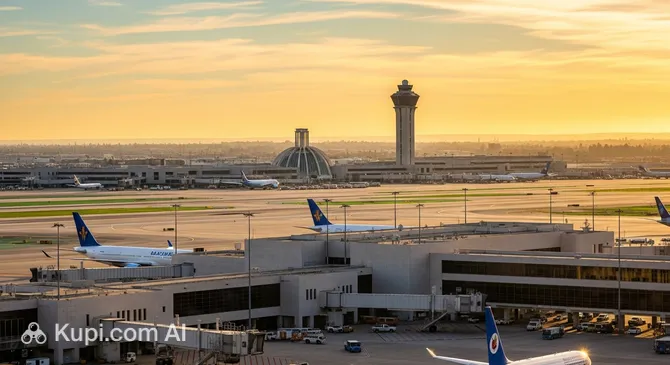
Los Angeles International Airport. Source: Kupi.com Binoculars

Los Angeles International Airport (LAX) is not just an air hub, but a true gateway to the world of dreams and the capital of world cinema. Every day, it welcomes and bids farewell to hundreds of thousands of travelers eager to immerse themselves in the vibrant life of California. LAX is one of the busiest airports not only in the USA, but in the entire world, and its futuristic Googie-style Theme Building has become as recognizable a symbol of the city as the famous letters on the Hollywood Hills. The airport is constantly evolving, offering passengers modern services and convenient navigation through its numerous terminals.

IATA Code LAX
ICAO Code KLAX
City Los Angeles
Distance to centre About 26-30 km.
Status International
Passengers per year Over 75 million (based on 2023 data).
Popular Airlines American Airlines, Delta Air Lines, United Airlines.
Schedule "Los Angeles International Airport" online arrivals/departures

Features and Infrastructure

Los Angeles Airport consists of nine terminals arranged in a horseshoe shape, ensuring convenient movement between them. For passenger convenience, free shuttles run between the terminals. The main international terminal is named after Tom Bradley (TBIT) and handles most flights from Europe, Asia, and Latin America. LAX is known not only for its scale but also for unique art installations and a variety of shops and restaurants to suit every taste. Furthermore, the airport is a vital economic centre for all of Southern California, creating thousands of jobs and fostering tourism and trade in the region.

Contact Information

Below is the essential contact information for Los Angeles International Airport (LAX) that travelers may need.

  • Official Website: You can find the most complete and up-to-date information, including flight status, terminal maps, and parking rules, on the airport's official website: www.flylax.com.
  • Information Service Phone: For general inquiries, you can call +1 (855) 463-5252. Please note that the call may be chargeable depending on your operator.
  • Airport Address: 1 World Way, Los Angeles, CA 90045, USA.
  • Lost & Found Information: If you have lost an item in the terminal, parking lot, or airport shuttle, you should contact the Airport Police Lost & Found. A request can be submitted via a special form on the website. If an item was lost on board an aircraft, you must contact your airline directly.
  • Social Media: The airport actively maintains social media accounts where important updates are frequently posted. The official handle is @flyLAXairport.
  • Passenger Support: To contact customer support, it is recommended to use the feedback form on the official website or call the general information phone number.

How to Get to the Airport

Getting to Los Angeles International Airport (LAX), one of the busiest in the USA, is possible in many ways suitable for any budget and preference. Due to heavy traffic in the city, it is recommended to leave in advance. A trip from the city centre (Downtown LA) can take from 30 minutes without traffic to 1.5 hours during peak hours.

Public Transport is the most budget-friendly option. The most economical way is to use the metro. You need to get to the Aviation/LAX station on the C Line (formerly the Green Line), and from there transfer to the free "G" shuttle, which runs between the station and all airport terminals. Also very popular is the direct LAX FlyAway express bus, which departs from several key points in the city, including Union Station, Van Nuys, and Hollywood. This is a convenient and inexpensive way to get to the airport without transfers; the trip cost is fixed and significantly lower than a taxi.

Taxis and Ridesharing Services (Uber, Lyft) are a convenient but more expensive method. It is important to know that boarding a taxi or rideshare vehicle does not take place at the terminals, but in a special zone called LAX-it. Upon arrival at the airport, you will need to take one of the free shuttles running from the terminals to this waiting area. Passenger drop-off, conversely, occurs directly at the required terminal. The cost of a trip from the city centre is usually from $40 to $60 and higher, depending on demand and time of day.

Car Rental and Personal Transport. If you are traveling by rental or private car, LAX has several parking options. Directly opposite the terminals are the Central Terminal Area (CTA) Parking complexes, which are convenient for short-term parking but are the most expensive option. For long-term parking, it is better to use the more affordable Economy Parking, from where free shuttles run to the terminals around the clock. Offices of all major car rental companies are located outside the airport, and they can also be reached by branded shuttles.

Terminals and Map

Los Angeles International Airport (LAX) is one of the busiest airports in the world, consisting of nine passenger terminals arranged in a horseshoe shape. The central position is occupied by the Tom Bradley International Terminal (TBIT or Terminal B), which handles most international flights. The remaining terminals, numbered 1 to 8, are primarily used for domestic flights, although some international flights may also arrive and depart from them.

The airport layout is organized around a two-level road: the upper level is for departing passengers (Departures), and the lower level is for arriving passengers (Arrivals). This structure helps distribute traffic flows, but movement can be difficult during peak hours. Inside the terminals, navigation is intuitive thanks to numerous signs. For passenger convenience, interactive screens with maps and flight information are installed throughout the airport.

Moving between terminals is possible in several ways. "Outside", in the public zone (before passing security control), free "Airline Connections" shuttles run, stopping at each terminal under blue "LAX Shuttle & Airline Connections" signs. "Inside", in the sterile zone (after security), many terminals are connected by pedestrian walkways and tunnels. For example, terminals 4 through 8 and TBIT are interconnected, allowing passengers with connections not to exit to the public zone and not to undergo screening again. Terminals 2 and 3 have been combined into the modern Delta Sky Way complex, which is also connected to TBIT.

Each terminal has its own features. TBIT stands out for its modern architecture, spacious lounges, and a large selection of world-class shops and restaurants. Terminals 1-3 serve airlines such as Southwest and Delta. Terminals 4-8 are hubs for American Airlines and United Airlines, and also serve Alaska Airlines, JetBlue, and other carriers. Departure zones are usually located on the upper floors, while baggage claim and transport exits are on the lower floors.

The time required for check-in and security screening can vary greatly. On average, it is recommended to arrive 2 hours before departure for domestic flights, and at least 3-4 hours for international ones. During peak periods, security queues can be very long, especially at TBIT. Having TSA PreCheck or Global Entry status can significantly speed up the process.

For comfortable navigation through LAX, follow simple recommendations: check your terminal number on the airline's website in advance, use online airport maps, and allow extra time for moving between terminals if you have a connection. Remember the two-level road system to correctly call a taxi or find the necessary shuttle stop.

Airport History

The history of Los Angeles International Airport (LAX) is the history of the City of Angels itself: ambitious, dynamic, and always looking towards the future. The airport was founded in 1928 on a site known as Mines Field, and was initially used for private and military aviation. The first commercial flights began only in 1946, after which rapid growth began. The name Los Angeles International Airport was officially assigned in 1949.

A real breakthrough happened on the eve of the "Jet Age". In the late 1950s and early 1960s, the airport was radically rebuilt. It was then, in 1961, that its most recognizable symbol appeared — the futuristic Theme Building, resembling a landed flying saucer. This massive reconstruction turned LAX into one of the world's first airports designed specifically to receive jet liners.

The next key stage in the airport's history was the preparation for the 1984 Summer Olympic Games. For this event, a two-level road was built separating the flows of arriving and departing passengers, the new Tom Bradley International Terminal was erected, and new terminals were added, which significantly increased capacity and set the standard for many airports around the world.

In the 21st century, LAX continued modernization. A major reconstruction of the Tom Bradley Terminal was carried out, turning it into one of the most modern in the world. Today, the airport is undergoing another grand update as part of the Landside Access Modernization Program (LAMP), including the construction of an Automated People Mover system that will connect terminals with the metro and new parking complexes.

Among LAX's achievements is a stable place in the top ten busiest airports in the world. An interesting fact: due to its proximity to Hollywood, the airport has become a filming location for hundreds of movies and TV shows, making it one of the most recognizable in popular culture. Its history is a continuous process of adaptation and growth, reflecting the development of aviation and Los Angeles itself.

Services and Amenities

Los Angeles International Airport (LAX) offers passengers a wide range of services to make waiting for a flight as comfortable as possible. In each terminal, you will find numerous restaurants, cafes, and dining lounges for every taste and budget — from fast food outlets to fine dining restaurants. For shopping lovers, numerous stores are open, including Duty-Free, boutiques of famous brands, souvenir shops, and electronics stores.

For those who need to stay connected or work, free Wi-Fi is provided throughout the airport. Numerous charging stations for electronic devices are located everywhere. The airport also has business centres and conference rooms for business meetings. Financial services are represented by ATMs, currency exchange points, and bank branches.

LAX cares about the comfort of all categories of passengers. For travelers with children, mother and child rooms and play areas are provided in some terminals. Passengers with reduced mobility can count on special assistance, an accessible environment with ramps and elevators, as well as adapted restrooms. In case of necessity, you can contact medical stations, which operate around the clock.

For a more comfortable wait for a flight, the airport has many premium lounges (VIP halls). Access to them is provided both for business class passengers and for a fee for everyone. If you have a long layover or an early departure, you can stay at one of the hotels located in the immediate vicinity of the airport, many of which are served by free shuttles.

Where to Eat

Los Angeles International Airport (LAX) reflects the culinary diversity of Los Angeles itself, offering travelers a wide selection of establishments for every taste and budget. Here you will find everything: from fast food outlets and cozy coffee shops to restaurants from famous chefs. Most of the best cafes and restaurants are located in the *airside* zone, that is, after passing security control, so plan your time accordingly.

A particularly rich selection awaits passengers in the Tom Bradley International Terminal (TBIT), which is famous for its high-class establishments. Here you can enjoy modern Mexican cuisine at Border Grill or try Californian dishes in other restaurants. Other terminals also do not lag behind: for example, in Terminal 3 there is the popular burger joint Shake Shack, and in Terminals 4, 5, and 7 you can find excellent coffee shops and dining venues. If you are looking for something typically Californian, look for places offering fresh salads, avocado toast, and smoothies.

For those in a hurry, each terminal has many options for a quick snack: Starbucks, Pret A Manger, The Coffee Bean & Tea Leaf, as well as kiosks with sandwiches and pastries. If you have time for a full lunch or dinner, it is worth looking into one of the table-service restaurants. Prices vary: a light snack will cost 15-25 dollars, and dinner in a good restaurant — from 40 dollars and up per person.

The airport also pays attention to passengers with special dietary needs. Finding vegetarian, vegan, halal, and gluten-free dishes will not be difficult — many establishments offer salads, bowls, and special menus. Opening hours vary: most are open from early morning until late evening, and some coffee shops and restaurants in international terminals work around the clock or until the last flight. Nevertheless, it is always recommended to check the current schedule on the official airport website before departure.

Travel Tips

Planning a trip through one of the busiest airports in the world requires preparation. Following these tips, you will make your journey through Los Angeles International Airport (LAX) more comfortable and predictable.

Arrival time at the airport. Los Angeles is famous for its heavy traffic, so always allow extra time for the road to the airport. For international flights, it is recommended to arrive 3-4 hours before departure, and for domestic ones — 2-3 hours. This will give you enough time for check-in, baggage drop-off, and passing security control without unnecessary haste.

Check-in and security control. To save time, complete online check-in for the flight and save the boarding pass on your phone. In TSA (Transportation Security Administration) screening zones, be ready to remove laptops and other large electronic devices, as well as containers with liquids, from your carry-on luggage. Keep your passport and boarding pass handy.

Choosing a seat on the plane. If you have a short layover, choose seats in the front of the cabin to exit the plane faster. Window seats are great for those who want to sleep or admire the views, while aisle seats provide more legroom and freedom of movement around the cabin.

Carry-on luggage. Remember the rule for carrying liquids: containers with a volume of no more than 100 ml (3.4 oz) packed in one transparent bag are allowed. Sharp objects, flammable substances, and other dangerous materials are prohibited in carry-on luggage. Always check the current rules on the airline and TSA websites before departure.

Passengers with transfers. LAX is a huge airport with nine terminals. Study the map in advance and clarify from which terminal your next flight departs. Shuttles run between terminals. If you arrive on an international flight and transfer to a domestic one, you will most likely need to collect your luggage, pass customs, and check it in again at the check-in counter.

Customs control. When entering the USA, you will need to pass border control (CBP). Be ready to answer the officer's questions about the purpose of your trip and present all necessary documents, including a visa and return tickets. Customs declaration filing now most often takes place electronically via special kiosks.

Saving time and money. Book parking online in advance if you are driving your own car — it is often cheaper. Instead of taxis or ridesharing services, consider FlyAway buses, which run to popular destinations in the city. To avoid spending money on water, take an empty reusable bottle with you and fill it after passing security control.

In case of flight delay. First of all, check your airline's mobile app for up-to-date information. Depending on the reason and duration of the delay, the airline may provide vouchers for food or even hotel accommodation. Do not hesitate to contact the air carrier's counter to find out about your rights. During this time, you can explore the shops, restaurants, or art installations that are in every LAX terminal.

Reached the end of the page?

That means the route is fully explored