Support

Kaloko-Honokohau National Historical Park

About

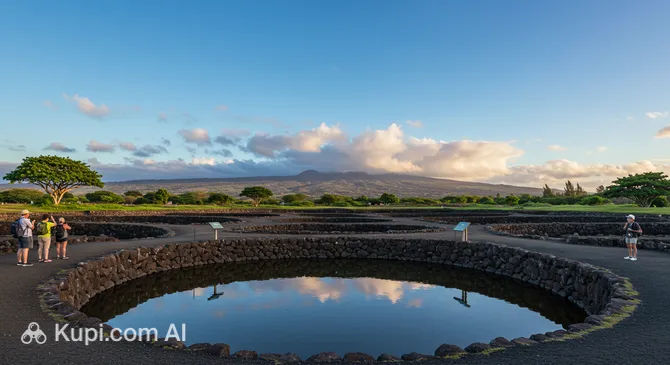
On the coast of the Island of Hawai'i, in the sunny town of Kailua-Kona, lies Kaloko-Honokohau National Historical Park. This protected area of about 1,200 acres is a unique symbiosis of an archaeological preserve and a nature park, established in 1978 to preserve the priceless heritage of the native Hawaiians.
\n\n
Kaloko-Honokōhau National Historical Park
Kaloko-Honokōhau National Historical Park. Иллюстрация. Источник: Kupi.com AI
\n\n

The park protects the remains of an ancient settlement and coastal sections of five traditional land divisions—ahupua'a. Here, you can see how harmoniously the ancient residents of the USA (the state of Hawaii) interacted with the ocean and the rugged volcanic land, building temples, homes, and complex engineering systems for raising fish.

\n\n

In addition to its cultural significance, Kaloko-Honokohau is home to rare representatives of flora and fauna. Within its territory, you can often spot Hawaiian stilts (ae'o) and coots, while the coastal waters and beaches attract marine life, turning a walk into a true wilderness safari.

Contacts

For more information or to plan your visit, you can use the park's official contact details.

How to contactContact
AddressKailua-Kona, HI 96740, USA
Phone+1 808-326-9057
Websitewww.nps.gov

What to Do

The main reason to visit this park is the opportunity to see ancient fishponds (loko i'a). These grand structures clearly demonstrate the engineering talent of the Hawaiians, who knew how to effectively use the tides to provide food for their settlements. Walking along the shore, you will inevitably come across petroglyphs—mysterious carvings etched into the hardened lava centuries ago.

\n\n

For outdoor enthusiasts, the park offers a network of historic trails that connect the ruins of ancient temples (heiau) and residential platforms. This is a great way to feel the scale of the ancient settlement. Don't forget to check out the beach areas: there is a very high chance of seeing green sea turtles, which often come out onto the sand to bask in the sun.

\n\n

The park's coastal waters are ideal for observing vibrant corals and tropical fish. Even a simple stroll along the water's edge will allow you to enjoy the authentic atmosphere of Hawaii, far from the noisy resort zones, and touch the living culture that is carefully preserved by local communities to this day.

Getting There

Kaloko-Honokohau National Historical Park is located in the northern part of Kailua-Kona on the Big Island. The nearest transport hub is Kona International Airport (KOA), which is just a 10–15 minute drive away (about 12 km). The most convenient way to get there is by rental car or taxi, following Hawaii Route 19 (Queen Ka'ahumanu Highway).

\n\n

If you are already in downtown Kailua-Kona, the drive will take only a few minutes. The park entrance is well-marked with signs and has its own visitor parking. Navigator coordinates: 19.6778522, -156.0216868.

\n\n

For those who prefer public transport, the Hele-On Bus network operates in the region. However, it is advisable to check current schedules and routes in advance, as stops may be some distance from the park entrance, and most travelers still choose a car for better mobility.

Ближайший город: Kailua-Kona

History & Facts

The history of this land is steeped in the spirit of the ancient Hawaiians who inhabited the Honokohau settlement between 1200 and 1700 AD. This site was considered sacred and strategically important. The indigenous people demonstrated incredible ingenuity, transforming the harsh landscape of cooled lava into a thriving community. They built massive fishponds and utilized underground freshwater springs to survive on the arid coast.

\n\n

In 1974, a group of elders and activists seeking to preserve the islands' cultural code presented a report titled "The Spirit of Kaloko-Honokohau" to the government. This occurred during the height of the "Second Hawaiian Renaissance"—a time of powerful resurgence in interest in the native language, hula dancing, and traditional crafts. The community's efforts were successful, and in 1978, the territory was granted National Historical Park status under the auspices of the USA.

\n\n

Today, the park serves not just as an open-air museum, but as a living center for the restoration of cultural identity. After decades of decline in the traditional way of life following contact with Europeans, Kaloko-Honokohau has become a platform for reviving ancient skills in fishing, navigation, and construction, allowing new generations of Hawaiians to maintain a connection with their ancestors.

Time Needed

To leisurely walk the historic trails, explore the ancient structures, and enjoy the ocean views, it is recommended to set aside 2 to 4 hours for your visit. This is plenty of time to reach the fishponds and spend time on the shore observing nature.

\n\n

If you plan to go snorkeling or study every information board and archaeological site in detail, it is better to plan for half a day. Keep in mind that walking across lava fields under the open sun can be tiring, so budget time for resting in the shaded areas by the water.

Working Hours

The park is open to visitors daily, making it easy to include in your travel itinerary. The schedule is the same for all days of the week: Monday through Sunday from 8:30 AM to 4:00 PM.

\n\n

It is recommended to arrive in the first half of the day to have time to see all the key sites before closing and to avoid the strongest midday heat. Please note that access to the territory ends promptly at 4:00 PM.

8:30 – 16:00

Nearby

Exploring the park's surroundings will allow you to dive deeper into the island's atmosphere and discover its gastronomic culture and historical heritage. In the immediate vicinity, you will find both ancient sanctuaries and modern leisure spots.

\n\n
NameDistance
Sport Fishing in Kailua-Kona0.9 km
Kona Commons Shopping Center3.6 km
Old Kona Airport State Recreation Area4.2 km
Big Chocolate Island4.5 km
Quinn's Almost by the Sea4.8 km
Da Shark Shack5 km
Kailua Pier5 km

Reached the end of the page?

That means the route is fully explored