Support

The Gamble House

About

Immerse yourself in the atmosphere of the early 20th century by visiting one of the most striking examples of the American Craftsman style. Located in picturesque Pasadena, this mansion, known as the Gamble House, was built in 1908 for the heirs of the Procter & Gamble company. Today, it is recognized as a National Historic Landmark and is considered the "ultimate bungalow," where architecture, interior design, and nature merge into one.
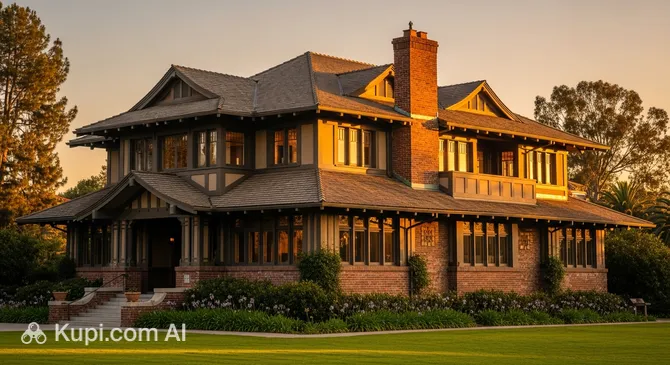
The Gamble House. Source: Kupi.com AI

This location in the USA is unique because its original furnishings, designed by the legendary Greene and Greene brothers, have been completely preserved. Noble woods such as maple, oak, and teak were used in the decoration, and the design is infused with the influence of Japanese aesthetics. The mansion surprises with its scale and attention to detail: from elegant stained glass to massive river boulders in the foundation finish.

Today, the Gamble House functions as a public museum. It attracts not only architecture enthusiasts but also those who want to see how masterpieces of the Arts and Crafts movement were created. It is a living monument to an era that still serves as a home for architecture students, maintaining the continuity of traditions in this wonderful corner of California.

Contacts

For up-to-date information on special events or to book private tours, you can use the official communication channels.

Address 4 Westmoreland Pl, Pasadena, CA 91103, USA
Phone +1 626-793-3334
Website gamblehouse.org
Social Media Instagram, Facebook

What to Do

The main event of your visit will be a guided group tour. This is the only way to get inside and see the 39 rooms for yourself, each of which is a work of art. You can examine unique handmade furniture, stained glass by master Emil Lange, and the famous "cloud" ceilings that create a sense of lightness in the massive wooden interior.

After wandering through the rooms, be sure to stop by the gift shop, which is housed in the former garage. Here you can buy rare art books, replicas of Craftsman-style interior items, and unique gifts. The surrounding garden also deserves attention: terraces and natural stone paths are seamlessly integrated into the landscape and offer excellent angles for exterior photographs.

For those who want a deeper immersion, special themed lectures and evening tours are occasionally held, when the house is illuminated in a specific way to emphasize the texture of the wood and glass. Since the site is very popular, it is best to book tour tickets in advance on the official website.

Getting There

Located in a quiet and prestigious neighborhood near the Arroyo Seco canyon, the mansion is easily accessible for travelers. If you are driving from Los Angeles, the route via the I-110 or I-210 will take about 20 to 30 minutes. Please note that parking directly at the house is limited, so visitors are encouraged to use the free parking spaces on Westmoreland Place or adjacent streets.

For those who prefer public transport, the Gold Line metro is a convenient option. Take the train to Memorial Park station, from where you can walk to the attraction in about 10–15 minutes through the city's picturesque streets. Metro bus routes 180 and 256 also run in this direction.

If you are coming from LAX, it is most convenient to use a taxi or Uber/Lyft services (the trip takes about an hour). An alternative is the FlyAway bus to Union Station, followed by a transfer to the metro. Active travelers can also arrive by bicycle using the dedicated paths that stretch along the Arroyo Seco.

History & Facts

This architectural masterpiece was built between 1908 and 1909 for David and Mary Gamble. As members of the family of the co-founder of the giant Procter & Gamble, they sought refuge in Pasadena from the harsh Cincinnati winters. To realize the project, brothers Charles and Henry Greene were invited, whose firm Greene and Greene had become famous for creating "ideal bungalows."

Interestingly, in the mid-20th century, the Greene brothers' style briefly fell out of fashion and was considered outdated. However, after World War II, interest in their work flared up with renewed vigor. The Gamble family carefully preserved the house for decades, and in 1966, it was gifted to the city and the University of Southern California (USC) School of Architecture, which allowed the authentic furnishings to be completely preserved.

The architects aimed for total harmony with nature: every detail, from the shape of the roof to the patterns on the stained glass, was inspired by Californian landscapes and Japanese philosophy. For example, the stained glass in the main doors depicts a Japanese black pine, and the lines of the furniture echo the shapes of clouds and mist. In 1977, the building officially received the status of a National Historic Landmark of the USA.

Time Needed

To fully appreciate the architects' craftsmanship and the interior details, it is recommended to set aside about 2–3 hours for your visit. A standard tour of the house lasts one hour, but you will likely want to spend additional time on the terraces and in the garden, studying the intricate stonework and landscaping.

If you plan to visit the gift shop located in the former garage or simply sit on the grounds and admire the view of the valley, add another 30–40 minutes to your schedule. It is best to arrive early, about 15–20 minutes before the start of your booked tour, to settle into the early 20th-century atmosphere.

Working Hours

The mansion is open to visitors on specific days of the week: Thursday through Sunday, as well as on Tuesdays from 10:00 AM to 4:00 PM. Monday and Wednesday are usually closing days. Please note that the last interior tour begins at 3:00 PM.

The schedule may change on holidays or during special events, so it is highly recommended to check the current schedule on the museum's official website before your trip.

Nearby

After immersing yourself in the world of the American Craftsman, it is worth spending time at other interesting sites located nearby. The area is rich in both architectural landmarks and cozy places to relax.

Name Type Distance (km)
The Maxwell House Historic building 0.8
Colorado Street Bridge Bridge / Landmark 0.9
St. Andrew Catholic Church Religious site 1.1
Wrigley Mansion Mansion 1.4
Castle Green Historic building 1.4
Mijares Mexican Restaurant Restaurant 1.7
Fishdoctorpros Point of interest 2.5
Albert Einstein’s Caltech Home Historic home 2.8
Bissell House 1887 Mansion 3.1
Van Halen childhood home Memorial site 4.6

Reached the end of the page?

That means the route is fully explored