Support

Olympic National Park Visitor Center

About

Your journey into the world of Northwest wilderness begins right here. The Olympic National Park Visitor Center is the primary gateway for explorers of one of the most spectacular protected areas in the USA. Located in the inviting town of Port Angeles, this center serves as an essential guide for anyone wishing to experience the pristine ecosystem of the peninsula.
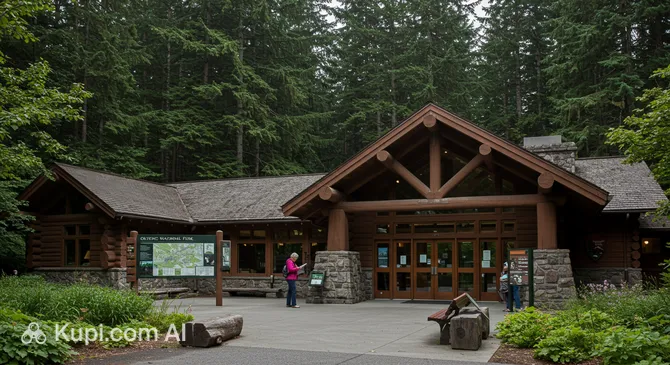
Olympic National Park Visitor Center. Source: Kupi.com AI

The center is not just an information desk, but a full-scale educational hub. Here, visitors can learn about three distinct worlds united under the park's umbrella: the rugged Pacific coast, ancient temperate rain forests, and majestic alpine peaks. The total area of protected land exceeds 3,700 square kilometers, and it is at this visitor center that the scale of the park becomes clear and tangible.

Due to its significance and convenient location, the facility is a mandatory stop. Every effort has been made here to ensure your holiday is not only beautiful but also safe, providing essential knowledge about the region's flora and fauna before you head deep into the forest trails.

Contacts

To check current road conditions in the park or for visitation details, you can use the official communication channels. Center staff are always ready to help tourists plan their route.

Phone +1 360-565-3130
Website nps.gov/olym
Address 3002 Mt Angeles Rd, Port Angeles, WA 98362, USA
Google Maps View on map

What to Do

Inside the information center, you'll be greeted by experienced rangers ready to share invaluable advice. Here, you can get the latest information on trail conditions, check tide schedules for beach walks, and obtain all necessary permits for overnight stays in the wilderness.

Be sure to spend some time at the educational exhibits. Interactive displays and expositions tell the story of the region's biodiversity, the history of indigenous peoples, and the park's unique climate zones. For many tourists, watching the orientation film in the center's theater provides an excellent emotional introduction to the upcoming adventure.

In addition, you can purchase detailed topographic maps and books about local nature in the souvenir shop. The center helps you competently plan your route to gems like the Hoh Rain Forest or the mountain glaciers, making your stay in the park as productive and experience-rich as possible.

Getting There

The information center is conveniently located at 3002 Mt Angeles Rd. The town of Port Angeles itself is situated on the scenic Olympic Peninsula. If you are traveling from Seattle, prepare for a journey of about 160 kilometers (100 miles) to the northwest, which takes approximately 2.5–3 hours.

The main route follows US-101, the primary highway encircling the entire park. For those arriving from Canada, regular ferry services are available from Victoria, British Columbia, arriving directly at the city's port.

The nearest major air hub is Seattle-Tacoma International Airport. The most convenient way to reach the visitor center from there is by renting a car, which gives you complete freedom to move around the vast territory of the national park. Local taxi services are also available within the city for the trip from the center to the complex doors.

History & Facts

Olympic National Park, of which the visitor center is a part, officially opened its doors in 1938. Its creation was a major milestone in the conservation history of the USA. Global recognition came later: in 1976, the territory was designated an International Biosphere Reserve, and in 1981, it was added to the UNESCO World Heritage list.

One of the most striking features of this area is its geographical isolation. For a long time, the Olympic Peninsula was separated from the mainland, which facilitated the evolution of unique species. Today, it is home to 15 animal species and 8 plant species that are endemic and found nowhere else on the planet.

The park's landscapes are strikingly contrasting thanks to the Olympic Mountain Range. Peaks reaching up to 2,400 meters create a unique microclimate. The western slopes receive a colossal amount of rainfall, nourishing the famous temperate rain forests, while the eastern side remains relatively dry, resembling the sunny climate of Southern California.

Time Needed

For an initial look at the visitor center's exhibits and a consultation with the rangers, 1–2 hours is usually sufficient. This is enough time to watch the orientation film, study the maps, and choose suitable routes for your excursions.

However, keep in mind that Olympic National Park itself is massive. To see at least its main attractions—from the ocean coast to the snow-capped peaks—it is recommended to set aside at least 2–3 full days for your trip.

Working Hours

The information center is ready to welcome guests throughout the day, providing support during the most active hours. The facility operates on a consistent schedule daily, seven days a week.

The center's doors are open from 9:00 AM to 4:00 PM Monday through Sunday. It is recommended to arrive in the morning to have time for a consultation and to set out on your route while it is still light.

Nearby

A visit to the visitor center is just the beginning of your acquaintance with the region. Exploring the surroundings will help you dive deeper into the history of exploration in the Northwest and enjoy the industrial heritage of Port Angeles. Nearby, you will find interesting technical monuments and scenic viewpoints.

A stroll through the nearby streets will lead you to cozy gastropubs and atmospheric coffee shops where you can discuss your upcoming trek through the national park. Below are the most noteworthy sites located within a radius of a few kilometers.

Name Distance (km)
Olympic National Park Headquarters Historic District 0.6
Rayonier Steam Locomotive 1.3
The Coffee Box 2.1
Zigzag Path 2.3
Next Door Gastropub 2.3
Breezeway 2.4
Pho New Saigon 2.4
John Michael Romiza Viewpoint 2.7
Friendship bridge 2.7
Tse-Whit-Zen 4.4

Reached the end of the page?

That means the route is fully explored