Support

BYU Museum of Paleontology

About

Imagine a place where Earth's past comes to life, not through plastic replicas, but through a connection with genuine witnesses of history. The BYU Museum of Paleontology, located in Provo, USA, is rightfully considered one of the most significant research centers in its field. It is not just an exhibition space, but a living laboratory housing thousands of fossil remains discovered in the famous Morrison Formation.
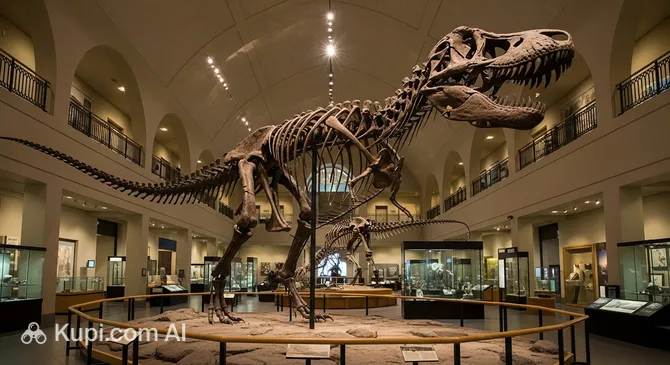
BYU Museum of Paleontology. Source: Kupi.com AI

The museum stands out from other paleontological collections because its halls are dominated by original dinosaur bones rather than casts. The exhibition spans a vast timeline: from the majestic giants of the Mesozoic era to the ancient horses, camels, and rhinoceroses of the Cenozoic. This allows guests to visually trace the complex path of evolution of life on our planet.

As part of Brigham Young University, the museum fulfills a vital educational role. Here, world-class paleontologists and students work continuously to prepare fossils for study, turning every visit into an immersion in real academic science.

Contacts

For those planning a visit, here are the museum's current contact details:

Address 1683 North Canyon Road, Provo, Utah 84604, USA
Phone +1 801-422-3680
Official website geology.byu.edu/museum-of-paleontology

What to Do

The main draw for visitors is undoubtedly the fully mounted skeletons of giants like the Supersaurus and Allosaurus. The scale of these creatures is breathtaking, making you feel tiny next to the masters of ancient ecosystems. Be sure to stop by the panoramic window of the fossil preparation lab: here, you can watch in real-time as specialists carefully extract fossils from the rock.

For those who prefer a tactile experience, the museum offers a unique opportunity to touch real fossils. This turns a standard tour into an interactive adventure, which is especially engaging for children. Museum staff are often present in the halls and are happy to answer questions, sharing details about recent finds—some of which scientists haven't even had the chance to officially name yet.

In addition to dinosaurs, the collection features ancient fish, invertebrates, and fascinating specimens of fossil plants. Each display case tells a complete story of what our world looked like millions of years ago, making a visit to the museum a comprehensive educational journey for the whole family.

Getting There

The BYU Museum of Paleontology is conveniently located in the northern part of Provo, right next to the Brigham Young University campus. Drivers can use the famous LaVell Edwards Stadium as a landmark; the museum building is situated nearby at 1683 North Canyon Road.

If you are coming from the city center, it is easiest to take a taxi or a rideshare service—the trip will only take a few minutes. Public transport (buses) also serves the BYU campus, with stops within walking distance of the museum entrance. For precise navigation, it is recommended to use GPS coordinates or online maps to easily find parking near the exhibit.

History & Facts

The history of this scientific center began in 1976, when a need arose for a secure storage facility for a massive fossil collection. The founder and inspiration behind the collection was James A. Jensen, a legendary paleontologist known in professional circles as "Dinosaur Jim." His expeditions to the Morrison Formation yielded unique materials that became the foundation of global knowledge regarding Torvosaurus and Allosaurus.

For many years, the facility was known as the BYU Earth Science Museum and occupied a modest technical building. However, the scientific value of the gathered artifacts demanded more space. A major upgrade took place in 2009: the museum officially changed its name and moved into a modern facility, increasing its area by 5,000 square feet. This finally allowed the public to view treasures that had been stored in archives under the university stadium for decades.

A significant milestone in the institution's history was 2026, when the BYU Museum of Paleontology celebrated its 50th anniversary. Today, under the leadership of Rodney Scheetz, Jensen's successor and student, the museum continues the tradition of field research, adding new and sometimes yet-to-be-named species of our planet's ancient inhabitants to its collections every year.

Time Needed

When planning your itinerary, keep in mind that this site rewards thoughtful exploration. While an hour might suffice for a quick glance at the main dinosaur skeletons, most visitors spend 1.5–3 hours here.

You should budget extra time if you wish to watch the painstaking work in the preparation lab or examine the Cenozoic mammal collection in detail. Immersing yourself in the world of ancient creatures is so captivating that time tends to fly by.

Working Hours

The museum is open to the public on weekdays, Monday through Friday from 9:00 AM to 5:00 PM. Please note that the exhibition halls are closed to the public on Saturdays and Sundays.

A pleasant bonus for travelers is that admission to the museum is free for everyone. However, it is recommended to check the university's official website before your trip, as the schedule may change during holidays or special university events.

Nearby

A visit to the museum can be perfectly combined with a stroll through the university campus or relaxation in city parks. The surrounding area offers both cultural sites and places for active family leisure.

Name Type Distance (km)
Centennial Carillon Tower Bell Tower 0.9
North Park Park 1.9
Historic Rare Elm Tree Natural landmark 2.6
Escalante Trail Historical Marker Historical marker 2.7
Splash Summit Waterpark Water park 2.8

Reached the end of the page?

That means the route is fully explored