Support

Bainbridge Island Japanese American Exclusion Memorial

About

The Bainbridge Island Japanese American Exclusion Memorial is a deeply moving outdoor historical site located near the city of Seattle in the USA. This place of remembrance is built on the site of the former Eagledale ferry dock, where in 1942, the first Japanese Americans were forcibly sent to internment camps.
\n
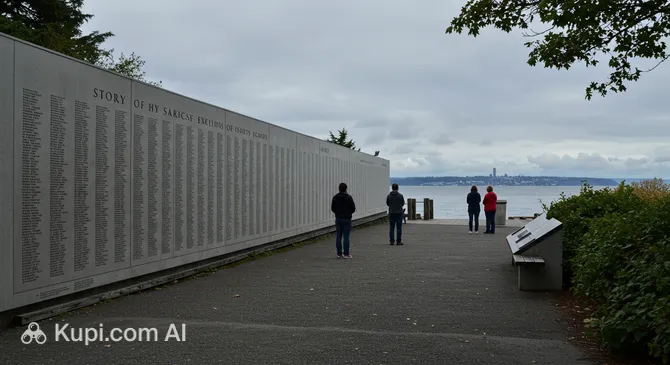
Bainbridge Island Japanese American Exclusion Memorial. Source: Kupi.com AI
\n

The central element of the memorial is the impressive 84-meter Story Wall, built from red cedar, granite, and basalt. It is engraved with the names of all 276 island residents of Japanese descent who were affected by the exclusion measures. Five terra cotta friezes by artist Steve Gardner vividly illustrate the community's journey: from a peaceful life and deportation to the long-awaited return home.

The Exclusion Departure Deck, a wooden platform extending over the harbor waters, carries a particular emotional weight. Stepping onto it, visitors can physically sense the very moment of departure that changed the lives of hundreds of people forever. The memorial is part of the Minidoka National Historic Site and serves as an important lesson in tolerance and humanity for all generations.

Contacts

To plan your visit and check for updates, you can use the memorial's official contact information. The site is managed by the community and the National Historical Park, so event information is regularly updated on their resources.

Address 4195 Eagle Harbor Dr NE, Bainbridge Island, WA 98110, USA
Phone +1 360-386-2114
Website https://bijaema.org/

What to Do

A visit to the memorial offers guests a unique experience of quiet reflection and education. The primary activity here is a walk along the Memorial Wall. Reading the names and ages of the people — which included infants and the elderly — helps one grasp the scale of the historical events. Take a close look at the friezes: they convey the emotions and daily life of the community better than any words.

For a deeper immersion, make use of the information kiosks and historical panels that tell the detailed story of World War II events on the island. Rest benches are placed along the path, where you can sit and enjoy the silence and calm views of Eagle Harbor while reflecting on the values of freedom and neighborliness.

A visit to the memorial is often combined with walks through the scenic surroundings of Bainbridge Island. The site is excellent for a family visit, as it teaches history through visual imagery and personal narratives. Many travelers include this site in a broader island itinerary, visiting local wineries and art galleries to see how the modern community thrives while preserving the memory of its past.

Getting There

Getting to Bainbridge Island from the city of Seattle (USA) is an enjoyable adventure in itself. The most popular and scenic way is to take the Washington State Ferries, which departs from the Pier 52 terminal. The journey across Puget Sound takes about 35 minutes, offering magnificent views of the city skyline.

Upon arriving at the Winslow terminal on Bainbridge Island, the memorial can be reached by Kitsap Transit buses (routes 398 or 399) or by taxi. If you prefer walking or cycling, the journey from the terminal is about 8 kilometers along scenic roads bordering Eagle Harbor.

For those traveling by car, free parking is available at the memorial. The drive from the ferry terminal to the site (4195 Eagle Harbor Dr NE) takes no more than 10–15 minutes. During peak seasons and on weekends, it is recommended to book ferry spots in advance or arrive early.

History & Facts

The history of the Japanese community on Bainbridge Island in the USA dates back to the 1880s. Japanese immigrants made a significant contribution to the development of the local economy, working in sawmills and transforming forested land into thriving strawberry farms. By the 1940s, they had become an integral and respected part of the island community.

The fate of these people changed abruptly after the signing of Executive Order 9066 in February 1942. Due to the island's strategic location near naval bases, its residents of Japanese descent became the first in the country to be subject to forced removal. On March 30, 1942, 227 men, women, and children were gathered at the Eagledale Ferry Dock under the guard of armed soldiers to be sent to internment camps.

The moment of their departure was captured in a famous photograph by the Seattle Post-Intelligencer, which became a symbol of that era. Despite the hardships, more than half of the 276 excluded residents returned to Bainbridge after the war. Unlike many other places, they were welcomed back warmly and with support — neighbors had looked after their homes and farms while the owners were in exile.

The idea of creating a memorial emerged in 2000, and the grand opening took place in 2011. The main motto of the commemorative site is "Nidoto Nai Yoni", which translates from Japanese as "Let it not happen again." The memorial serves as a permanent reminder of the importance of civil rights and the commitment to the principles of justice.

Time Needed

For a thoughtful exploration of the Bainbridge Island Japanese American Exclusion Memorial, most visitors find 1–2 hours sufficient. This is enough time to walk leisurely along the Story Wall, read the names, examine the artistic panels, and sit on a bench in the quiet of Eagle Harbor.

If you plan to participate in an organized tour or are a deep history enthusiast, your stay may extend to 3 hours. The memorial encourages slow contemplation, so it is best not to plan a rushed visit — the atmosphere of this place unfolds in silence and attention to detail.

Working Hours

As the Bainbridge Island Japanese American Exclusion Memorial is located outdoors, it is accessible for visiting 24 hours a day throughout the year. There are no gates or ticket booths, allowing guests to come at any convenient time for quiet reflection.

However, to ensure the best visibility of the artistic elements and the Story Wall, and for personal safety, it is recommended to plan your visit during daylight hours. In the event of special commemorative events or educational programs, access to certain parts of the complex may be adjusted, so it is worth checking the official BIJAC community website before your trip.

Nearby

A trip to Bainbridge Island provides a great opportunity to combine a visit to the memorial with other interesting sights. The Seattle area and the island itself are rich in recreation areas, parks, and activities for the whole family.

If you have time after your tour, consider the following attractions located within reach:

Attraction Name Distance (km)
Lake Union Spraypark 12.9
Wallingford Playfield Wading Pool 13.8
Volunteer Park Wading Pool 14.8
Ron K. Bills Spraypark 15.2
Northacres Spraypark 18
View Ridge Playfield Wading Pool 18.5
Spraypark 18.7
Elevated Sportz Trampoline Park & Event Center 33
High Trek Adventures - Ziplines, Ropes Course, & Birthday Party Venue 35.2
Remlinger Farms 45.5

Reached the end of the page?

That means the route is fully explored