Support

Sparrevohn

About the Airport

Sparrevohn Airport (Sparrevohn) is not just a runway, but a gateway to one of the most remote and inaccessible places in the USA, located in the very heart of wild Alaska. This airfield serves the Long Range Radar Site of the same name, playing a key role in logistics and ensuring its operation. For the ordinary tourist, arriving here is the beginning of a true adventure far from civilisation, where nature appears in its pristine and rugged beauty.
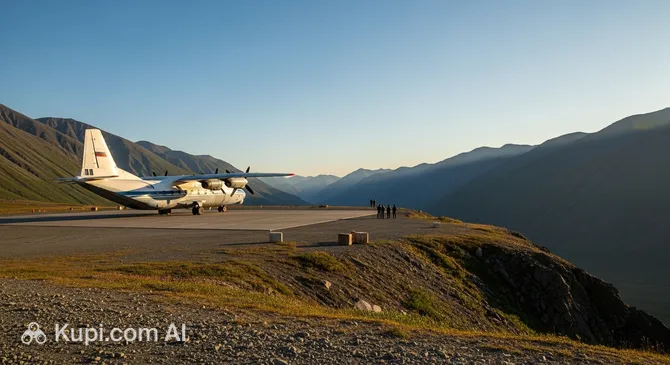
Sparrevohn. Source: Kupi.com Binoculars
IATA Code SVW
ICAO Code PASV
City Sparrevohn
Distance to the centre Located directly on the Air Force base grounds
Status Military / Domestic
Passengers per year Data unavailable, used primarily for military and charter transport
Popular Airlines No regular commercial flights, serviced by charter and military aircraft

The main feature of Sparrevohn Airport is its utilitarian nature and strategic importance. This is not a commercial hub with shops and restaurants, but a vital infrastructure facility. The runway is located in mountainous terrain, making take-off and landing here a task for experienced pilots and a true spectacle for passengers. The main advantage of the airfield lies in its ability to provide access to an isolated region for base personnel, service contractors, and rare adventure seekers.

The airport infrastructure is minimal and designed to perform specific tasks. Travellers planning to arrive here should take care of all details of their subsequent stay in advance, as standard tourist services are absent on-site. Nevertheless, it is precisely this remoteness and rugged functionality that give Sparrevohn Airport its unique, inimitable character — it is a true outpost at the edge of the world.

Contact Information

It is important to note that Sparrevohn Airport (SVW) is a military airbase (Sparrevohn Long Range Radar Site) and is not intended to serve commercial passenger flights. For this reason, most standard contacts for travellers are unavailable.

  • Official Airport Website: There is no public website for passengers, as this is a military facility.
  • Inquiry Service Phone: A public telephone number for inquiries is not provided.
  • Airport Address: Sparrevohn Long Range Radar Site, Alaska, USA. Access to the facility is restricted.
  • Email: There is no specialised public e-mail for communication.
  • Airport Social Media: The airport does not maintain official pages on social networks for the general public.
  • Lost Luggage Information: Since the airport does not serve commercial airlines, a luggage tracing service is not provided.
  • Passenger Support Contacts: Passenger services are not offered at this facility.

How to Get to the Airport

When planning a trip to Sparrevohn Airport, it is important to understand its unique location and specific nature. This is not a major commercial hub, but rather a remote airfield located in a sparsely populated part of Alaska, USA. Access to it has its own peculiarities, and standard methods of transportation are not applicable here.

Public Transport

Traditional forms of public transport, such as regular buses, trains, or the metro, are absent in Sparrevohn and its surroundings. Due to the remoteness and lack of a road network, one can get here primarily by air.

Taxi and Private Transfer

Standard taxi services do not operate in this area. The only realistic way to get to Sparrevohn Airport is by a pre-chartered private aircraft (air taxi) from larger Alaskan settlements, for example, from Anchorage. The cost of such a flight can be significant and depends on the airline, the type of aircraft, and the number of passengers. It is recommended to contact charter companies well in advance of the intended travel date to clarify details and prices.

Car Rental and Parking

It is impossible to rent a car to drive to Sparrevohn Airport, as no public roads lead to it. Consequently, there are also no organised parking zones here. Any movement on the ground, if possible at all, is carried out on specialised all-terrain vehicles and requires special preparation.

Recommendations for Travellers

A trip to Sparrevohn is a real adventure requiring careful planning. The key moment is the organisation of your flight on a private charter. Since there is no tourist infrastructure, shops, or hotels in the area, ensure that you have everything necessary with you and a clear plan of action upon arrival. Travel time from a nominal "centre" is not applicable, as the airfield itself is the main object in this area.

Terminals and Map

Sparrevohn Airport (SVW) is a specific aviation facility located in a remote district of Alaska. It is important to understand that it serves as an auxiliary airfield for a military long-range radar station (Sparrevohn LRRS). In this regard, its infrastructure differs radically from familiar civil airports: there are no busy waiting lounges, shops, or complex gate systems here.

Number of Terminals and Their Purpose

The airport does not possess passenger terminals in the classical sense. All infrastructure is concentrated around a single functional complex serving the needs of the military base and station personnel. This building acts as an operations centre where all processes related to cargo arrival and rotational crew changes take place. Civilian flights here are a rarity and are performed exclusively under special permits or charter programmes to support the station's operations.

Airport Map and Navigation

Logistics in Sparrevohn are extremely simple and utilitarian. The airfield consists of one gravel runway and a small apron for aircraft parking. The distance from the aircraft stopping point to the entrance of the administrative base building is minimal and is covered on foot. It is impossible to get lost here: arriving passengers (usually employees or contractors) are met by station personnel and escorted inside.

Features of Arrival and Departure Zones

Since the airport is closed to free public access, there is no separation into "sterile" zones, customs control, or baggage claim areas as in major hubs.

  • Arrival Zone: Represents an area on the apron where luggage and equipment are unloaded directly from the aircraft.
  • Departure Zone: Waiting for the return flight takes place in a specially designated room inside the main base building, which serves as a waiting room and a place for pre-flight briefing.

Time for Procedures

Registration and screening processes in Sparrevohn are formal but strict regarding flight safety and access to a military facility.

  • Check-in: Passenger lists are agreed upon in advance. Document checks take literally 5–10 minutes before boarding.
  • Screening: The main focus is on checking cargo and personal belongings for compliance with safety regulations for transport on small aircraft.

Recommendations for Navigation and Visiting

If you are due to fly to Sparrevohn, the key factor is preliminary preparation.

  • Obtain permission (PPR) in advance: without coordination with the military department, the landing of civilian aircraft is prohibited.
  • Be prepared for the absence of mobile coverage and internet in the airfield zone.
  • Take weather conditions into account: due to the complex terrain and climate of Alaska, departures may be delayed, so timing here is always tentative.

Airport History

The history of Sparrevohn Airport (SVW) is inseparable from the history of the military radar station of the same name, created at the height of the Cold War. This is not a civil airport in the usual sense, but rather a key logistical hub for one of the most isolated facilities in Alaska.

The founding of the airport and station dates back to the early 1950s. Construction was carried out as part of the creation of the Aircraft Control and Warning (AC&W) network to protect North American airspace. The Sparrevohn station was officially commissioned in 1957. Its main task was the early detection of bombers. The runway was built at the foot of the mountain where the radar installation itself was located, to ensure its supply by air.

A key stage of modernisation was the 1980s, when the station was integrated into the new, more advanced North Warning System. This required updating equipment and infrastructure. Later, in the 1990s, the station was largely automated, which radically changed its operation and reduced the number of personnel required on-site.

One of the most interesting facts from the history of Sparrevohn is the unique engineering system that connected the airport in the valley with the radar station at the top of the mountain. To lift people and cargo to a height of about 500 metres, a cable car (tramway) spanning over 1,800 metres was used. Today, despite automation, the gravel runway of SVW airport remains the only thread connecting this remote facility with the outside world, as no ground roads exist leading to it.

Services and Amenities

Given the specific nature of Sparrevohn Airport (SVW) as an auxiliary facility of a military radar station in a remote part of Alaska, passengers (most often rotational staff or crews of special flights) should not expect the standard set of civil aviation services here. The facility's infrastructure is strictly utilitarian and not designed for the comfortable stay of tourists.

Dining and Shopping

Commercial food and retail outlets are completely absent in Sparrevohn.

  • Restaurants and Cafes: There are no coffee shops, snack bars, or vending machines here. Staff meals are organised in the base canteen, access to which for transit passengers or visitors is strictly regulated and possible only by prior agreement with the facility administration.
  • Shops: Duty Free, souvenir shops, or pharmacies are absent. It is strongly recommended to bring everything necessary (food, water, hygiene products) with you.

Communication and Financial Services

The airport is located in a zone where familiar communications may be unavailable.

  • Wi-Fi and Device Charging: There is no public Wi-Fi. The internet connection is used exclusively for the station's operational needs. The possibility to charge electronic devices may be provided in the administrative building upon request, but dedicated charging stations are absent.
  • Banks and ATMs: There are no ATMs or currency exchange points on the facility's territory. Any financial transactions here are impossible, so carrying cash has no practical sense, except for use upon arrival in the "outside world".

Comfort and Accommodation

Waiting conditions here are spartan and dictated by the harsh climate and functionality of the base.

  • Waiting Lounges: There are no separate VIP halls or business lounges. Waiting for a flight takes place in the general room of the base, where it is warm and safe, but entertainment is absent.
  • Hotels: There are no commercial hotels at the airport or within a radius of hundreds of kilometres. Accommodation is possible only in residential blocks (barracks) for station personnel and only in emergency cases (for example, during severe weather deterioration and flight cancellation). Booking accommodation here is impossible.
  • Conference Rooms: Rooms for business meetings are absent.

Medical and Special Services

Capabilities for providing assistance in Sparrevohn are extremely limited.

  • Medical Services: Personnel trained in first aid are usually present at the station, and there is a basic medical kit for emergency situations. There is no full-fledged medical centre or doctor for passengers. Evacuation to the nearest hospital is possible only by air transport.
  • Passengers with Children: The infrastructure is not adapted for children: there are no mother-and-child rooms or play areas. Travelling here with children is highly discouraged.
  • Passengers with Reduced Mobility: A barrier-free environment is absent. The gravel runway and lack of ramps or special equipment make the movement of passengers with reduced mobility extremely difficult or impossible without physical assistance from others.

Where to Eat

When planning a journey, it is important to consider the features of Sparrevohn Airport (SVW). You should know that this is not a commercial passenger airport in the usual sense. Sparrevohn represents primarily a private or military runway, and standard passenger terminals are absent here, and consequently, so are any restaurants, cafes, or bars.

In this regard, there is no opportunity to purchase food or drinks within the territory of Sparrevohn Airport. Travellers whose route passes through this facility must without fail take care of food and water supplies in advance. No options for a quick snack or a full meal, including specialised menus (vegetarian, halal, gluten-free, etc.), are provided here.

Thus, there are no public catering establishments at Sparrevohn Airport, and all infrastructure is oriented towards service purposes rather than tourism. If your trip involves this location, the key aspect of preparation is complete autonomy regarding nutrition.

Travel Tips

Travelling through Sparrevohn Airport (SVW) requires a special approach and thorough preparation. Since this is not a standard civil hub, but a remote military infrastructure facility in Alaska, familiar rules work differently here. The main advice for any passenger in this region is flexibility and complete autonomy.

Arrival and Registration

Unlike major international airports, there is no need to arrive 3 hours before departure here.

  • Arrival Time: Follow the instructions of your flight coordinator or aircraft commander. Usually, it is sufficient to be ready for boarding 30–45 minutes before the appointed time. It is important to remember that the schedule here is often "floating" and depends on weather windows.
  • Documents: Keep your identification and visit permit (if applicable) easily accessible. Verification is carried out not by automated systems, but personally by base staff or pilots.

Luggage and Hand Luggage

Flights to Sparrevohn are often performed on small aircraft where every kilogram counts.

  • Weight Matters: Strictly observe the luggage allowances established by your air carrier. Excess weight may result in your belongings (or even you yourself) remaining on the ground.
  • What to Take in the Cabin: Your hand luggage must contain vital medicines, documents, and warm clothing. If luggage flies on a separate cargo flight, you should not be left without essential items.
  • Prohibited Items: Besides standard weapons and explosives, it is strictly prohibited to bring alcohol and narcotic substances here (federal facility). Also, be careful with food items — they should not attract wild animals.

Seat Selection and Comfort in Flight

On small aircraft flying to Sparrevohn, the concept of "seat selection" is nominal.

  • Aircraft Balance: Often the pilot seats passengers personally to distribute the weight (balance) of the aircraft correctly. Do not argue with the crew — this is a matter of safety.
  • Views: If there is a choice, sit by the window. The flight over the wilderness of Alaska will offer you unforgettable views of mountains and tundra, which compensate for the lack of an in-flight entertainment system.

Transfers and Connections

Sparrevohn is a final destination, not a transit hub.

  • If your route involves a transfer in Anchorage or another major city to fly here, allow for the maximum possible time buffer (minimum 24 hours). Flights to remote villages are often cancelled or rescheduled, so tight connections here are a huge risk.

What to Do in Case of Flight Delay

This is the most important point for a traveller in Alaska. Weather in the Sparrevohn area is changeable and harsh.

  • Be Prepared to Wait: The flight may be postponed for several hours or even days due to fog, wind, or runway icing.
  • Autonomy: Have a supply of food (snacks, canned goods), water, and a book or downloaded films on your phone (do not forget a power bank, as power outlets may be unavailable). There is no entertainment at the station, so your leisure is your responsibility.
  • Clothing: Always dress in layers. Even if you are flying in summer, the temperature can drop sharply, and waiting may take place in cool rooms or outside near the aircraft.

Tips for Saving

It is impossible to spend money here, as there are no shops, but you can save nerves and resources. The main advice is to bring everything with you. Purchasing forgotten items (toothpaste, batteries, warm socks) on-site is impossible for any amount of money. Full equipment before departure is the guarantee of a peaceful stay.

Reached the end of the page?

That means the route is fully explored