Support

National Archives Museum

About

Imagine a place where the most important documents that defined a nation's fate are gathered under one roof. That place is the National Archives Museum—a majestic treasury of history located in Washington, D.C. It is not just a paper repository, but a true symbol of democracy and statehood in the USA.
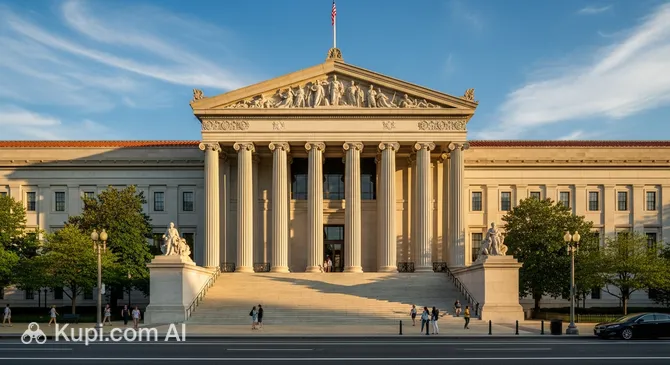
National Archives Museum. Source: Kupi.com Binoculars

The museum's main pride is the Charters of Freedom: the original Declaration of Independence, the Constitution, and the Bill of Rights. These priceless documents are housed in the specially designed Rotunda, where unique conditions have been created to protect them from the passage of time. The neoclassical building itself is an architectural landmark, occupying a place of honor between the White House and the Capitol.

Beyond the famous declarations, the archives house billions of pages of historical records, photographs, and artifacts. Here, you can see rare objects such as an original 1297 copy of the Magna Carta or the Emancipation Proclamation signed by Abraham Lincoln. This site literally allows you to touch the past and feel the scale of events that shaped the modern world.

Contacts

To plan your visit and check for current information, you can use the museum's contact details below:

Address701 Constitution Ave. NW, Washington, DC 20408, USA
Phone+1 202-357-5000
Official Websitevisit.archives.gov
Google MapsView on map

What to Do

The highlight of any visit is traditionally the Rotunda for the Charters of Freedom. Here, in a solemn and subdued atmosphere, you can see the original texts of the Declaration of Independence and the U.S. Constitution with your own eyes. Information panels around the exhibits explain in detail the context of their creation and the role they played in world history.

Be sure to stop by the David M. Rubenstein Gallery, which features the "Records of Rights" exhibition. It houses one of the few surviving copies of the Magna Carta. Of particular interest are documents related to the struggle for civil rights, including working materials for the 1964 Act, which allow you to trace the nation's journey toward equality.

For those who love interactive experiences, there is "The American Story" exhibition. Through the use of AI technology, visitors get a personalized experience learning about 40 extremely rare artifacts. In the "Public Vaults" area, you can feel like a researcher by exploring materials on family history, national defense, and scientific discoveries.

If you have time left, visit the William G. McGowan Theater, which regularly screens fascinating documentaries, or stop by the Boeing Learning Center, which offers many educational activities for children and teenagers, turning the study of history into an exciting game.

Getting There

Finding this majestic building is easy, as it is located at 701 Constitution Ave. NW, in the heart of the city's tourist life. The building is situated on the National Mall, almost exactly halfway between the Capitol and the White House, making it a must-stop on any walking tour of the center.

The most convenient way to reach it is by public transport. The nearest metro station is Archives-Navy Memorial-Penn Quarter (Green and Yellow lines), which is just a few minutes' walk away. You can also use numerous bus routes passing through Pennsylvania Avenue and Constitution Avenue.

If you prefer the comfort of a taxi or rideshare service, a trip from the central districts will take only 5–10 minutes. However, keep in mind that parking in this area is extremely limited and can be quite expensive, so a private car is not the most practical option for visiting this part of the city.

History & Facts

This unique institution was established in 1934 at the initiative of President Franklin D. Roosevelt. Before this, U.S. government papers were stored haphazardly in various departments, often leading to damage or permanent loss due to fires. The creation of a centralized archive was a crucial step in preserving American heritage.

The museum building itself deserves special attention—it is a masterpiece of neoclassical architecture designed by John Russell Pope. President Herbert Hoover, who laid the cornerstone in 1933, prophetically called the structure a "temple of our history." At the time, a colossal sum of nearly $9 million was allocated for its construction.

The building's facade is adorned with four massive statues symbolizing the connection of time: Past, Future, Heritage, and Guardianship. Every detail of the exterior underscores the importance of the documents kept inside. Today, the National Archives has evolved into a powerful system managing dozens of presidential libraries and research centers across the country.

Interestingly, modern technology allows for more than just paper records to be stored here. The archives hold billions of pages, audio recordings (including secret Oval Office conversations), photographs, and even artifacts like the original Louisiana Purchase Treaty signed by Napoleon Bonaparte himself.

Time Needed

To leisurely view the main relics and grasp the essence of the exhibits, most travelers need between 2 and 4 hours. This is enough time to visit the Rotunda, explore the Rubenstein Gallery, and check out the interactive Public Vaults halls.

If you plan to visit during peak tourist season (spring or summer), it's worth allowing extra time for queues, especially for entry into the Rotunda where the original Charters of Freedom are kept. For those who wish to study every document in detail and watch documentaries in the local theater, a visit can easily take up half a day.

Working Hours

The National Archives Museum is open to visitors daily, making it easy to include in any travel schedule. The opening hours are the same for all days of the week:

  • Monday – Sunday: 10:00 AM – 5:30 PM

Please note that entry to the museum stops 30 minutes before closing, so it is best to arrive early to allow time for security screening and viewing the main galleries.

Nearby

After immersing yourself in history within the archive's halls, you can continue exploring the surrounding area. The museum's location in the very heart of the capital provides easy access to many other interesting spots, though some entertainment parks may require a short trip outside the center.

A stroll along the National Mall offers dozens of Smithsonian museums within walking distance. If you are traveling with family and want to trade historical settings for active recreation, consider these attractions in the region:

Attraction Name Distance (km)
Ocean Dunes Waterpark10.7
Great Waves Waterpark11.8
Cameron Run Regional Park11.8
Six Flags America21.7
Urban Air Trampoline and Adventure Park24.2
Lake Fairfax Park26.6
Water Mine Family Swimmin' Hole26.7
Sky Zone Trampoline Park28.7
City of Gaithersburg Water Park at Bohrer Park30.6
Field of Screams Maryland32

Reached the end of the page?

That means the route is fully explored