Support

Bridge Monkey

About

The Bridge Monkey (Brückenaffe) is one of the most recognizable and photographed landmarks in the charming city of Heidelberg, Germany. This striking bronze sculpture, installed on the south side of the famous Old Bridge (Karl Theodor Bridge), is an integral part of the cityscape and a popular tourist attraction.
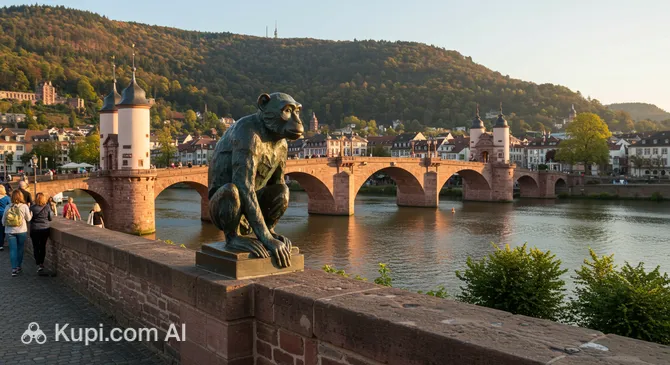
Bridge Monkey. Illustration.
Source: Kupi.com AI

Traveller photos:

The author of this modern sculpture is Gernot Rumpf. The figure of the monkey is not just a bridge decoration; it carries a deep meaning. The monkey holds a mirror (or disk) in its paws, which, according to the creator's vision, symbolizes human traits such as ugliness, shamelessness, and vanity. Thus, the sculpture invites passersby to reflect and look at themselves from the outside.

Next to the main figure of the monkey, you can spot two small bronze mice on the stones, which complete the composition. The Bridge Monkey quickly became one of the hallmarks of Heidelberg, attracting many tourists who want to take a commemorative photo and, according to local legend, rub the mirror for good luck.

Contacts

The Bridge Monkey is a famous sculpture and a popular photo spot located in a public area of Heidelberg. Since it is a freely accessible site, it does not have separate contact details.

For more information about the city's attractions or if you have any questions, you can visit the Heidelberg Tourist Information Center. They can provide you with up-to-date information and help you plan your visit.

How to contactContact
AddressNeckarstaden 66, 69117 Heidelberg, Germany
Phone+49 6221 5844444
Websitewww.heidelberg.de

What to Do

Upon arriving at the famous Bridge Monkey in Heidelberg, visitors first hurry to take souvenir photos with this amusing sculpture. But it is not just a statue—local legends are associated with it. They say that if you stroke the monkey, you will surely return to Heidelberg again. And students at Heidelberg University believe that rubbing the disk the monkey holds in its paws will bring good luck in exams. So don't miss the chance to touch a bit of luck!

In addition to the monkey sculpture itself, don't forget to enjoy the surrounding views. The bridge where it is installed offers magnificent panoramas of the majestic Heidelberg Castle, the picturesque medieval town, and the calm waters of the Neckar River, as well as the surrounding nature. The Old Bridge itself is decorated with other interesting sculptural compositions that are also worth your attention. A walk across the bridge, especially in clear weather, will provide many pleasant impressions and be a great addition to your visit to Heidelberg.

Getting There

The famous Bridge Monkey sculpture is one of the landmarks of Heidelberg and is located on the Old Bridge, also known as the Karl Theodor Bridge. This historic bridge is ideally situated in the city center, connecting the Old Town (Altstadt) with the Neuenheim district on the opposite bank of the Neckar River. Thanks to its central location, reaching the sculpture is easy.

The most pleasant way to see the Bridge Monkey is on foot, especially if you are exploring the historic center of Heidelberg. From the city's main pedestrian street, Hauptstrasse, head towards the river, following the signs for "Alte Brücke" (Old Bridge). The university campus is also nearby and can serve as an additional landmark.

For those who prefer public transport or are coming from more distant parts of Heidelberg, the Old Bridge can be reached by city buses or trams. Many routes pass through the center and stop nearby. Choose the stop closest to the bridge, and a short walk will lead you straight to the site.

Nearest city: Heidelberg

History & Facts

The history of the Bridge Monkey in Heidelberg, Germany, dates back to the 15th century, when a similar sculpture was located on the north tower of the Old Bridge. In the 17th century, another tower, which protected the entrance to the bridge from the city side and was part of its fortifications, was also decorated with a monkey relief. This monkey held a mirror in its paws, and as history tells it, there was a cheeky inscription next to it, which the famous encyclopedist Martin Zeiler even quoted in his work "Topographia Germaniae." This detail highlights that the monkey was not just a decoration but carried a specific symbolic meaning, perhaps mocking or moralizing.

Unfortunately, the original Bridge Monkey has not survived. In 1689, the bridge's north tower was destroyed, and the historic sculpture disappeared with it. The monkey that tourists see today is a later recreation of this famous symbol of Heidelberg. It serves as a reminder of the city's centuries-old history and its iconic structures, continuing to attract attention and bring smiles to passersby.

Equally interesting is the history of the bridge itself where the famous monkey sits. The first crossing over the Neckar River at this location appeared as early as the 1st century AD — it was a wooden bridge built by the Romans. Around 200 AD, it was replaced by a stone one. However, after the Roman bridge was destroyed, this part of Heidelberg remained without a permanent crossing for almost a thousand years. It was only between the 12th and 13th centuries, after the city itself was founded, that a bridge was built here again, likely around 1284, marking the beginning of the series of bridges that preceded the current Old Bridge, also known as the Karl Theodor Bridge.

Time Needed

Viewing the famous Bridge Monkey sculpture in Heidelberg itself doesn't take much time. To examine this interesting bronze figure, take a few souvenir photos, and perhaps follow the local tradition of touching the mirror it holds or the mice next to it, about 15–20 minutes should be sufficient. This is enough time to get acquainted with one of the most photographed symbols of the city.

However, the Bridge Monkey is only part of the charm of the Old Bridge (Karl-Theodor-Brücke), at the entrance of which it is installed. If you want to take a leisurely stroll across the bridge itself, enjoy the magnificent views of the Neckar River, Heidelberg Castle, and the Old Town, and pay attention to other sculptures and details of the bridge, it's worth setting aside about 30–45 minutes for your visit. This will allow you to fully experience the atmosphere and take beautiful photos without rushing.

Working Hours

The Bridge Monkey in Heidelberg is an open-air sculpture located directly on the Old Bridge. Thanks to its location, this famous landmark is available for viewing at any time of day, all year round, and completely free of charge. You won't need to book tickets or make an appointment in advance to touch this piece of the city's history.

Although access to the sculpture is not limited by time, for the best experience and photos, it is recommended to visit the Bridge Monkey during daylight hours. Especially picturesque views open up at sunrise or sunset, when the soft light highlights the details of the sculpture and the surrounding landscape of the Old Bridge and the Neckar River.

Open 24/7

Nearby

Visiting the Bridge Monkey is undoubtedly a highlight of any trip to Heidelberg. However, to make your experience of the city complete, don't limit yourself to just this iconic spot. Exploring the surroundings will allow you to dive deeper into the city's atmosphere, discover its hidden gems, and better understand its history and culture.

Heidelberg is a city with a rich heritage, and many of its interesting corners are within walking distance of each other, especially in the Old Town area. A walk through the nearby streets and squares after meeting the Bridge Monkey can provide just as many pleasant discoveries and memorable moments. Below is a list of some attractions located nearby.

NameDistance
Heidelberg Market Square0.1 km
President Friedrich Ebert Memorial0.1 km
Old Bridge Heidelberg0.1 km
Heidelberg Old Town0.2 km
Student Prison0.3 km
Heidelberg Castle0.5 km
Palatinate Museum0.5 km

Reached the bottom of the page?

Looks like you know this route inside out

We use cookies for your convenience.