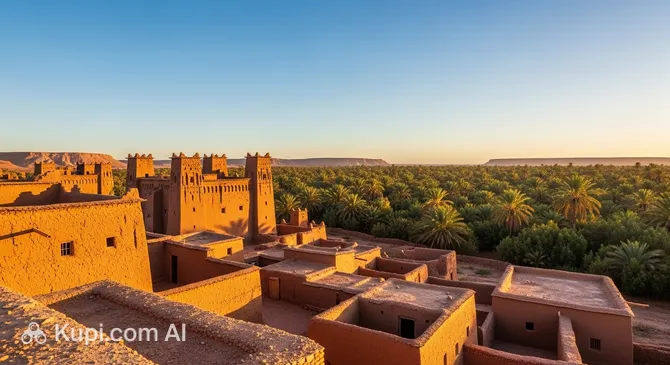
While Adrar is situated in the heart of the Sahara, its landscape is not solely defined by arid dunes. The city and its surroundings offer unique "green spaces" in the form of lush oases that stand in stark contrast to the red desert, alongside cultural institutions that preserve the deep intellectual history of the Touat region. Visitors here can explore the natural miracle of the palm groves and delve into centuries of Saharan heritage preserved in local museums.
The Palm Groves (Palmeraies)
In Adrar, the concept of a "city park" is replaced by the sprawling Palm Groves that encircle the urban area. These agricultural gardens are the lungs of the city, created and maintained by the ancient foggara irrigation system. Walking through the palmeraie offers a refreshing escape from the intense sun, as the canopy of date palms provides dense shade and significantly cooler temperatures. It is a serene natural area where you can observe local farmers tending to their plots of mint, henna, and vegetables, offering a peaceful glimpse into the region's sustainable lifestyle.
The Grand Erg Occidental Dunes
For a natural experience of a different kind, the edge of the city opens up to the majestic dunes of the Grand Erg Occidental. While not a park in the traditional sense, this vast expanse of sand serves as a natural playground for locals and tourists alike. It is the perfect spot for watching the sunset, where the shifting sands turn deep shades of orange and violet. Many visitors head here in the late afternoon to enjoy the silence of the desert or to organize small picnics on the crest of a dune, surrounded by nothing but the horizon.
Adrar Regional Museum (Musée de Wilaya)
Located prominently on the central square, the Adrar Regional Museum is the primary custodian of the area's history. This museum is an essential stop for anyone wishing to understand how civilization has thrived in such a harsh environment. The exhibits cover a wide range of topics, including prehistory, geology, and local flora and fauna. However, the most fascinating sections are dedicated to ethnography, displaying traditional costumes, jewelry, and detailed models of the foggara system. It provides invaluable context to the sights you will see around the city.
The Manuscript Libraries (Khizanat)
Adrar is historically known as a center of learning, and its "galleries" are often the traditional Manuscript Libraries found within the local zawiyas (religious schools). While access to some may be restricted or require permission, they are the cultural treasures of the region. These libraries house thousands of ancient manuscripts, some dating back centuries, covering astronomy, law, and theology. Viewing these beautifully calligraphy-adorned texts offers a rare insight into the intellectual legacy of the Trans-Saharan trade routes, where books were once as precious as gold.
Authentic Experiences
For a truly authentic experience, try to visit the Adrar Regional Museum in the early morning when it is quieter and cooler. Afterward, ask a local guide to show you the "kasria" (water comb) distribution point within the nearest palm grove. Watching the water being divided by these stone combs is a mesmerizing display of ancient engineering that is still in use today.