Support

Flagstaff Point Lighthouse (Wollongong Head)

About

Perched atop a scenic headland stands the majestic Flagstaff Point Lighthouse — one of the most recognizable landmarks gifted to travelers by the city of Wollongong. It is an active navigational aid that has served for decades as a reliable beacon for vessels plying the waters of the Tasman Sea. Australia is famous for its coastal views, and this snow-white concrete giant, standing over 25 meters tall, is an integral part of them.
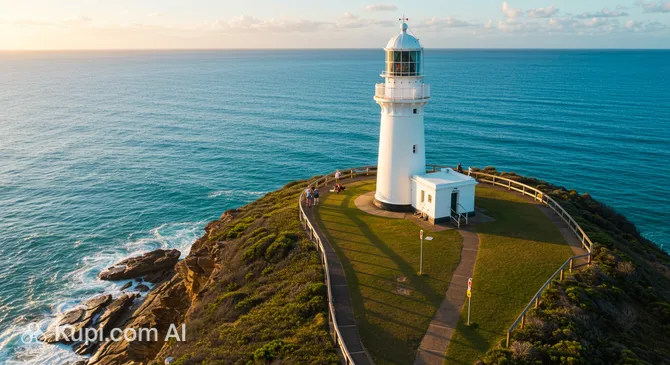
Flagstaff Point Lighthouse
Flagstaff Point Lighthouse. Иллюстрация. Источник: Kupi.com AI

Built in 1936, it became the first fully automatic lighthouse in the state of New South Wales. Its cylindrical tower, featuring an elegant balcony and a red lantern room, is a classic example of maritime architecture from that era. The uniqueness of the site also lies in the fact that this is the only city on the country's east coast where two lighthouses are located in close proximity to each other.

Today, the site attracts not only sailors but thousands of tourists. The lighthouse is considered a historical monument and an important cultural site, offering visitors a chance to touch the region's maritime heritage and enjoy breathtaking panoramic views.

Contacts

For up-to-date information on the site's status or to plan your visit, you can use the official lighthouse service resource or maps.

How to contactContact
Addresslot 2500/LOT 2 Endeavour Dr, Wollongong NSW 2500, Australia
Websitewww.lighthouses.org.au

What to Do

The main reason to visit the lighthouse is for the breathtaking panoramas. From the top of the headland, you can enjoy magnificent views of the endless Tasman Sea and the harbor. Visitors often come here to have a small picnic right on the slopes while watching the waves play and ships pass by. This spot is considered one of the best photo zones in the region, especially during the "golden hour" before sunset.

History buffs will appreciate the three massive vintage cannons from 1879 installed at the base of the tower. These 68-pounders are reminders of a time when the coastline required protection. You can stroll along the paths around the headland, watching the maritime activity in the port or simply enjoying the fresh ocean air. In August, during International Lighthouse Weekend, special displays are held where you can see historical equipment in action.

Don't forget to head down to the historic harbor located nearby. There, you can walk along the promenade, watch the fishing boats, and feel the rhythm of a seaside city. It's the perfect place for leisurely relaxation and contemplating nature in harmony with architectural heritage.

Getting There

The lighthouse is conveniently located at Flagstaff Point, east of the city center. If you are traveling by car, follow Endeavour Drive — there is parking for visitors right at the foot of the hill. The drive from Sydney takes about an hour and a half via the scenic Princes Highway.

For those who prefer public transport, buses #55 and #56 run from the city center to stops in the harbor area. From the bus stop, the lighthouse is just a few minutes' walk away, allowing you to enjoy the sea breeze.

The most pleasant way to reach your destination is a walk. From the city center, the journey takes about 20–30 minutes along a well-maintained coastal path. Alternatively, you can always use a local taxi; the ride from the train station will take no more than 5-10 minutes.

Ближайший город: Wollongong

History & Facts

The history of this navigational giant began in 1936. It was erected by the Commonwealth Lighthouse Service specifically to ensure the safety of vessels heading to the rapidly growing Port Kembla. Construction cost more than 6,800 pounds, an impressive sum at the time. This facility became the first fully automated lighthouse in New South Wales, marking the beginning of a new technological era in maritime navigation.

Its optical system deserves special mention. Inside the tower is a first-order fixed lens from Chance Brothers, manufactured back in 1863. Interestingly, it was originally used on Gabo Island but was later transported and adapted for Flagstaff Point. Initially, the lighthouse ran on acetylene and only switched to electrical equipment in the late 1930s.

In the 1970s, the structure faced the threat of demolition due to decay; however, the local community stood up to protect their symbol. Thanks to active protests and the townspeople's love for their history, the demolition project was canceled. After an extensive restoration in 2000, the lighthouse not only regained its historical appearance but also returned to service as an active landmark for sailors.

Time Needed

Tourists usually find 1–2 hours sufficient to leisurely explore the tower itself, examine the vintage cannons at its base, and take impressive photos of the Tasman Sea. This is plenty of time to read the information boards and walk around the headland.

If you plan to have a picnic on the grass or want to wait for the sunset when the lighthouse beam starts piercing the dusk, you should set aside about 3 hours. During special events when indoor access is granted, the visit time may increase slightly.

Working Hours

The area around Flagstaff Point Lighthouse is open to visitors 24/7. As the site is an active navigational aid, access to the open areas on the headland is free 24 hours a day, 7 days a week.

This allows tourists to plan their visit at any convenient time — whether it's early morning to catch the sunrise or late at night to see the powerful beam of light cutting through the darkness over the ocean.

Круглосуточно

Nearby

A walk around Flagstaff Point reveals many interesting spots that allow for a deeper dive into the atmosphere of coastal Australia. The proximity of historical monuments and modern recreational areas makes this district ideal for long walks.

NameDistance
Wollongong Breakwater Lighthouse0.4 km
Cove Beach0.5 km
Lang Park0.6 km
Lux Bistro Bar1.2 km
Wollongong City Beach1.2 km
Wollongong Central1.4 km
His Boy Elroy1.5 km

Reached the end of the page?

That means the route is fully explored