Support

Paro Airport

About the Airport

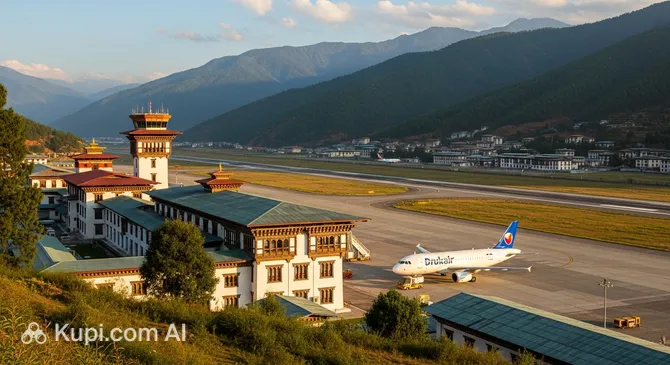
Paro Airport. Source: Kupi.com Binoculars

Arrival at Paro Airport is not merely a logistical stage of your journey, but a breathtaking adventure that begins while you are still in the sky. The aircraft performs skillful maneuvers between high mountain ranges, descending into the picturesque valley so close to the slopes that it feels as if you could touch the treetops. The terminal itself resembles a majestic Buddhist temple or palace rather than a standard airport building, instantly immersing guests in the atmosphere of ancient traditions and the tranquility of the "Land of the Thunder Dragon".

IATA Code PBH
ICAO Code VQPR
City Paro
Distance to Centre 6 km
Status International
Passengers per Year About 400,000

Features and Advantages of the Airport

The main feature of the Paro air hub is its unique location and navigational complexity. The airport is situated at an altitude of over 2,200 metres above sea level, surrounded by Himalayan peaks rising to five thousand metres. This makes it one of the most challenging airports in the world for landing: pilots must possess special qualifications and perform the approach exclusively in manual mode and only during daylight hours. For travellers, this guarantees unforgettable views from the window, often cited as some of the best in civil aviation.

The aesthetics of the airport deserve special attention. The terminal building is constructed in the traditional Bhutanese Dzong style: with massive walls, characteristic multi-tiered roofs, and intricately carved wooden window frames. Instead of the usual glass and concrete, an atmosphere of cosiness and national character reigns here, making the wait for a flight a pleasant part of the cultural programme. Thanks to its compact size, all procedures are completed quickly and without the hustle and bustle typical of large hubs.

Contact Information

Below you will find the main contact information for Paro International Airport (PBH), which serves as the main air gateway to Bhutan.

  • Official Website: Currently, the airport does not have a separate website. It is managed by the Department of Air Transport of Bhutan; information can be found on their official resource: www.doat.gov.bt.
  • Inquiry Service Phone: +975 8 271856. This is the main number for obtaining information about flights and airport services.
  • Address: Airport Road, Paro, 12001, Bhutan.
  • Email: A direct email address for general passenger inquiries is not published. For communication, it is recommended to use the telephone or contact airline representatives.
  • Social Media: The airport does not maintain official pages on social networks. For news and updates, please follow the websites of the carriers operating flights to Paro (Drukair and Bhutan Airlines).
  • Lost Luggage Information: For issues related to lost or damaged luggage, you must contact the Lost and Found service of your airline directly at the airport.
  • Passenger Support Contacts: For general information, consultations, and assistance at the airport, please call the main inquiry service number.

How to Get to the Airport

Getting to Paro International Airport (PBH), the main air gateway of Bhutan, is quite simple thanks to its close proximity to the city of the same name. The distance from the city centre to the terminal is only about 6 km. Since most travellers arrive in the country as part of organised tours, the transfer to the airport is usually already included in the programme. However, if you need to get to the airport on your own, there are several convenient options.

Taxi and Private Transfer

The most common and reliable way to get to the airport is to use a taxi service or book a private transfer through your hotel. The journey from Paro city centre will take just 15–20 minutes depending on traffic conditions. This is an affordable option that ensures comfort, especially if you have a lot of luggage. It is recommended to arrange the trip in advance to avoid unnecessary hassle before departure. For tourists, this is the optimal choice in terms of price, speed, and convenience.

Car Rental

Self-driving car rental without a driver is not a common practice for tourists in Bhutan. Usually, travellers hire a car complete with a driver for the entire duration of their stay. If you are travelling around the country in this way, your driver will have no trouble getting you to the airport at the required time. This option is, in essence, a form of private transfer and should be coordinated with your tour operator or agency.

Public Transport and Parking

There are no direct public transport routes, such as dedicated shuttle buses, to Paro Airport. The local bus system is not oriented towards tourists with luggage, so this method is not recommended for trips to the airport. For those arriving by private vehicle, there is parking available on the airport territory where cars can be left for short or long periods.

Terminals and Map

Paro Airport (PBH) is a unique air hub that is a landmark in itself. Its structure is simple and intuitive, making the stay here comfortable even for those flying into Bhutan for the first time.

The main feature of the airport is its single terminal, which serves both international and domestic flights. The terminal building is designed in the traditional Bhutanese architectural style with intricate wood carvings and colourful paintings, immediately immersing travellers in the country's culture. Due to the presence of only one terminal, there is no issue of transferring between them—everything is located in one building.

The airport layout is extremely simple. The Arrivals Zone is located on the ground floor, where passport control takes place and luggage is collected. The Departures Zone, with several check-in counters and a security checkpoint, is located here as well. Navigation presents no difficulties: there are signs everywhere in English and Dzongkha, and the small size of the terminal ensures you won't get lost. Staff are always ready to help and direct passengers.

Completing all formalities usually does not take much time. Thanks to the small number of flights, queues for check-in and security screening are usually minimal. Nevertheless, it is recommended to arrive at the airport generally 2-3 hours before the departure of an international flight to check in luggage without rushing, pass through controls, and enjoy the unusual atmosphere of this place. Inside the terminal, there are several souvenir shops, a small café, and a waiting area with a view of the runway surrounded by Himalayan peaks.

History of the Airport

The history of Paro Airport (PBH) is inextricably linked with the history of the opening of the Kingdom of Bhutan to the outside world. Its story is a tale of overcoming incredible natural obstacles and maintaining a careful regard for national identity. Located in a deep valley at an altitude of over 2,200 metres and surrounded by Himalayan peaks up to 5,500 metres high, it is rightfully considered one of the most challenging airports in the world.

Initially, in the 1960s, a simple airstrip was built on this site, which was used by helicopters of the Indian Armed Forces at the request of the Royal Family. However, the official birth date of commercial aviation in Bhutan is considered to be 1983. It was then that the national carrier, Drukair, operated its first flight on a small Dornier 228 aircraft. This step became a pivotal event, opening the country to a limited number of tourists and strengthening its connection with the outside world.

As interest in Bhutan grew, the airport required modernisation. An important stage was the extension of the runway in 1990, which allowed for the reception of larger aircraft, such as the BAe 146, known for their ability to take off and land on short strips. The true jewel of the airport became the new terminal, opened in 1999. Its building, constructed in the traditional Bhutanese architectural style with intricate wood carvings and paintings, is a landmark in itself and introduces arrivals to the culture of the country even before they exit the airport.

The main achievement and simultaneously an interesting fact from the history of Paro Airport is its operation. Due to the extremely difficult landing approach, requiring pilots to perform a steep maneuver between the mountains, only a very limited number of pilots in the world are certified to fly here. Landing is possible only during daytime and in good weather conditions, as pilots rely exclusively on visual landmarks. This fact turns every flight into Paro into a true testament to the highest aviation skill.

Services and Amenities

Despite its compact size, Paro Airport offers passengers all the necessary services for a comfortable wait for their flight. It is the only international airport in Bhutan, and its infrastructure is well thought out to serve the flow of tourists.

In the terminal, you will find several cafés where you can have a snack or drink a cup of tea, as well as try local dishes. Shops offer a wide selection of authentic Bhutanese souvenirs, including handmade textiles, masks, and jewellery—an excellent opportunity to buy gifts at the last moment. For business class passengers of Drukair and Bhutan Airlines, a VIP lounge with beverages and snacks is available.

Free Wi-Fi is provided throughout the airport, allowing you to stay connected. Special stations are equipped for charging electronic devices. Within the terminal building, there are bank counters and currency exchange points where you can exchange major world currencies for local Ngultrums (BTN).

To ensure the safety and health of passengers, a medical point operates at the airport. Travellers with small children can use the mother and child room. The airport is also equipped for the needs of passengers with reduced mobility, ensuring their convenience in moving around the terminal.

There are no hotels directly on the airport territory, however, many accommodation options can be found in the city of Paro, which is just a few minutes' drive away. Specialised conference rooms and business centres are absent at the airport, as it is primarily oriented towards serving tourists.

Where to Eat

Paro Airport (PBH) is the gateway to the amazing Kingdom of Bhutan, and its atmosphere is cozy and intimate rather than bustling like large international hubs. Dining options here correspond to its compact size: they are few in number but allow for a comfortable snack or lunch while waiting for a flight.

The main place for a full meal is the restaurant on the first floor (second floor in US/UAE terms) in the departure lounge (airside, after passing passport control). Its main advantage is the panoramic windows offering a stunning view of the runway and the surrounding Himalayan peaks. It offers a mixed menu including dishes of Bhutanese, Indian, and Continental cuisine. This is a great opportunity to enjoy local flavours one last time. We recommend trying Momo (dumplings with various fillings) or, if you like spicy food, the national dish Ema Datshi (stewed cheese with chili peppers). This is the best place for a leisurely lunch.

For those short on time, there is a small cafeteria or snack bar at the airport. Usually, it is also located in the departure zone. Here you can quickly grab coffee, tea, soft drinks, a sandwich, or fresh pastries. This is an ideal option for a quick snack right before boarding the plane.

Regarding special dietary needs, one should be prepared for a limited selection. Specialised vegan, gluten-free, or halal menus are practically rarely found here. However, due to the influence of Indian cuisine, vegetarian dishes are often available, for example, vegetable curry or dal (lentil stew), which are generally suitable for many dietary requirements. It is recommended to check the ingredients with the staff. Prices in the airport establishments are higher than in the city but remain moderate by international standards. The opening hours of all food outlets are tied to the flight schedule, so they are open whenever there are passengers in the airport.

Tips for Travellers

Travelling through Paro Airport is an adventure in itself and the first step to getting to know the amazing Kingdom of Bhutan. To ensure your trip goes as smoothly as possible, use these tips to prepare for the specific features of the country's only international airport.

Arrival time at the airport. Although Paro Airport is small and cosy, it is recommended to arrive at least 2-3 hours before the departure of your international flight. This will give you enough time to check in, drop off luggage, and pass through immigration and customs controls without rushing, which can be very thorough.

Choosing a seat for the best views. This is perhaps the most important tip for anyone flying into or out of Paro. Landing in the valley between Himalayan peaks is an unforgettable spectacle. To enjoy it fully, when flying into Paro, try to get a window seat on the left side of the aircraft. When flying out of Paro, sit on the right side. If you are lucky with the weather, you will be able to see Mount Everest and other majestic peaks.

Customs control and luggage. Be prepared for strict customs control. The import of tobacco products into Bhutan is extremely restricted and subject to high duties. The export of antiques and religious artefacts without special permission is prohibited. Standard international rules apply to hand luggage: liquids in containers up to 100 ml packed in a transparent bag, and no sharp objects. Electronics and power banks must be in hand luggage.

Transfers and flight delays. Paro Airport is not a transit hub, so long layovers here are very rare. Flights to this high-altitude area are highly dependent on weather conditions. Delays and even cancellations due to fog or strong winds are not uncommon. We recommend building an extra day into your itinerary in case of unforeseen schedule changes and always staying in touch with your airline.

Saving time and money. To save time, complete online check-in if your airline provides this option. Currency exchange is best done in cities, for example in Paro or Thimphu, as the rate at the airport may be less favourable. Arrange a transfer with your hotel or tour operator in advance—this will be both more convenient and often cheaper than looking for a taxi on the spot.

Reached the end of the page?

That means the route is fully explored