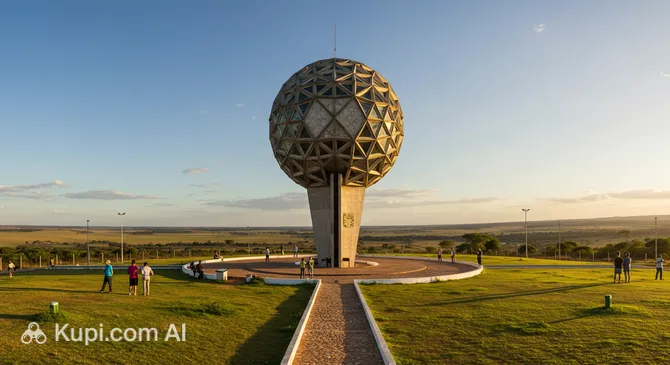
Imagine a point equidistant from the Pacific and Atlantic oceans — right here, in the city of Cuiabá, lies the famous Geodesic Center of South America. This unique historical landmark officially confirms the status of the Mato Grosso state capital as the geographic "heart" of the vast continent.
Geodesic Center of South America. Illustration.
Source: Kupi.com AI
Traveler photos:
The complex's main element is a majestic 20-meter obelisk clad in white marble. The monument was erected in 1973 directly over a historical marker from the early 20th century. The site serves not only as an important landmark for geodesists but also as a popular observation deck, offering impressive views of the city blocks and the endless expanses of Brazil.
The site is considered a symbol of the city's identity and a point of pride for locals. Here, history meets geography: the obelisk is decorated with cardinal point indicators and plaques showing distances to the continent's largest cities, reminding every visitor of the scale of South America and the scientific achievements of past explorers.
Contacts
To clarify information about visiting this iconic site or holding official events, you can use the following contact details:
Upon arriving at the obelisk, you can see the bronze plaque with precise geographic coordinates, calculated as far back as 1909. This is a great place to grasp the scale of the continent while studying the signs indicating the directions and distances to major South American metropolises.
Many tourists come here for the panoramic views. A small natural observation deck (mirante) offers a wide view of the urban landscape and the distant plains of the Pantanal. Especially striking photos are taken at dawn or sunset when the obelisk's marble is tinted in golden hues.
Visiting the center often marks the start of a broader cultural route, as important sites like the Cathedral and a unique museum housed in an old water tower are nearby. Since there are no cafes on the grounds, it's best to plan your visit as a short but inspiring stop before lunch at one of the nearby restaurants.
Getting There
Finding this geographical symbol is easy, as it is located in the very heart of Cuiabá at R. Barão de Melgaço, 2902. If you are staying in the historic Centro Sul district, the obelisk is well within walking distance, allowing you to enjoy the atmosphere of the old neighborhoods.
For those who prefer comfort, a taxi or popular ride-sharing apps are great options — the trip from Marechal Rondon Airport (CGB) takes only about 15–20 minutes. Municipal buses also run regularly to the center, and parking spaces are available nearby for travelers with rental cars.
It is important not to confuse this site with another "contender" for the title of the continent's center, located in Chapada dos Guimarães (about 65 km from the city). The Geodesic Center in Cuiabá is specifically an urban monument, accessible at any time without long trips outside the metropolis.
Nearest city: Cuiabá
History & Facts
The history of this place began back in 1909 thanks to the work of the legendary Brazilian officer and explorer — Marshal Cândido Mariano Rondon. It was he who, using astronomical and mathematical calculations complex for that time, determined the point equidistant from the waters of the Pacific and Atlantic oceans.
Initially, the marshal placed a modest marker here in an area known as Campo da Encruzilhada. Rondon was a key figure in the development of the Mato Grosso region and the protection of indigenous peoples, so his scientific achievements in mapping the continent became a matter of national pride for Brazil.
The landmark took on its modern appearance on November 15, 1973. To protect the original historical marker and give the site its proper status, a majestic white marble obelisk 20 meters high was erected over it. Although modern satellite technology has made adjustments to the center's coordinates, the monument remains a vital cultural and scientific symbol of the 20th-century era of great discoveries.
Time Needed
Typically, travelers need 30 to 60 minutes to explore this landmark. This time is quite sufficient to leisurely examine the commemorative plaques, admire the obelisk's architectural details, and take a few memorable photos.
If you plan your visit at sunset, we recommend allowing about 1–1.5 hours. During this time, the soft light makes the panoramic views of the city and the Pantanal plains especially picturesque, allowing you to fully experience the unique moment of being in the "heart" of South America.
Working Hours
One of the main advantages of this landmark is its accessibility: the site is open for visitors 24/7, seven days a week. You can come here early in the morning to catch the sunrise or late in the evening when the monument is beautifully illuminated against the night city skyline.
Whether you plan your visit for a Monday or a holiday weekend, access to the obelisk remains free at any time of day or night.
Open 24 hours
Nearby
A visit to the central point of the continent can easily be combined with exploring other interesting locations in the city, making your walk even more rewarding. The Centro Sul district is rich in cultural sites and places for family recreation.
In the immediate vicinity and slightly further away, there are amusement parks and game centers that may interest tourists with children: