Support

Universidade Federal de Mato Grosso

About

Imagine a space where academic knowledge meets wildlife: that is the best way to describe the Zoo of the Federal University of Mato Grosso. Located in the city of Cuiabá, this facility is part of the massive UFMT campus — a leading educational institution that is the pride of Brazil. Despite its formal classification as a "zoo," this place is much broader: it is a living open-air laboratory stretching across thousands of hectares.
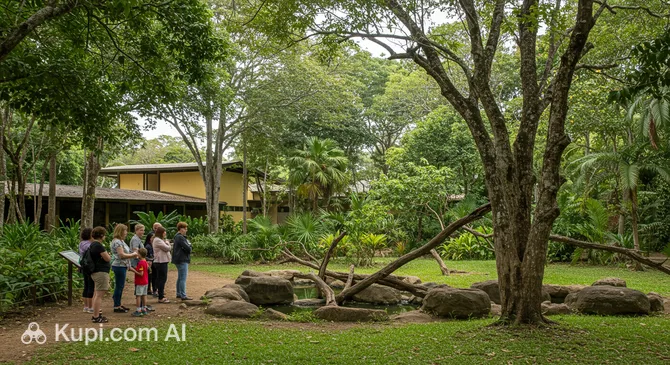
Federal University of Mato Grosso Zoo
Federal University of Mato Grosso Zoo. Иллюстрация. Источник: Kupi.com AI

Founded in 1970, the university campus in the Boa Esperança district has become a true oasis for residents and visitors alike. It is not just where thousands of students study, but also where critically important research is conducted aimed at preserving the unique ecosystems of the Mato Grosso region. For tourists, it is primarily an opportunity to see the harmonious coexistence of modern architecture and lush tropical vegetation.

The central campus occupies a colossal area, including experimental farms and research zones. It is one of the most visited spots in Cuiabá, serving as a cultural and ecological hub. Here, you can feel the spirit of Brazilian science and see how the biodiversity of the Amazon and Pantanal is carefully protected through university activities.

Contacts

To find the most current information regarding visits to the campus and its facilities, you can use the official communication channels. The university is open to public engagement and provides reference data through its administration.

How to contactContact
AddressR. Quarenta e Nove, 2367 - Boa Esperança, Cuiabá - MT, 78060-900, Brazil
Phone+55 65 3615-8000
Websitewww.ufmt.br

What to Do

A stroll through the campus is a great way to experience academic life in Brazil. Visitors can move freely through the extensive green areas, which locals often use for sports and outdoor relaxation. Of particular interest is the modern architecture of the academic buildings and the Júlio Müller University Hospital.

For those interested in science, there are research centers on-site dedicated to Amazonian ecology. While access to internal laboratories may be restricted, information stands and open areas allow you to learn a lot about regional biodiversity conservation. The university often hosts free exhibitions, public lectures, and cultural festivals open to the general public.

Nature lovers should head to the experimental farm area, where you can observe tropical agriculture in action. The campus grounds are also a wonderful place for spotting local birds and small animals that feel safe amidst the thick vegetation.

Getting There

Getting to the campus, located at R. Quarenta e Nove, 2367 in the Boa Esperança district, is quite easy thanks to the city's well-developed transport network. Municipal buses run regularly from the city center through this lively neighborhood; stops are located in the immediate vicinity of the university entrances.

For a more comfortable trip, you can use taxis or popular ride-sharing apps like Uber. A journey from central Cuiabá or the airport takes about 15–20 minutes depending on traffic conditions. If you are using a navigator, head to coordinates -15.6098867, -56.0651571.

If you are arriving from other parts of the state by intercity bus, it is most convenient to travel to the city's main terminal and then transfer to local transport or order a car. It is recommended to plan your trip outside of peak hours to avoid congestion on the main roads leading to the campus.

Ближайший город: Cuiabá

History & Facts

The history of this significant site began on December 10, 1970, when the Federal University of Mato Grosso was officially established by federal law. The university's creation was the result of a merger between the Faculty of Law, whose roots go back to 1934, and the Institute of Science and Literature. From its earliest days in the Coxipó district, active construction of academic buildings and the development of a research base began.

In the 1980s, the university significantly expanded its reach: the Júlio Müller University Hospital was opened, becoming a vital medical center for the region. During this same period, the decentralization of education began, with university branches appearing in other cities across the state, making higher education accessible to residents in remote areas.

A notable fact is that in 1994, UFMT became a pioneer of distance learning in Brazil. The university was the first in the country to implement remote higher education programs, which later received official recognition from the Ministry of Education. Today, it is the state's largest educational and scientific institution, playing a key role in preserving the cultural and natural heritage of the region.

Time Needed

To take a leisurely stroll through the vast grounds, see the main architectural features, and enjoy the green zones, usually about 2–3 hours are required. This is enough time to soak up the campus atmosphere and see the main research centers from the outside.

If you plan to visit temporary exhibitions, go to the library, or participate in one of the open cultural events, you should set aside 4–5 hours for your visit. The scale of the territory, spanning several thousand hectares, invites long walks, so time will fly by quickly.

Working Hours

Since the site is located within an active state university, access to the public areas of the campus is usually possible throughout daylight hours. However, the operating hours for specific exhibition halls, libraries, or administrative buildings may vary.

To plan your visit, it is highly recommended to check the official university website in advance or clarify details with the administration, as the schedule may change depending on the academic calendar or public holidays.

Nearby

After a walk through the university's green campus, it is worth exploring other interesting places in the vicinity. The Boa Esperança district and its surrounding neighborhoods offer various options for leisure, especially if you are traveling with family or looking for active entertainment.

The proximity of modern parks and entertainment centers makes it easy to put together a full day's itinerary. Below is a list of popular attractions located nearby:

NameDistance
Nerd Armchair Bar1.1 km
Tia Nair Park1.8 km
Moinho Bakery3 km
Mato Grosso Museum of Natural History3.1 km
Parish of Our Lady of the Rosary and Saint Benedict3.3 km
Mahatma Gandhi Family Park3.4 km
Sesi Papa3.6 km

Reached the end of the page?

That means the route is fully explored