Source: Kupi.com AI
| Characteristic | Value |
|---|---|
| IATA code | YAX |
| City | Angling Lake |
| Country | Canada |
| Time zone | America/Winnipeg |
| Schedule | Live departures board |
| Characteristic | Value |
|---|---|
| IATA code | YAX |
| City | Angling Lake |
| Country | Canada |
| Time zone | America/Winnipeg |
| Schedule | Live departures board |
Getting to Angling Lake Airport (YAX) is a task that differs significantly from a trip to a standard international terminal. Since the airport serves the small, isolated community of Wapekeka (Wapekeka First Nation), there is no complex transport system, traffic jams, or toll highways here. Logistics here are simple, rugged, and entirely dependent on local arrangements and weather conditions.
The distance from the residential area of the settlement to the runway is only about 3 kilometres. In the warm season, this journey takes 5–10 minutes by car, while in winter the road may be covered in snow, requiring the use of special equipment or four-wheel-drive vehicles.
Public Transport
In the settlement of Angling Lake (Wapekeka), public transport in the conventional sense is completely absent. There are no bus routes, shared taxis, trains, or metro. The infrastructure is designed exclusively for the internal needs of the small community.
Taxi and Transfer
There are no official taxi services or ride-hailing apps (like Uber) here. If you are visiting the community for work or by invitation, the issue of transfer must be resolved in advance:
Car Rental and Personal Transport
There are no car rental points in Angling Lake. It is impossible to arrive here in a rented car from major cities, as the settlement is not connected to Canada's road network by year-round highways.
The only exception is winter roads (ice roads). During the coldest months (usually January–March), temporary roads are constructed over frozen lakes and swamps. During this period, local residents can travel to the airport in their own vehicles that were previously delivered via the winter road.
Airport Parking
Parking at Angling Lake Airport consists of a small open dirt area next to the airfield.
Nearest Alternative Airports
Since Angling Lake is a remote point, travellers sometimes have to build routes via neighbouring regional hubs. Here is a list of the nearest airfields that can be used as transit points or backup options in the region:
Recommendations Before Departure
When planning your departure from Angling Lake, always allow extra time. Although the drive to the airport takes minutes, the lack of regular transport can be a problem. It is recommended to coordinate your departure time with local residents or the administration the day before the flight. Additionally, keep in mind that in bad weather, small aviation flights are often delayed or cancelled.
The infrastructure of Angling Lake Airport (YAX) differs radically from familiar international hubs. There are no multi-level car parks, confusing corridors, or trains between terminals. This is a typical small airport of a remote northern community, where everything is arranged as compactly, simply, and functionally as possible.
Terminal Structure
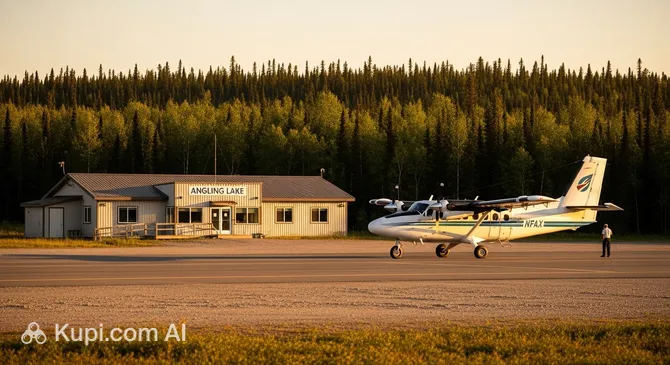
The airport has just one small passenger terminal. It is a single-story building that performs all functions at once: waiting room, check-in area, baggage claim area, and administrative block. The building serves primarily as a reliable shelter from the weather for passengers awaiting the arrival of the aircraft.
Layout and Navigation
It is impossible to get lost at Angling Lake Airport. The entire "map" is limited to one room and an exit to the airfield. Navigation is intuitive: the entrance to the building is on the side of the access road, and the boarding exit is on the opposite side, leading directly to the apron.
Departure and Arrival Zones
Due to the small size of the airport, the departure and arrival zones are effectively combined or located in immediate proximity to each other.
Procedure Times
The absence of queues and complex logistics makes passing through pre-flight formalities very quick.
Recommendations for Passengers
The main feature of the terminal at Angling Lake is its austerity. There are no cafés, ATMs, shops, or pharmacies here.
The history of Angling Lake Airport (YAX) is not just a chronicle of building an infrastructure facility, but a record of the Wapekeka community's struggle for a reliable connection with the outside world. Unlike city airports that emerged for commerce, this airfield appeared as a vital necessity in the harsh conditions of the Canadian North.
The Era of Floatplanes and Seasonal Isolation
Before the advent of a stationary runway, aviation communication with the settlement depended on the whims of nature. In the mid-20th century, the surface of the lake itself served as the "air gate" for the community. In summer, floatplanes landed here, and in winter, aircraft equipped with skis. However, this period of history was marked by a serious problem: during the autumn freeze-up and the spring thaw, the village was completely blockaded for several weeks, making the emergency delivery of patients or cargo impossible.
Construction and Opening of the Runway
A key stage of development was the inclusion of Angling Lake in the Ontario Ministry of Transportation's programme to create a network of remote northern airports. The transition from water-based to land-based operations occurred in the second half of the 20th century. The construction of the gravel strip was a true engineering challenge: heavy machinery for clearing and levelling the ground was delivered here via "winter roads" — temporary roads laid over the ice of frozen lakes — as there was no other way to deliver bulldozers and graders in the summer.
Modernisation and Technical Equipment
The development of the airport followed the path of improving flight safety rather than expanding passenger comfort. Significant reconstructions primarily concerned navigation and lighting equipment:
Historical Role and Events
Angling Lake Airport has repeatedly become the centre of dramatic events related to natural disasters. There were periods in the community's history when the airfield worked at the limit of its capacity, ensuring the evacuation of residents during massive forest fires characteristic of Northern Ontario. It was thanks to the presence of the runway that children and the elderly could be promptly evacuated to safe areas.
Interesting Facts
The infrastructure and service at Angling Lake Airport (YAX) fully correspond to the status of a remote northern airfield. It is important for travellers to understand: this is not a commercial hub oriented towards comfort and entertainment, but a functional transport node ensuring the basic needs of the community. The level of service here is defined not by the presence of branded shops, but by the human attitude and mutual assistance characteristic of the North.
Restaurants, Cafés, and Shops
The terminal building is completely devoid of catering and retail outlets. You will not find coffee shops, vending machines with snacks, or Duty Free shops here.
Waiting Rooms and VIP Services
The terminal consists of a single common space. Concepts like "Business Lounge" or "VIP Lounge" are not applicable here.
Communication and Finance
Angling Lake Airport is a place where one should be prepared for a digital detox.
Medical Services
There is no dedicated medical post or pharmacy in the airport building. However, given the specifics of the region, airline staff and local residents possess first aid skills.
Services for Passengers with Children
Specialised infrastructure for children (mother and child rooms, play areas) is not provided. There is enough space in the waiting room to settle down with a child, but you will have to entertain them yourself. Given the lack of toilets with changing tables, parents of infants should prepare all necessary hygiene products in advance.
Services for Passengers with Disabilities
The terminal building is single-story and located at ground level, which facilitates access. However, the lack of automation leaves its mark:
Hotels and Accommodation
There are no hotels in the airport itself or within walking distance. Angling Lake is a small community not oriented towards mass tourism.
Business Services
Conference rooms, business centres, fax, or copying services are absent at the airport. If you need to conduct urgent negotiations or send documents, this can only be done in the community administrative buildings (Band Office) by prior agreement.
The gastronomic scene of Angling Lake Airport (YAX) fully reflects its character: rugged, utilitarian, and far from commercial. Passengers accustomed to food courts and coffee shops in departure zones should be prepared for the fact that catering establishments are completely absent at this airport. There are no restaurants, bars, cafeterias, or even vending machines with snacks.
Restaurants and Cafés
The single terminal building does not provide facilities for preparing or selling food. This means that:
Dining Recommendations: "Bring Your Own" Strategy
Since there is no opportunity to buy food on-site, the issue of nutrition falls entirely on the shoulders of the travellers themselves. To ensure your flight and wait are comfortable, follow these recommendations:
For a Quick Snack
The optimal choice is non-perishable products that do not require special storage conditions, as there are no refrigerators for public use in the terminal.
For a Full Meal
If you are facing a long wait or flying at lunchtime:
Dietary Requirements (Vegetarian, Halal, Gluten-Free)
The lack of public catering has a hidden advantage for people with strict dietary restrictions: you have complete control over what you eat. You will not have to study ingredient lists on menus or worry about cross-contamination with allergens — your "on-board cuisine" will consist only of those products that you have personally verified and packed. This ensures your meals are strictly Halal or meet other specific needs.
Local Cuisine
It is impossible to try traditional dishes of the northern peoples (for example, fresh fish, game, or Bannock — traditional bread) directly at the airport. However, if you are visiting the Wapekeka community, local residents may treat you to these delicacies privately before your departure.
Important Warning Regarding Alcohol
Looking for a bar at Angling Lake Airport is not only pointless but also inappropriate. Many Indigenous communities in Northern Canada are "dry" or have strict restrictions on the possession and consumption of alcohol.
Where to Buy Food Before Departure?
The only place where you can replenish food supplies before heading to the airport is the Northern Store, located in the residential zone of the settlement (about 3 km from the strip).
Travelling through Angling Lake Airport (YAX) is a unique experience unlike a standard flight through major international hubs. Here, in the heart of the Canadian taiga, unwritten rules apply, dictated by the harsh climate and remoteness from civilisation. To ensure your trip goes smoothly, we have prepared a series of practical tips.
Optimal Arrival Time
Forget the "arrive 3 hours early" rule. At Angling Lake, everything happens much faster, but being late is not an option either.
Check-in and Security: Be Prepared for Simplicity
You will not see metal detector frames or shoe scanners here. The screening procedure is more personal and informal, yet strict.
Choosing a Seat on the Plane
Flights to Angling Lake are operated on small turboprop aircraft (like the Pilatus PC-12 or King Air), where seating has its own peculiarities.
Hand Luggage and Baggage: Do's and Don'ts
Due to the small dimensions of the aircraft, baggage requirements here are stricter than on major airlines.
Tips for Transit Passengers
Angling Lake is usually the final point, and transfers occur in larger hubs such as Sioux Lookout (YXL) or Thunder Bay (YQT).
Customs Control
The airport serves only domestic flights, so there is no border or customs control in the classical sense. However, remember bio-safety rules: it is not recommended to remove plants, animals, or items of cultural value to Indigenous peoples from the forest without appropriate permission.
How to Save Time and Money
What to Do in Case of Flight Delay
Delays due to fog, snow, or low cloud cover happen frequently. This must be treated philosophically.
Reached the bottom of the page?
Looks like you know this route inside out
Where travelers fly most — pick a route and check prices