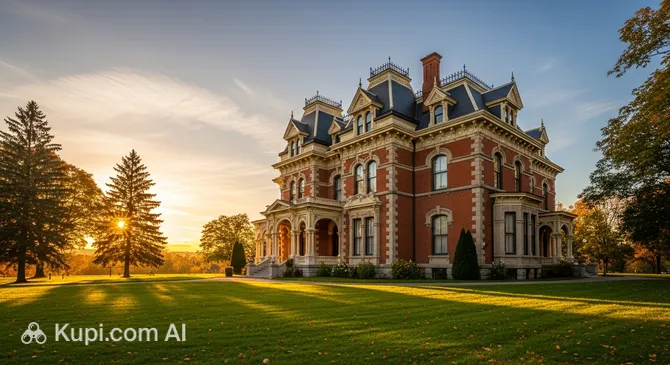
This majestic Victorian-era mansion is a true architectural gem that Belleville is rightfully proud of. Built in 1882–1883, Glanmore is a rare and superbly preserved example of the Second Empire style. With its characteristic mansard roof and exquisite detailing, it transports visitors back to the heyday of the upper-middle class that Canada was famous for in the late 19th century.
Glanmore National Historic Site. Illustration.
Source: Kupi.com AI
Traveler photos:
Originally built as a private residence for the successful banker John Phillips, today Glanmore holds the status of a National Historic Site. It is more than just a building; it is a living museum where every yellow brick and every curve of the moldings tells the story of the region. Since 1973, the mansion has served as a cultural center, carefully preserving the heritage and traditions of the local community.
Inside Glanmore, a fascinating journey into the past awaits you: the mansion's interiors have been meticulously restored to accurately recreate the atmosphere of the 1880s. Here, you can see not only luxurious furniture and artwork but also learn about the lives of the people who lived and worked within these walls over a century ago.
Contacts
To clarify information about visiting, special events, or group tours, you can use the museum's contact details. Glanmore always welcomes guests and offers a high level of service.
Inside Glanmore, visitors will experience an immersive journey into the atmosphere of the 1880s. Be sure to notice the lavishly hand-painted ceilings and the elegant suspended staircases—true masterpieces of engineering for their time. Strolling through the rooms furnished with original pieces from the Phillips-Burrows-Faulkner collection, you can imagine how the daily life of a wealthy Canadian family unfolded.
Art historians and beauty lovers will be particularly interested in the famous Couldery Collection. It is one of the world's best collections of paintings by the English artist Horatio Couldery, renowned for his incredibly detailed depictions of animals. Additionally, the museum features unique portrait collections and a rare collection dedicated to the history of lighting systems, which clearly shows the progression from oil lamps to the first electrical appliances.
Don't forget to head down to the basement of the house. Here you'll find an exhibition dedicated to pioneer life, featuring artifacts that tell the story of the challenging lives and labor of the region's first settlers. Interesting fact: thanks to its authenticity, Glanmore has frequently served as a set for popular TV series like "Murdoch Mysteries" and music videos.
Getting There
Glanmore National Historic Site is located at 257 Bridge Street East. Thanks to its convenient location in the central part of the city, getting there is easy. For those traveling by car, the mansion is just a 12-minute drive from the busy Highway 401.
If you are already in the city center, you can easily walk to the museum while enjoying the architecture of the old neighborhoods. You can also use local taxi services, which will quickly take you to the mansion's main entrance from anywhere in the city or from the train station.
Belleville's public transit also covers this area, so you can check the city bus routes passing through Bridge Street East to plan your trip as affordably and conveniently as possible.
Nearest city: Belleville
History & Facts
The history of this magnificent building began in 1882 when local architect Thomas Hanley designed it for influential banker John Philpot Curran Phillips. The plot of land where the mansion rose was part of the inheritance of his wife, Harriet Dougall Phillips. Construction took about a year, and the result became a symbol of the family's success and high social status in late 19th-century society.
One of the most remarkable features of Glanmore is that it remained the home of four generations of the same family—the Phillipses, Burrowses, and Faulkners—for nearly 90 years. It is thanks to this continuity that the building has preserved its original appearance and unique interiors, avoiding the radical renovations that befell many other historic homes.
In 1969, Glanmore was designated a National Historic Site of Canada. Specialists highly praised its Second Empire architecture—a style that originated in France under Napoleon III and became incredibly popular in North America in the 1870s and 1880s. Since 1973, the mansion's doors have been open to the general public as a museum.
Time Needed
To leisurely explore all three floors of the mansion, study the rich collections, and look into the historic basement, a typical visitor will need about 1.5 to 2 hours. This is the optimal time to soak in the spirit of the Victorian era and examine the decorative elements in detail.
If you plan to take part in a special guided tour or are a passionate connoisseur of antiques and painting, you might want to set aside a bit more time for your visit. The grounds surrounding the house also lend themselves to a short walk after exploring the indoor exhibits.
Working Hours
Glanmore National Historic Site welcomes visitors Tuesday through Friday from 12:00 PM to 4:00 PM, and on Saturday and Sunday from 1:00 PM to 4:00 PM. The site is closed on Mondays. The museum is open year-round and is equipped with an air-conditioning system, making the visit comfortable even during the hot summer months.
Since the schedule during holidays may change, we recommend checking the official website or calling the museum to confirm the current hours before your trip.
Day
Working hours
Monday
Закрыто
Tuesday
12:00–16:00
Wednesday
12:00–16:00
Thursday
12:00–16:00
Friday
12:00–16:00
Saturday
13:00–16:00
Sunday
13:00–16:00
Nearby
A walk around the Glanmore National Historic Site will allow you to immerse yourself even deeper into the atmosphere of this Canadian region. Exploring nearby attractions will perfectly complement your sightseeing day and provide plenty of new impressions.