Support

Parliament Hill

About

Parliament Hill is a majestic architectural complex in the heart of Ottawa, home to the highest legislative body of Canada. Locals often refer to the site simply as "The Hill." This limestone outcrop overlooking the Ottawa River has been an important landmark for Indigenous peoples and European explorers for centuries, and today it stands as one of the country's primary symbols.

The complex is designed in the Gothic Revival style, giving it a resemblance to famous European government buildings. The main structures are built from grey granite blocks, and their roofs are covered with characteristic copper plates that have turned green over time. The centerpiece of the ensemble is the main building with the majestic Peace Tower, which serves as a memorial to Canadians who died in the First World War. Originally built in the 19th century, the Centre Block was almost entirely destroyed by fire in 1916 and rebuilt, preserving its historical appearance.
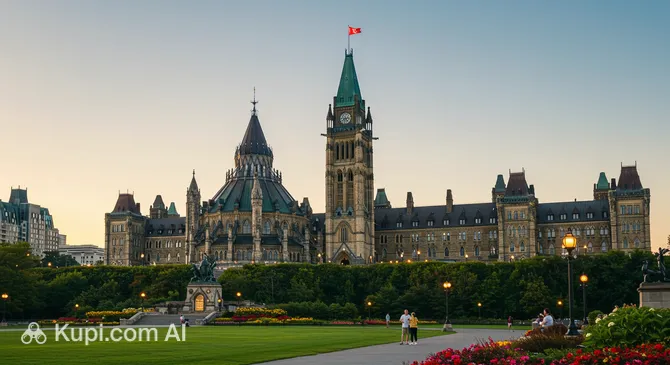
Parliament Hill. Illustration.
Source: Kupi.com AI

Traveler photos:

Inside the complex are key rooms for government business. The main building houses the "red chamber" for Senate sessions and the "green chamber" where the House of Commons meets. Special attention should be paid to the circular Library of Parliament—the only part that survived in its original form after the 1916 fire. The East and West Blocks house the offices of senators and members of parliament.

Parliament Hill is not only a government district but also a popular tourist destination. It hosts national celebrations, including Canada Day festivities, and in the summer, visitors can watch the colorful Changing of the Guard ceremony. In the plaza in front of Parliament, the Centennial Flame burns, lit to commemorate the 100th anniversary of Canadian Confederation and symbolizing the unity of the country. It is a place where history and modernity harmoniously blend, attracting millions of visitors every year.

Contacts

To get the most up-to-date information on operating hours, available tours, and visiting rules, it is recommended to check official sources, as schedules may change depending on parliamentary sessions and state events. All tours of Parliament Hill are free, but tickets must be booked in advance.

How to contactContact
AddressWellington St, Ottawa, ON K1A 0A9, Canada
Phone number+1 613-992-4793
Websitewww.parl.ca

What to Do

A visit to Parliament Hill is an opportunity to touch the heart of Canadian democracy and enjoy magnificent architecture. Walking around the grounds allows you to fully appreciate the majestic Victorian Gothic buildings that form an impressive ensemble. The Queen’s Gates are particularly noteworthy—a ceremonial entrance intended for the monarch or their representative, symbolically separating Ottawa's urban space from the political center of Canada.

One of the main attractions for tourists is the Peace Tower—the tallest structure in the complex. It serves as a moving memorial to Canadians who died in the First World War, and its observation deck offers panoramic views of the city and the river. Of equal interest is the Library of Parliament—a true architectural treasure and the only part of the main building that survived the devastating fire of 1916. Its richly decorated interior and unique atmosphere leave a lasting impression.

Free guided tours allow you to look inside the buildings and learn more about the country's political system. Currently, while the Centre Block is closed for restoration, tours are conducted in the West Block, where the House of Commons now meets, and in the Senate of Canada Building (a former railway station). Guides talk about the history of these sites, architectural details, and parliamentary traditions. During the summer months, access is also available to the East Block, where you can see restored historical offices that provide a glimpse into how the government worked in the 19th century. In addition to tours, the Hill's grounds are open for walks, where you can view numerous statues and monuments dedicated to key figures in Canadian history.

Getting There

Getting to Parliament Hill in Ottawa is easy, as it is located in the very heart of the city on Wellington Street. Thanks to its central location, this iconic Canada landmark is within easy walking distance of most hotels and other key tourist sites downtown, such as the ByWard Market or the National Gallery. A scenic stroll allows you to enjoy views of the city and the Ottawa River.

For those who prefer public transport, Ottawa operates a convenient system called OC Transpo. The closest light rail station (O-Train) to Parliament Hill is aptly named Parliament. It is located just a few steps away from the Hill. Additionally, numerous bus routes run along Wellington, Sparks, and Albert streets, with stops in the immediate vicinity of the complex. This is one of the fastest and most economical ways to reach the destination from different parts of the city.

If you are traveling by car, please note that there is no visitor parking directly on the grounds of Parliament Hill. However, there are many paid underground and surface parking lots in downtown Ottawa. You can also use taxis or popular ridesharing services, which will drop you off right at the main entrance. This is an especially convenient option if you want to avoid the hassle of finding a parking spot in the busy city center.

Nearest city: Ottawa

History & Facts

Surprisingly, before becoming the political heart of Canada, the site where Parliament stands today had a military past. In the 18th and 19th centuries, it was home to a military base, and the hill itself was known as Barracks Hill. Everything changed in 1859 when Queen Victoria made the momentous decision to choose this very hill in what was then Bytown for the construction of the new parliament buildings. The resulting construction became one of the largest projects of its time in North America.

The original Centre Block, built in the 1860s, stood for half a century until tragedy struck. On the evening of February 3, 1916, a devastating fire broke out in the building, almost completely destroying it and claiming seven lives. The cause of the fire was never officially determined, which sparked rumors of sabotage given that World War I was underway. The only part to miraculously survive the flames was the magnificent Library of Parliament—saved by iron doors that were closed just in time.

Despite the war, it was decided to immediately begin rebuilding the national symbol. The new building we see today was completed by 1922. In place of the destroyed Victoria Tower, a new, more majestic Peace Tower was built. It became not just an architectural centerpiece, but a moving monument to Canadians who lost their lives in the First World War. Flanking the new Centre Block are the East and West Blocks, which were built in the 19th century and survived that tragic night.

Time Needed

When planning a visit to Parliament Hill, it is worth setting aside 2 to 4 hours to explore this iconic landmark without rushing. This will be enough time for a leisurely stroll through the scenic grounds, admiring the majestic architecture and taking photos of the main buildings. The recommended time for exploring only the exterior grounds is about 1-2 hours. This will allow you to see the Centennial Flame, examine the numerous statues and monuments, and enjoy panoramic views of the Ottawa River.

If you want to dive deeper into the history and political life of Canada, be sure to schedule one of the free guided tours. The duration of these tours is usually 45 to 60 minutes. Keep in mind that booking tickets (even free ones) and going through security screening will also require additional time. In the summer months, you can add the Changing of the Guard ceremony and the evening sound and light show to your itinerary, which can extend your total time on the Hill to half a day.

Working Hours

Visiting the interior of Parliament Hill is only possible as part of free guided tours, which are held year-round. However, hours may vary depending on parliamentary activity and state events, so the exact schedule should always be checked in advance. It is highly recommended to book tickets online through the official website, as space is limited and same-day tickets may not be available. Tours are available for different buildings, including the West Block (House of Commons) and the Senate building, and typically last between 30 to 45 minutes.

The grounds of Parliament Hill in Ottawa are open to the public and can be explored freely. To enter the buildings for a tour, you must arrive 25–45 minutes before the start time to go through security screening. Given that the Centre Block and Peace Tower are undergoing long-term restoration, access inside them is temporarily closed, but you can learn about their history through an immersive show, which also requires advance booking. For the most up-to-date information on hours and available tours, always check the official website of the Parliament of Canada.

Nearby

Visiting Parliament Hill is just the beginning of exploring the heart of Ottawa. The surroundings of this iconic site are filled with other interesting attractions, cultural sites, and scenic parks that will enrich your experience of the Canadian capital. Exploring nearby locations will provide a more complete picture of the city and its multifaceted life.

Many key tourist spots are within walking distance of Parliament Hill, making a stroll through the city center especially convenient and pleasant. You can easily combine a visit to Parliament with a trip to museums, galleries, or simply relax in one of the cozy parks while enjoying views of the river and architectural masterpieces.

NameDistance
Bank of Canada Museum0.3 km
National Gallery of Canada0.7 km
Rideau Centre0.8 km
Canadian Museum of History0.9 km
Royal Canadian Mint0.9 km
Ottawa Art Gallery1 km
Canadian Children's Museum1 km

Have you reached the end of the page?

So the route has been studied inside and out