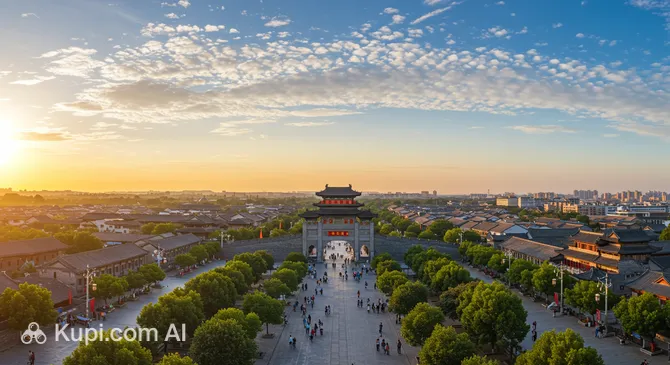
Baoding is a major prefecture-level city in Hebei Province, located in the heart of the North China Plain. Situated on a strategic route between Beijing and Shijiazhuang, this city has long served as an important administrative hub and even spent time as the provincial capital. Today, Baoding is a dynamic industrial and educational center in China, home to over 11 million people.
The city possesses a rich historical heritage that harmoniously coexists with modern production clusters. While Baoding is not a classic tourist resort, its atmosphere is filled with the energy of everyday life in a massive metropolis. Travelers are drawn here by authentic architectural monuments preserved from the era of imperial China and the proximity to unique natural sites.
Baoding. Illustration.
Source: Kupi.com AI
The main gems of the city are considered to be the Ancient Lotus Pond and the Han Dynasty tombs, which allow you to touch the region's centuries-old culture. A visit to Baoding is an excellent opportunity to see the real, "non-postcard" northern China, appreciate the scale of its industry, and experience the hospitality of the locals. We invite you to explore this hardworking yet incredibly interesting city.
Weather Overview
Baoding has a temperate continental monsoon climate characterized by a sharp change of seasons. Summers in the city are typically hot and humid—the peak of precipitation occurs in July and August, when temperatures often rise to +30°C or higher. Winters, by contrast, are cold and very dry, with minimal snowfall and average temperatures around -2°C, although nighttime frosts can be significant.
If you are planning a trip, it is worth noting that the weather in Baoding is most comfortable in spring (April–May) and autumn (September–October). During these periods, pleasant warm temperatures settle in, and the amount of rainfall does not interfere with long walks through historical parks. In winter, due to the dry air and the topography of the North China Plain, dust storms or periods of haze can occur, which is important for travelers with sensitive health to consider.
Average monthly temperature
Average monthly precipitation
Interesting Facts
Baoding is world-famous as the birthplace of "health balls"—hollow steel spheres used for hand massage and motor skills development.
The city is an important automotive hub: it is home to the headquarters of Great Wall Motors, one of the largest SUV manufacturers in China.
Administratively, Baoding is a giant agglomeration including many counties and districts, comparable in area to a small European country.
Located near the city is Lake Baiyangdian—the largest natural freshwater body in northern China, famous for its reed beds and water villages.
In its historical past, the city served as the residence of the Governor-General of Zhili Province, making it one of the most important political centers of the Qing Empire.
How to Get There
The transport accessibility of Baoding is one of its main advantages, due to its proximity to the capital. Thanks to the developed network of high-speed trains, the journey from Beijing takes only about 30–40 minutes, making the city part of the capital's vast transport radius. Baoding is also conveniently connected by high-speed expressways, including the G4 national highway, to the key centers of the north.
The city does not have its own major civil airport; however, travelers usually use the international airports of Beijing or Shijiazhuang. From there, Baoding can be easily reached by train or intercity bus. A car transfer from the capital can take 2 to 3 hours depending on traffic and the exit route from the metropolis.
Within the city, the key transport hub is Baoding Railway Station (BVQ). It is conveniently located relative to the historical center, just a couple of kilometers away. High-speed trains from across the country as well as regular passenger trains arrive here. The station is equipped with modern infrastructure, and taxis and city buses are always available nearby.
The pride of Baoding is the Ancient Lotus Pond (Gu Lianchi). This magnificent classical garden, established back in the 13th century, is one of the ten most famous gardens in China. Walking along its winding shores, you will see elegant pavilions and bridges that look particularly picturesque during the lotus blooming season. It is an ideal place for those seeking solitude and quiet amidst the city bustle.
For lovers of archaeology and ancient mysteries, the Mancheng Han Tombs are a must-see. These burials belong to Prince Liu Sheng and his wife, who lived during the Han Dynasty. It was here that the famous jade burial suits, sewn with gold wire, were found. The scale of the underground halls and the craftsmanship of the ancient builders leave a lasting impression on every visitor.
In the very center of the city, pay attention to the Baoding Bell Tower and old buildings that recall the district's military past, such as the Baoding Military Academy. Also of interest is the Daxi Temple, reflecting the region's religious traditions. Although Baoding lacks massive tourist quarters, its attractions allow for a deep dive into the history of northern China.
Local Cuisine
The cuisine of Baoding is a vibrant representative of China's northern culinary traditions. You won't find the excessive spiciness of the south here; instead, you can fully appreciate hearty wheat-based dishes. The local diet is based on various noodles, dumplings, and the famous steamed buns. The flavor profile of dishes is usually salty and rich, with active use of soy sauce, garlic, and ginger.
One of the main local delicacies is the so-called "donkey burger" (Lürou Huoshao)—crispy flatbreads filled with tender braised donkey meat. This dish is considered the city's signature and is sold on almost every corner. It is also worth trying the fresh fish dishes and lotus roots supplied from the nearby Lake Baiyangdian. The gastronomic scene here is very approachable: the best taste experiences can often be found in small family-run eateries.
As for drinks, local brands of strong alcohol (baijiu) are popular in Baoding, while non-alcoholic options include various types of green and flower teas. The tea-drinking tradition is deeply rooted here, and you can find specialty shops with an excellent selection of tea leaves. The general character of the food in the city can be described as honest and substantial—it is simple but incredibly delicious everyday food that warms you up perfectly during cold winters.
Travel Tips
A trip to Baoding will be much more comfortable if you prepare in advance for the specifics of life in a large northern Chinese city. These practical tips will help you navigate the local rhythm and avoid minor difficulties.
Clothing and Essentials: Choose your wardrobe according to the season—summers here are hot and humid, while winters are dry and windy. Be sure to bring comfortable shoes for long walks. When visiting temples, a strict dress code is not required, but it is better to dress modestly.
Transport: Install the DiDi app for ordering taxis. This will save you from having to explain things to the driver and ensure transparent payment. For trips to Beijing, it is better to buy high-speed train tickets a couple of days in advance.
Finance: Cash is accepted less and less often. It is recommended to link an international card to Alipay or WeChat Pay—these are the primary payment methods everywhere, from markets to hotels.
Health and Safety: The city is safe, but in industrial areas, the air can be dusty. People with allergies should carry a mask. Pharmacies are common, but medicine names will be in Chinese.
Communication: English is not widely spoken here. Download an offline translator and save your hotel address in Chinese characters.
Local Etiquette: Be prepared for the fact that public places can be noisy. Politeness and a smile are your best assistants when communicating with locals.
What to Avoid: Do not plan important travel during rush hours (8:00–9:30 and 17:30–19:00), when the city's transport system is working at its limit.
Additional Tip: Be sure to visit the Lotus Pond early in the morning—this is when the atmosphere is most peaceful, and you can see locals practicing gymnastics.
May your visit to Baoding be filled with interesting discoveries and pleasant impressions of the real China!
Entertainment & Nightlife
The entertainment scene in Baoding is primarily geared towards local residents, which gives it a special authenticity. Evening life here is concentrated in central shopping areas and around large public spaces. It is not the kind of city famous for nightclubs booming until dawn; however, you can find many cozy cafes and local bars where people relax after a working day.
For those who prefer cultural leisure, there are city theaters and cinemas offering both modern Chinese blockbusters and traditional performances. During the day, popular activities include strolling through parks or visiting large shopping centers, which often host interactive exhibitions and family events. The atmosphere in most establishments is usually friendly and relaxed, without a strict dress code.
If you are looking for larger-scale shows or a more boisterous nightlife, many Baoding residents prefer to head to neighboring Beijing for the weekend. Nevertheless, an evening walk through the illuminated streets of the center or dinner at one of the city's lively restaurants will give you an insight into the modern lifestyle of a Chinese metropolis. Safety in the city is high, and taxis can be called via mobile apps at any time of day.
Parks & Museums
The most famous spot for a stroll in the city is the Ancient Lotus Pond (Gu Lianchi) park. It is not just a green space, but a full cultural and historical complex with ancient pavilions, steles, and ponds. Here, you can spend hours admiring traditional garden architecture. Another notable spot is the Baoding Botanical Garden, which offers visitors a chance to get acquainted with the region's flora and enjoy the silence among well-kept alleys.
Among cultural institutions, the Baoding Military Academy Museum stands out. Located in the building of China's first modern military school, it tells the story of officer training and the city's history at the beginning of the 20th century. For those interested in archaeology, the sites related to the Han Dynasty tombs in Mancheng are a must-visit, showcasing unique finds that shed light on the life of imperial nobility.
The cultural environment of Baoding may seem localized, but every site here possesses deep meaning. The city's parks and museums are the places where the connection between eras is felt best. Despite the city's industrial status, the presence of spaces like the Lotus Pond makes Baoding attractive for the thoughtful tourist wishing to study the historical roots of Hebei Province.
Getting Around
Baoding's transport system is designed to efficiently move huge numbers of people between residential and working districts. The main form of urban transport is buses, with a route network covering the entire district. This is a budget-friendly way to get anywhere, though you should keep in mind that buses can be overcrowded during peak hours, and traffic may slow down due to congestion on major arteries.
The metro in Baoding is currently in the development stage, so the primary load falls on ground transport and taxis. Calling a car through apps (such as DiDi) is the most convenient option for tourists: prices are quite affordable, and the lack of a language barrier when entering an address in the app makes trips comfortable. Bicycle rental and electric scooter services are also popular in the city, perfectly suited for short trips around the center.
To pay for bus fares, you can use cash (it is better to have small bills) or transport cards, but increasingly, payment is made via QR codes on smartphones. Tourists should remember that the city is very large and should plan travel time with a margin. Baoding's external connectivity through high-speed railways is its main pride, allowing you to reach Beijing or other regional cities in just a few minutes.
Accommodation
The hotel sector in Baoding is primarily focused on business travelers and specialists visiting industrial enterprises. There is a wide selection of business hotels from major Chinese and international chains, offering a high level of comfort and modern service. For those planning a longer stay, many apartment rental options are available in modern residential complexes.
For tourists, staying in the central districts or in the immediate vicinity of the railway station will be most convenient. Such a location provides easy access to major attractions, restaurants, and transport hubs. Budget options and hostels are less common than in Beijing, but accommodation prices in Baoding are generally significantly lower than in the capital, allowing you to find quality housing for reasonable money.
When planning your trip, it is recommended to book a room in advance, especially during major industrial exhibitions or Chinese national holidays. Most hotels accept international cards, but having accounts in payment systems like WeChat or Alipay will significantly simplify the payment process. If you are looking for peace and quiet, it is better to avoid hotels on the outskirts in industrial zones, where the landscape may be too utilitarian.
Nearby Cities
Thanks to its location, Baoding serves as an excellent starting point for exploring the surrounding area and neighboring metropolises. The most popular day-trip destination is undoubtedly Beijing, which can be reached by high-speed train faster than traveling to some districts within Baoding itself. It is also worth paying attention to Shijiazhuang, the provincial capital, where you can visit interesting museums and shopping districts.
For those who prefer smaller towns with a unique flavor, there are several interesting places within an hour's drive. For example, the city of Anguo is known throughout China as the largest center of traditional Chinese medicine, with huge markets for healing herbs. You can also visit Gaolincun or Tongkou to see provincial Chinese life without the capital's grandeur.
Exploring the region around Baoding allows you to see the contrast between ultra-modern highways and quiet countryside. Whether it's the natural beauty of Lake Baiyangdian or the historical monuments of neighboring counties, each such trip will add new colors to your journey through northern China. We recommend using the railway as the fastest and most reliable way to move between cities.
Shopping & Souvenirs
Shopping in Baoding is primarily practical and reflects the needs of a major industrial city. You won't find high-fashion boutiques at every turn; instead, there is a huge selection of high-quality daily goods, electronics, and clothing from local brands. Most commercial activity is concentrated on central streets like Chaoyang Dajie, where modern shopping centers sit alongside traditional shops.
Large chain malls operate in the city, where you can find everything from cosmetics to household appliances. Among the souvenirs worth bringing back from Baoding, the legendary "health balls" take first place. They are sold in various designs, from simple steel to exquisite ones decorated with cloisonné enamel. It is also worth paying attention to local textiles and handicrafts from Hebei Province.
For lovers of colorful shopping, local food markets are a must-visit, where you can buy the freshest fruit, tea, and traditional sweets. Shops usually operate from 9–10 AM until 9 PM, seven days a week. Payment in most places is made via mobile apps (AliPay, WeChat), so tourists are recommended to set up these services in advance for a comfortable shopping experience.