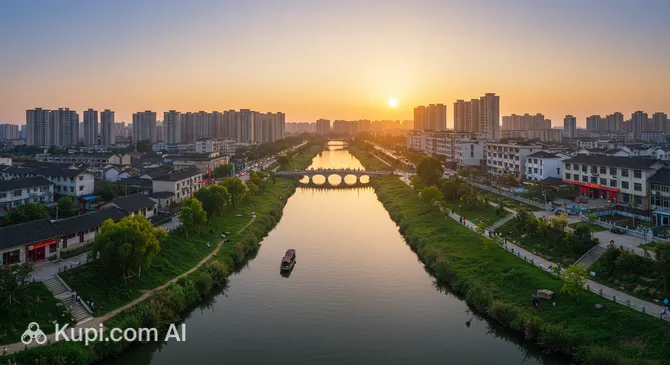
Located just 50 kilometers southwest of bustling Beijing, Zhuozhou is a dynamically developing industrial and residential hub in Hebei Province. As an integral part of China's capital metropolitan area, the city harmoniously combines modern urbanism with echoes of ancient heritage. With a population of over 600,000 people, the city moves at the rhythm of daily hustle and bustle, offering guests an authentic glimpse into modern Chinese suburban life.
Zhuozhou. Illustration.
Source: Kupi.com AI
Geographically, Zhuozhou is spread across a plain through which the picturesque Zhuma River flows. Despite its status as an industrial node, the city draws attention with its rich history, dating back more than two millennia. While it lacks the dazzling glitz of major tourist centers, this is precisely what allows visitors to experience the true atmosphere of the region, where industrial power sits side-by-side with quiet residential neighborhoods.
Travelers will find unique sites here, such as the famous Zhuozhou Twice Tower and the historical Sanyi Palace. Zhuozhou is ideal for those who want to explore life in the Middle Kingdom beyond standard tourist routes, while enjoying affordable prices and convenient transport logistics. We invite you to discover this "quiet suburb" of the great capital, where every alleyway holds its own story.
Weather Overview
The climate in Zhuozhou has a pronounced continental monsoon character, which defines a clear change of seasons. Winters here are cold and quite dry: the average January temperature is about -3°C, but nighttime frosts can reach -8°C. Summer, conversely, is hot and humid—in July and August, the mercury often rises to +30... +32°C, and most of the annual precipitation falls as heavy rain during this period.
The most comfortable times for a visit are considered to be spring (April-May) and autumn (September-October), when mild and sunny weather sets in. However, in spring, one should account for the possibility of dust storms originating from the northern deserts. To ensure your trip is as predictable as possible, we recommend checking a detailed Zhuozhou climate guide in advance and monitoring air quality forecasts, as proximity to the capital and industrial zones affects atmospheric clarity.
Average monthly temperature
Average monthly precipitation
Interesting Facts
Ancient Roots: The history of Zhuozhou spans over 2,300 years, making it one of the oldest settlements in the Beijing-Baoding-Tianjin triangle.
Cinematic Fame: The city is an important center for Chinese film production thanks to the Zhuozhou Movie Town complex, where many famous historical dramas have been filmed.
Waterway: The Zhuma River flows through the city; it historically played a key role in the region's logistics and still defines the landscape of the central districts.
Transport Phenomenon: Despite having a population of over 600,000, Zhuozhou functions largely as a "bedroom community" for Beijing, with thousands of people commuting to work in the capital daily.
Literary Heritage: It is believed that some key events described in the classic novel "Romance of the Three Kingdoms" took place in this area, making the city a cult location for literature connoisseurs.
How to Get There
The accessibility of Zhuozhou is due to its strategic position near the capital. The city is an important logistics hub, through which key highways and railway lines connecting the north and south of the country pass. Travelers have many options for how to get to the city using Hebei Province's developed public transport network.
For those arriving by air, the main gateways are Beijing's airports. Beijing Capital International Airport (PEK) and the new mega-airport Daxing (PKX) are located within 80–100 km of the city center. The most convenient way to get from the airports is by taxi or a pre-booked transfer, which takes about 1.5 hours. You can also use high-speed trains or shuttle buses traveling via Beijing.
Railway communication is the fastest and most comfortable way to get there from Beijing. High-speed trains depart from Beijing West station, and the travel time to Zhuozhou station is only 30 to 50 minutes. If you prefer a car, the drive along the G4 (Jing-Ku) expressway from the center of the capital will take about an hour, although potential rush-hour congestion at the city exits should be considered.
Station
Passenger traffic
Distance
Beijing Fengtai railway station
12
49 km
Pingguoyuan station
11
52 km
Beijing West railway station
25
54 km
Beijingnan railway station
26
54 km
Beijing Railway Station
31
60 km
Main Attractions
Although Zhuozhou is often perceived as an industrial satellite of the capital, it hides several noteworthy places worth visiting. One of the city's most recognizable landmarks is the Zhuozhou Twice Tower—ancient towers that serve as an excellent landmark and offer guests a touch of the region's architectural past. From the height of the observation platforms, views of industrial landscapes and residential quarters open up, demonstrating the scale of urban development.
For those interested in culture and traditions, the Sanyi Palace is a must-visit. This historical site is dedicated to the heroes of the Three Kingdoms era and is steeped in the atmosphere of ancient legends. Although the site is primarily oriented toward local visitors, it allows one to feel the deep connection the residents have with their great cultural heritage.
Movie buffs and fans of unusual sets should check out Zhuozhou Movie Town. This open-air film studio is used for filming historical movies and TV series. Walking through its streets, you can momentarily travel through different eras of Chinese history, seeing reconstructed palaces and traditional huts. This place adds a special charm to the city and makes a visit here more diverse.
Local Cuisine
The gastronomic face of Zhuozhou is inextricably linked to the culinary traditions of Northern China. Hearty and aromatic dishes based on flour products and various types of meat predominate here. The main hit of the local cuisine is jiaozi dumplings with a wide variety of fillings and long wheat noodles, served both in hot broths and fried with sauces.
Walking through the city streets, it is impossible to pass by the fragrant chuan'er skewers cooked directly over charcoal. Another local specialty is tofutuo—tender tofu prepared in a thick, spicy sauce. During the cooler months, Hot Pot (Huoguo) restaurants are especially popular, where guests cook the ingredients themselves in boiling broth right at the table. Among the chain establishments, the famous Haidilao stands out, known for its impeccable service.
The food culture here is democratic: most locals prefer small family-run eateries and lively street markets. It is customary to wash down the meal with strong green tea or local light beer. While there are few fine-dining international restaurants in the city, the honest and rich flavors of traditional Hebei province dishes will not leave any gourmet indifferent.
Travel Tips
Visiting an industrial suburb requires some preparation to ensure your trip to Zhuozhou goes smoothly and leaves only pleasant impressions. These practical tips will help you better navigate local life and culture.
Clothing and Seasonality: The region's climate is continental, so pack clothes according to the season: hot summers require light clothing and sun protection, while winter requires a warm jacket as frosts can be significant. Be sure to bring comfortable walking shoes and a mask in case of smog, which occasionally happens in industrial zones.
Transport Apps: Install Didi for calling taxis and Baidu Maps for navigation. English is not widely spoken in the city, so apps will be your main assistants.
Finance and Payment: Cash is becoming a thing of the past. Register for Alipay or WeChat Pay by linking an international card. UnionPay cards work in ATMs, but they are rarely accepted in shops and cafes.
Health: During periods of unfavorable winds, air quality can decline. Monitor AQI indices and try to avoid long walks outside on days of heavy smog. Pharmacies are common, but medicines have Chinese names—keep photos of the necessary preparations with you.
Connectivity: Buy a local SIM card at Beijing airport upon arrival. To access familiar social networks and services, you may need a VPN, as many Western resources are blocked.
Etiquette and Communication: Locals are friendly but may show curiosity towards foreigners. A polite "Nihao" (hello) and "Xiexie" (thank you) are always welcomed. Be prepared for cafes to be noisy—it's part of the local communication culture.
What to Avoid: Do not visit remote industrial outskirts after dark. Also, refrain from discussing political topics and do not photograph military or government facilities.
Registration: Remember that if you are not staying in a hotel (for example, with friends or in private housing), you are required to register at the local police station within 24 hours.
May your journey be a true discovery, and may your introduction to everyday life in Hebei provide many interesting observations and warm memories!
Entertainment & Nightlife
Evening leisure in Zhuozhou reflects the habits of the locals and is primarily focused on quiet relaxation or family entertainment. Most activity after sunset is concentrated around large shopping centers and city squares, where modern cinemas and gaming zones operate. There is virtually no vibrant club scene with noisy dance floors here, as young people usually head to nearby Beijing for that kind of energy.
A popular entertainment format remains karaoke bars (KTV), which can be found both in separate buildings and at large hotels. This is a favorite place for meetings in large groups, where it is customary not only to sing but also to order traditional snacks and drinks. The atmosphere in such establishments is relaxed, and they often stay open until late at night.
For those who prefer evening walks in the fresh air, the landscaped embankments of the Zhuma River or central park zones are excellent options. Here, you can see impromptu dance floors where residents engage in gymnastics or dancing to music. To call a taxi at night, it is best to use the Didi app, as it guarantees safety and a fixed price for trips to any part of the city.
Parks & Museums
Landscaping in Zhuozhou is predominantly functional in nature, providing recreation areas for the residents of this industrial center. The main green spaces are concentrated along the banks of the Zhuma River, where walking paths and squares have been established. These are popular spots for morning exercises and evening relaxation, where one can escape the city noise while admiring the flow of the water.
Notable sites include small parks near the Twice Tower, where historical monuments are surrounded by well-kept flower beds and trees. Despite the absence of large-scale botanical gardens, these locations create the necessary comfort within the city limits. For more serious nature walks, locals often travel to suburban areas or landscape parks on the border with Beijing.
The city's museum scene is mainly represented by historical sites under the open sky. A key site is the Sanyi Palace, which, although not a classic museum with exhibits in display cases, gives a clear idea of the architecture and heroes of antiquity. For full-scale art galleries and large local history museums, travelers usually head to neighboring Baoding or the capital.
Getting Around
The movement system in Zhuozhou relies on bus services and taxi services. A developed network of municipal buses covers all major districts and industrial zones, connecting the center with the outskirts. The fare is minimal; however, during peak hours—from 7:00 to 9:00 AM and from 5:00 to 7:00 PM—transport can be very crowded, and traffic jams often occur on the roads.
Since there is no metro in the city, the most convenient and fastest way for tourists to get around remains taxis. We recommend using the Didi app: it allows you to call a car to a specific point and avoid translation difficulties, as the destination is entered in the app. A trip around the city usually costs between 5 and 20 yuan. Bicycle and e-scooter rental services, available through mobile apps like Meituan, are also popular.
For trips to Beijing and other major cities in the province, residents actively use suburban trains and high-speed rail expresses. It is better to purchase train tickets in advance through official services or at station ticket offices by presenting a passport. Inner-city buses require payment in cash (exact change) or through transport cards and QR codes, making a smartphone with internet almost a mandatory requirement for comfortable navigation.
Accommodation
The real estate and hospitality market in Zhuozhou is primarily geared towards business travelers and transit tourists. It offers a wide selection of mid-range and budget hotels that provide comfortable conditions at significantly lower prices than in neighboring Beijing. A typical price range for a room in a quality three-star hotel is between 200 and 400 yuan per night.
For a short-term visit, the most convenient area is considered to be near the railway station, where chain hotels like Ibis and local guest houses are concentrated. This helps minimize travel time between cities. In the central part of the city, you can also find apartments for long-term rent, which are popular among expats and industrial employees.
It is recommended to book accommodation in advance, especially during China's national holiday periods when the flow of domestic tourists increases sharply. Most establishments accept payment via popular apps like WeChat Pay and Alipay, but it is wise to check beforehand if the hotel accepts international bank cards or cash. Using verified booking services will help you find the best option with up-to-date reviews.
Nearby Cities
Thanks to its location at the intersection of important transport routes, Zhuozhou serves as an excellent base for exploring the neighboring regions of Hebei Province and the capital district. In just a few dozen minutes, you can find yourself in places with a completely different atmosphere, each offering a unique experience and new impressions.
The most obvious destination for a trip is majestic Beijing, offering an endless list of attractions from the Forbidden City to the Great Wall. It is also worth paying attention to the city of Gaobeidian, located just 20 kilometers away. It is known for its commercial opportunities and industrial potential. For a quieter introduction to the life of smaller settlements, Songlindian and Baichigang, located in the immediate vicinity, are suitable.
We highly recommend setting aside time to visit Baoding—a historical city with a rich heritage, reachable in about an hour. Exploring the surroundings will allow you to see the multi-faceted China, where modern agglomerations sit side-by-side with authentic villages that preserve centuries-old ways of life.
Shopping & Souvenirs
Shopping in Zhuozhou is primarily a practical experience focused on everyday needs. The city's commercial life hums in the central districts adjacent to the Zhuma River. Modern shopping centers are located here, where you can find clothing from popular Chinese brands, household appliances, and electronics. Prices in local stores are often lower than in the capital, making shopping quite profitable.
For those looking for local color and fresh produce, numerous city markets are in operation. These are ideal places to feel the pulse of local life, purchase seasonal fruits, or try street food. In souvenir shops at historical sites, you can find folk crafts, tea, and traditional accessories, although many goods are brought in from Beijing due to the proximity to the capital.
Shops generally operate from 9:00 AM to 9:00 PM or 10:00 PM, seven days a week. The main method of payment is digital wallets like WeChat Pay and Alipay, which are accepted everywhere—from large malls to street food stalls. The Tax-Free system is not well-developed in the city, so you shouldn't count on tax refunds for purchases, but the affordable prices more than compensate for this.