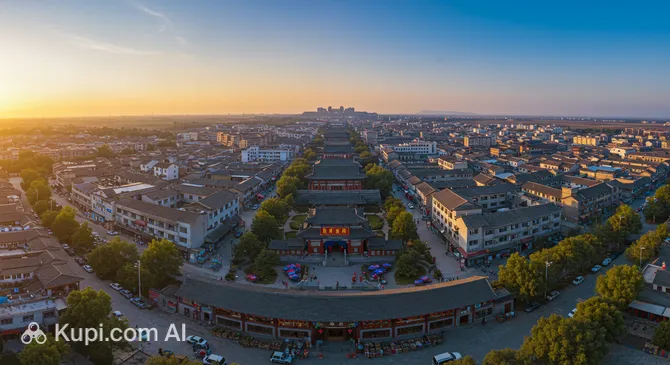
Renqiu is a dynamically developing industrial hub located in the heart of Hebei Province. Situated within China, the city harmoniously combines the features of a modern industrial center with deep historical roots. With a population of about 822,000, it plays a vital role in the regional economy, being a well-known oil production center due to its proximity to rich deposits.
Geographically, the city stretches across a plain, which largely determined its architectural appearance — dense development dominated by residential areas and production facilities. Despite its purely business status, Renqiu has the special atmosphere of a hardworking Chinese county where life pulses at the rhythm of modern industry.
Renqiu. Illustration.
Source: Kupi.com AI
Interestingly, the founding history of this place dates back to antiquity: as early as 2 AD, a fortification was established here for coastal defense. Today, for tourists passing through or visiting on business, the city offers a glimpse into the daily life of North China, its authentic shopping streets, and the hospitality of local residents. Visiting Renqiu is a curious experience for those who want to see the "real" industrial China beyond the glossy megacities.
Weather Overview
Renqiu is dominated by a continental monsoon city climate, typical of the northern plains of China. The seasons here are very distinct: expect hot, humid summers and rather harsh, dry winters. Maximum temperatures in July can reach +33°C, while in January the thermometer often drops to -7°C, creating a significant contrast.
Most precipitation falls during the summer months, especially in July and August, when the region is influenced by monsoons. In winter, rain and snow are rare, and the weather remains mostly sunny but freezing. Spring and autumn are considered the most comfortable periods to visit, when air temperatures stay within a pleasant +15°C to +25°C.
When planning a trip, keep in mind that the flat terrain and industrial status of the city can affect air quality, especially on windless winter days. Nevertheless, typical weather in Renqiu allows for enjoyable walks most of the year if you choose your wardrobe correctly: from light cotton clothes for summer to warm down jackets for the winter months.
Average monthly temperature
Average monthly precipitation
Interesting Facts
The name of the city, Renqiu, has a poetic translation — it literally means "Ren's Hill". This name is associated with Ren Guang, who founded the first fortification here over two thousand years ago.
The nearby Yinzhou Grand Temple once held the unofficial status of the largest temple in the world, and its territory rivaled the size of the imperial Forbidden City.
Renqiu is one of the key hubs of the oil industry in Northern China, which leaves a unique mark on the architecture and economic structure of the entire city county.
Despite its status as a county-level city, the population of Renqiu along with its surrounding areas exceeds one million people, highlighting the scale of urbanization in this part of Hebei Province.
The city was founded as an important defensive point on the coast as far back as the Han Dynasty (2 AD), making it one of the oldest inhabited spots in Cangzhou Prefecture.
How to Get There
Transport accessibility makes Renqiu a convenient destination for business trips throughout Hebei Province. The city is advantageously located along many routes connecting the major metropolises of Northern China. The main emphasis here is on land transport, which provides reliable connections to administrative centers.
The city does not have its own airport, so travelers usually use the air harbors of neighboring megacities. The nearest international hubs are located in Beijing, from where you can reach Renqiu in 1.5–2 hours by car or high-speed train. It is also convenient to use Cangzhou airports for domestic flights.
Railway communication is the most popular and fastest way to get to the city. High-speed trains (高铁) connect Renqiu station with important hubs such as Shijiazhuang and Cangzhou. The journey from Cangzhou takes only about an hour, making it easy to plan day trips. To clarify routes and prices, you can always check information on how to get to the city in more detail.
Besides trains, there is a developed network of intercity buses and expressways. A trip by taxi or private transport from Beijing may take a bit longer during peak hours due to heavy traffic on the approaches to industrial zones, so it's worth budgeting extra travel time.
Main Attractions
Although Renqiu is primarily known as an industrial center, several iconic sites reflecting the rich heritage of the Hebei region can be found here. One of the main historical gems is the Yinzhou Grand Temple (or Medicine King Temple), located in the village of the same name. This reconstructed complex is impressive in its scale — during the Ming and Qing dynasties, its area reached 157,000 square meters, making it comparable to the Forbidden City in Beijing. Here you can see halls dedicated to Bian Que and the God of Wealth.
For those who prefer city walks, it's worth checking out the commercial streets, such as YangGuang DaJie and YanShan ShangYeJie. These are typical Chinese pedestrian zones where commercial life is concentrated, with many shops and small cafes. Here you can feel the rhythm of the city and observe the daily life of locals amidst bright signs and storefronts.
In the city's surroundings, natural and historical sites also deserve attention. For example, the Baiyang Lake Miles Dike offers picturesque views and a chance to relax from the industrial landscape. Also nearby are the ruins of the ancient city of Yinzhou, which will appeal to lovers of archaeology and ancient mysteries seeking to touch the origins of civilization in this part of the Celestial Empire.
Local Cuisine
The gastronomic scene of Renqiu is a classic embodiment of Hebei Province cuisine, where hearty dishes based on wheat and fragrant meat predominate. While walking around the city, be sure to try the local handmade noodles and steamed baozi buns with various fillings. Particularly popular are the jiajing street flatbreads, which are fried right in front of you and served hot.
Meat dishes in the region are often prepared with spices and spicy sauces, with a preference for pork and lamb. The food culture here is simple and democratic: most locals and visitors eat in small street cafes or family-run canteens located on **YanShan ShangYeJie** shopping street. This is the best place to experience the authentic taste of the region without any unnecessary fuss.
For drinks, people in Renqiu traditionally prefer strong tea of various sorts, which accompanies any meal. You can also find local beer and rice wine in local shops, which perfectly complement spicy dishes. Despite the absence of world-renowned restaurants, the city's honest and high-quality everyday cuisine will not leave a Chinese gastronomy enthusiast indifferent.
Travel Tips
Preparing for a trip to Renqiu will help make your journey as comfortable as possible and avoid unpleasant surprises. Here are some practical tips from experienced travelers that will be useful in this industrial heart of Hebei Province.
Clothing and essentials: Choose clothing according to the season — winters here are harsh and dry, while summers are hot and humid. Be sure to bring comfortable shoes for long walks and a mask, which may be useful on days with low air quality due to industrial operations.
Transport: For moving around the city, it is most convenient to use the Didi app. Public buses can be crowded, and English is rarely spoken among drivers, so save the addresses of your destinations in Chinese in advance.
Finances: In Renqiu, as in the rest of China, cash is becoming a thing of the past. Install and link a card to Alipay or WeChat Pay — this is the primary payment method even in the smallest markets. International cards are only accepted in very large hotels.
Health: Pharmacies are common, but medicine names will be in Chinese. We recommend carrying a basic first aid kit and hand sanitizer. It's better to buy bottled water.
Communication: English is not widely spoken in the city. Be sure to download an offline translator and a map app that works without Google (such as Baidu Maps or Amap).
Etiquette: Chinese people are very hospitable. Be polite and don't be afraid to use simple gestures. A nod of the head as a greeting is quite appropriate. Remember that punctuality is valued in business circles.
What to avoid: You shouldn't walk through remote industrial outskirts after dark — not because of danger, but because of poor lighting and active truck traffic.
Extra tip: If you plan to visit the Yinzhou Temple, allow at least an hour for it and prepare about 25 yuan for the entrance ticket.
May your acquaintance with Renqiu be productive and bring only positive impressions from immersing yourself in the life of real China!
Entertainment & Nightlife
Nightlife in Renqiu is quiet and measured, which is typical for industrial counties in this region. Here you won't find world-class noisy nightclubs or endless rows of bars. Most activity after sunset is concentrated on commercial streets like YangGuang DaJie, where locals gather for evening strolls, family dinners, and light shopping. The atmosphere here is friendly and safe, and venues are mainly geared toward locals and business travelers.
For those seeking more vibrant night entertainment, concerts, or large-scale parties, the best option is to head to neighboring Cangzhou or even Beijing, which are a short high-speed train ride away. In Renqiu itself, karaoke clubs (KTV) are popular, being an important part of Chinese leisure culture. These are great places for large groups to spend time in a private setting.
Daytime entertainment in the city includes visiting cinemas in shopping districts and walking through small city parks. If you plan to spend the evening outside the hotel, we recommend calling a taxi via a mobile app to comfortably reach the restaurants on YanShan ShangYeJie, where life continues a bit longer than in residential areas.
Parks & Museums
In Renqiu itself, park infrastructure is mainly represented by small squares and green areas along the central streets, which serve as recreation spots for residents. This is typical for industrial centers where every free meter is used rationally. Nevertheless, these green islands offer a brief escape from the city noise and a chance to observe local life.
The role of the main cultural and historical site, replacing traditional museums, is played by the Yinzhou Temple. It is effectively an open-air museum where you can study architectural styles of past eras and learn about the region's religious traditions. For those interested in archaeology, the Yinzhou ruins, which hold the memory of the ancient fortification, are a must-visit.
For a complete retreat into nature, residents and visitors usually head to the surroundings of Baiyang Lake. This picturesque area with lakes and canals offers a completely different landscape that contrasts with Renqiu's industrial districts. Here you can enjoy clean air and boat trips, making a trip out of town the perfect addition to a visit to the county itself.
Getting Around
The public transport system in Renqiu is represented by an extensive network of bus routes and accessible taxi services. Buses run between the main districts and industrial zones, providing stable communication throughout the day. Keep in mind that during peak hours, transport can be crowded due to the large flow of workers and employees, so it's better to plan your trips in advance.
For tourists, the most comfortable way to get around the city is by taxi or using the Didi service (the local equivalent of Uber). This eliminates the need to figure out bus maps in Chinese and allows you to quickly reach key points, such as **YanShan ShangYeJie** shopping street or the railway station. Taxi prices in the county are quite moderate.
There are no metro or tram lines in the city, but this is compensated for by the popularity of personal electric transport. Bicycles and electric scooters are the preferred way for locals to move short distances. If you are planning a trip to neighboring cities, the best choice would be high-speed trains, tickets for which can be purchased at the station or through official mobile apps.
Accommodation
The hotel stock in Renqiu is primarily oriented toward business travelers and specialists visiting the city for industrial matters. Mid-range and business hotels predominate here, offering a standard set of amenities such as air conditioning, conference rooms, and high-speed internet access.
Among the popular accommodation options, the Renqiu Yuanping Hotel stands out, offering comfortable family rooms and quality service. Most hotels are concentrated in the central blocks and near major transport interchanges, making it easier to move around the city and access shopping streets.
For those planning a long stay, rental apartments are available in the city's residential areas. During peak business seasons, it is recommended to book accommodation in advance through popular Chinese services. The price range in Renqiu remains very affordable compared to large megacities, making the city accessible for budget travelers.
Nearby Cities
Renqiu serves as an excellent starting point for exploring nearby cities in Hebei Province, each of which has its own unique character. The nearby settlements allow tourists to diversify their itinerary and see different facets of life in the region.
Just 30 kilometers away is Hejian, a city with a rich history and developed infrastructure, where you can go for new experiences. For shorter trips, Maozhou and Wofotang are suitable, with the journey taking no more than half an hour. Also of interest may be Tongkou and the commercial hub of Baigou, known for its markets.
If you have time for a longer trip, be sure to visit Cangzhou — the administrative center of the prefecture, offering wide opportunities for shopping and cultural leisure. Exploring the surroundings of Renqiu will allow you to better understand the economic and cultural landscape of this part of China, opening doors to cozy county towns and natural areas like Baiyang Lake.
Shopping & Souvenirs
Shopping opportunities in Renqiu are concentrated on its lively commercial streets, where you can find everything you need — from everyday goods to local specialties. The main points of attraction for shoppers are YangGuang DaJie and YanShan ShangYeJie. These streets are literally dotted with clothing, electronics, and household goods stores catering to the needs of local residents.
If you are looking for something unique, pay attention to the local markets. There are no giant luxury malls here, but you can find high-quality Hebei tea, local crafts, and traditional Chinese sweets. Markets such as KeYan XiaoQu ShangYeJie allow you to shop in an authentic atmosphere where it is customary to bargain and choose goods with special care.
Shops in the city usually operate from early morning until late evening, without lunch breaks. To pay for purchases, it is most convenient to use the WeChat Pay or Alipay mobile payment systems, which are accepted almost everywhere, including small street stalls. Visiting local shopping rows will be a great way to bring home a piece of everyday China.