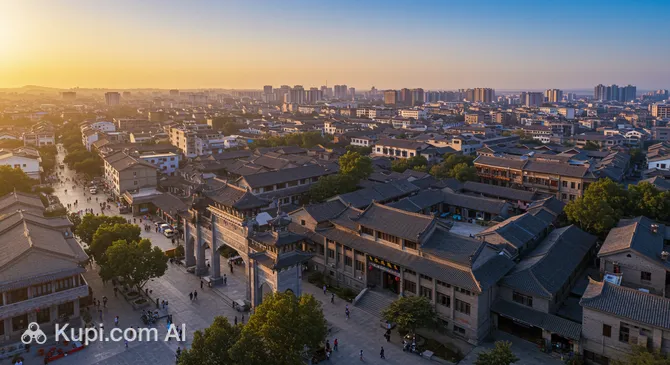
Botou is a dynamic industrial hub located in the heart of Hebei Province in China. The city does not strive to be a flashy tourist center, but it possesses its own unique, truly authentic atmosphere of industrial North China. Here, everyday life flows to the rhythm of production, and dense urban development coexists with modern industrial districts.
Botou. Illustration.
Source: Kupi.com AI
Geographically, the city covers an area of about 970 km² and is an important part of the Cangzhou prefecture-level city. The population of Botou is approximately 584,000 people, making it a fairly large and densely populated county-level city. The climate here is continental with distinct seasons, typical for this part of the country.
If you are interested in the history of the city's founding and heritage, it is worth knowing that Botou has always played the role of an important transport and trade hub. Today, it primarily attracts those who want to see the "real," non-tourist China, get acquainted with its economic way of life, and feel the rhythm of life in industrial Hebei.
Weather Overview
The weather in Botou is dictated by its location on the North China Plain, which accounts for its moderate continental climate. Travelers should expect a hot and humid summer, when the thermometer in July and August can rise to +32...+35°C. Most of the precipitation falls during the summer months, often in the form of heavy downpours.
Winters in the city are cold, dry, and windy. In January, the average temperature drops to -6°C, and nighttime frosts can be quite severe. Spring in the region is often accompanied by dust storms due to the proximity to arid areas, so masks and goggles can become a necessary accessory. If you want to know more, check the detailed weather forecast for the city before leaving.
The industrial specifics of Botou also leave their mark on the perception of the weather: on windless days or during the heating season, air quality may decrease due to emissions from enterprises. The best times to visit are considered to be May, September, and October, when mild and comfortable temperatures set in without excessive humidity.
Average monthly temperature
Average monthly precipitation
Interesting Facts
The name Botou translates from Chinese as "anchorage", which emphasizes the historical role of the river in the city's development as an important logistics point.
The city is showing impressive growth rates: while its population in 1950 was only 26,000 people, today it is approaching the 600,000 mark.
The population density here reaches almost 570 people per square kilometer, creating the feeling of a very compact and lively city.
In China's administrative hierarchy, Botou has the code 130981 and is subordinate to Cangzhou prefecture, while maintaining the status of an independent county-level city.
How to Get There
The transport accessibility of Botou is largely determined by its advantageous location between the major metropolises of northern China. Getting here is quite simple, especially when using neighboring transport hubs. If you are interested in logistics details, study the information on how to get to the city in the most convenient ways.
The city does not have its own airport, so travelers usually use the air harbors of the nearest major cities, such as Tianjin or Beijing. From there, you can transfer to a high-speed train or bus, which will take from one to three hours depending on the chosen route.
The main transport hub of the city itself is Botou Railway Station. It is located on the Shijiazhuang–Dezhou line and receives trains from Beijing and Tianjin. Trips via the station in neighboring Cangzhou are also popular, as high-speed trains arrive there, after which Botou can be reached by taxi or regular bus in about an hour.
The city of Botou is a classic example of an industrial county where the architectural appearance is shaped by functionality and production needs. Although there are no world-famous monuments here, tourists might find it interesting to walk around the city's Central Square, which serves as the main gathering place for locals in the evenings. This is where you can observe the daily life of the townspeople: from traditional outdoor dancing to spontaneous markets.
Other landmarks include local markets and trading quarters located near the railway station. These are noisy, lively places where trade is conducted the old-fashioned way, and the variety of goods is impressive—from industrial equipment to the freshest local produce. This is the best way to feel the energy of the city and see it "without filters."
For those passing through Botou, the modern industrial zones may be of interest. Despite their utilitarian nature, their scale is impressive and clearly demonstrates the economic power of the region. The city is often visited by specialists and business travelers for whom these facilities are the main points of attraction.
Local Cuisine
The culinary traditions of Botou are firmly rooted in those of Hebei Province and are typical of Northern China. The basis of the local diet consists of wheat products, which are prepared here with special skill. Be sure to try lamian (hand-pulled noodles) and various baozi—steamed buns with juicy meat or vegetable fillings.
The city's gastronomic scene is mainly represented by cozy local canteens and street stalls. Popular dishes for a quick snack are fried jiaozi (dumplings) and tofu-based soups, which are traditionally eaten hot here. The cuisine in Botou is simple, filling, and affordable, reflecting the city's working-class character.
Among drinks, green tea remains the favorite, served in almost any establishment. Fans of stronger drinks may appreciate the local beer or traditional rice wine, baijiu. Despite the lack of fine dining restaurants, the food in Botou attracts with its authenticity and the opportunity to try real homemade Northern Chinese dishes.
Travel Tips
Planning a trip to this industrial corner of Hebei? Our practical tips will help you feel confident in Botou and get the most out of visiting this working city.
Clothing and Protection: Given the industrial nature of the city and potential dust, it is useful to have a protective mask with you in spring and summer. Shoes should be as comfortable as possible for walking on city sidewalks.
Internal Transport: The best way to get around is the Didi app. it will save you from having to explain the route to the driver in Chinese, as the destination is entered in the app.
Finance: Be sure to set up Alipay or WeChat Pay before your trip. International bank cards are rarely accepted in Botou, and ATMs for withdrawing cash from foreign cards may only be in large bank branches.
Language Barrier: English is practically not spoken here. Download an offline translator in advance and save your hotel address in Chinese characters.
Health: During the heating season (winter), air quality can deteriorate. If you have sensitive lungs, monitor AQI indices and try to spend less time outdoors in smog.
Etiquette: Botou residents are friendly but are not used to foreigners. A polite nod and using simple phrases like "Ni hao" (hello) will help establish contact.
Connectivity: Wi-Fi is available in hotels, but for city navigation, it's better to buy a local SIM card. Remember that many familiar Western services in China only work via VPN.
What to Avoid: It is not recommended to walk in the dark in peripheral industrial zones—there may be poor lighting and a lack of sidewalks.
May your visit to Botou be an interesting immersion into the life of real industrial China. Have a great trip!
Entertainment & Nightlife
The entertainment infrastructure in Botou is primarily oriented toward local residents and family leisure. You won't find noisy nightclubs or massive concert venues here; however, the city's evening life has its own unique color. Most activity after sunset is concentrated around street cafes and small restaurants where workers and families gather for dinner.
Karaoke bars (KTV) remain a popular leisure activity for the townspeople and are an integral part of Chinese entertainment culture. For a more extensive program, including modern cinemas or large shopping malls, residents often head to nearby Cangzhou. Nevertheless, a walk along the well-lit central streets of Botou in the evening allows you to experience the calm and safe atmosphere of provincial China.
Daytime entertainment is limited to small parks and public spaces where you can see groups of people practicing gymnastics or playing board games. For those seeking cultural diversity, it is recommended to plan trips to the region's larger metropolitan areas, using Botou as a convenient starting point.
Parks & Museums
Since Botou is primarily an industrial city, there are few classic museums or large nature reserves here. Cultural life is concentrated in small exhibition spaces at enterprises or administrative centers, which may be inaccessible to the general public. However, urban greening is gradually developing, offering residents places to rest from the noise of the factories.
In the city center, you can find small green zones and squares that serve as the city's "lungs." Despite their modest size, they are important points of attraction for walks. For visiting large-scale botanical gardens or historical museums with rich collections of artifacts, residents and guests of Botou most often head to nearby Cangzhou.
Nevertheless, a walk through the local parks allows you to see the features of Chinese landscape design in an industrial environment. These are functional spaces designed for the recreation of workers and their families, where you can often meet people practicing tai chi or playing mahjong right in the open air.
Getting Around
The public transport system in Botou is represented by an extensive network of bus routes and minibuses. They connect the city center, the railway station, and numerous industrial zones. A bus trip within the county usually takes from 10 to 30 minutes, although it is worth considering that during peak hours, transport can be very crowded with workers from local factories.
An alternative to buses are taxis and the Didi ride-hailing service. This is the most comfortable and inexpensive way for tourists to get around—a trip across the city rarely costs more than 20 yuan. There are no subways or trams in Botou, which is typical for cities of this level, so taxis remain the priority option.
Payment on buses is made in cash or via payment system QR codes. If you decide to use a bicycle or electric scooter, which are very popular among locals, be extremely careful on the roads: traffic in the city is intense, and traffic near industrial zones can be difficult due to heavy vehicles.
Accommodation
The accommodation market in Botou is specific and primarily oriented toward business travelers and specialists visiting local enterprises. Mid-range hotels and budget guesthouses offering a basic set of amenities predominate here. Most housing options are concentrated in the central part of the city and in the immediate vicinity of the railway station.
If you are planning a visit, it is worth looking at Chinese hotel chains and motels, where the cost of stay usually ranges from 100 to 300 yuan per night. There are practically no luxury international hotel brands in the city, so travelers should expect practical service and functional rooms.
It is recommended to use popular Chinese services like Ctrip for booking accommodation. Remember that hotel staff in Botou rarely speak English, so it is useful to have a printout of your reservation in Chinese. During peak periods related to national holidays, it is better to take care of housing in advance.
Nearby Cities
The city of Botou is an excellent starting point for exploring the surroundings, where the larger cultural and economic centers of Hebei Province are concentrated. Proximity to high-speed highways makes it easy to plan short day trips.
Just 33 kilometers away is the large city of Cangzhou, which offers a much more developed infrastructure, museums, and shopping centers. Also within an hour's drive are cities such as Qincun, Dusheng, and Hejian, each of which has its own local flavor.
For those ready for longer trips, opportunities open up to visit world-class metropolises—Tianjin and Beijing. Exploring neighboring cities will allow you to see the contrast between industrial Botou and the historical heritage of ancient China.
Shopping & Souvenirs
Shopping in Botou primarily means visiting lively markets and small shopping centers concentrated in the central part of the city. The markets in the railway station area are of the greatest interest to tourists. Here you can find almost everything: from everyday clothes and electronics to specific industrial goods at very attractive prices.
Although there are no large international shopping malls in the city, local department stores fully satisfy shoppers' needs. Here, it is worth paying attention to quality textile products and inexpensive gadgets. There are practically no specialized souvenir shops in Botou, so the best gifts from here would be local delicacies, spices, or high-quality Chinese tea.
Shops in the city usually operate from early morning until 8–9 PM. For payment, it is recommended to use the Alipay or WeChat Pay mobile apps, which are accepted everywhere—from large shops to street vendors. Cash yuan is also in use, but international bank cards may not work at smaller retail outlets.