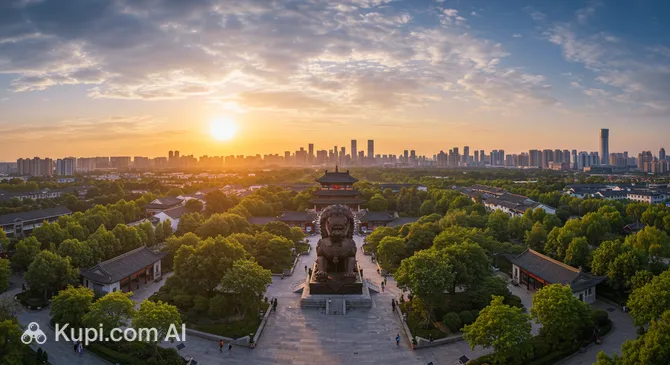
Cangzhou is a dynamically developing industrial and port center located in eastern China, in Hebei Province. With a population of over 7.5 million, the city plays a key role in the regional economy as a vital link in the Bohai Economic Rim. Its strategic position and developed infrastructure have transformed it into a powerful transport hub connecting the country's northern provinces with maritime routes.
Cangzhou. Illustration.
Source: Kupi.com AI
The city's atmosphere is a harmonious blend of rapid modernization and deep respect for cultural heritage. An observant traveler will find not only modern industrial landscapes here but also echoes of the city's rich history, which dates back to ancient times. Cangzhou is actively regenerating, attracting tourists with its unique industrial charm and authentic North Chinese atmosphere.
Among the features that make Cangzhou an attractive destination are its status as the "city of martial arts" and the "hometown of the Chinese circus," as well as the famous "Iron Lion"—a colossal ancient statue. We invite you to discover this multifaceted city, where the energy of modernity meets centuries-old traditions.
Weather Overview
The climate of Cangzhou is distinctly continental with a clear change of four seasons. Summer here is long and quite hot: from June to August, the thermometer often rises to +29...+31°C, and high humidity brings occasional heavy rains. Winters, on the contrary, are harsh and frosty—the average January temperature fluctuates around -1°C, and night frosts down to -8°C are not uncommon.
The most favorable times for a visit are the transition seasons—spring and autumn. In September and October, a comfortable temperature of around +23°C sets in, and the sky is clear. To get more detailed information about the weather in the city by month, it is worth checking the forecast before planning your trip.
Average monthly temperature
Average monthly precipitation
Interesting Facts
Getting to know this industrial giant will reveal many surprising facets of its centuries-old biography.
Cangzhou has a rich history dating back more than two millennia, making it one of the oldest cultural centers in Hebei Province.
The city is officially recognized in China as the "hometown of Wushu" (martial arts) and acrobatics, which is reflected in many local traditions and festivals.
It is home to the famous "Iron Lion of Cangzhou"—the world's largest ancient cast-iron statue, created over a thousand years ago during the Late Zhou Dynasty.
Thanks to its port and status as a major logistics center, Cangzhou is part of the Bohai Economic Rim, being one of the fastest-growing regions in China.
How to Get There
Cangzhou enjoys excellent transport accessibility thanks to its location at the intersection of key highways in Northern China. Most tourists arrive here through the major transport hubs of neighboring metropolises, such as Beijing or Tianjin, from where the city can be reached quickly by modern train or intercity bus. You can find detailed information on routes and logistics in the section on how to get to Cangzhou.
Since the city itself does not have its own international airport, travelers most often use the airports of nearby cities. This is convenient, as the extensive high-speed rail network allows you to cover the distance from the airport to the city center in minimal time.
Rail travel is the most popular and reliable way to get around the region. Cangzhou is served by several stations that handle both regular and high-speed trains, connecting the city with the largest economic centers of Hebei Province and the entire country.
The attractions of Cangzhou reflect its unique journey from an ancient outpost to a modern industrial giant. One of the city's main landmarks is the legendary Iron Lion—a colossal sculpture symbolizing the power and historical continuity of the region. This unique monument of casting art attracts antiquity enthusiasts from all over the world.
For those interested in spiritual heritage, traditional temple complexes with characteristic northern architecture have been preserved in the city and its surroundings. These quiet oases allow visitors to take a break from the city noise and experience ancient rituals. Cangzhou's industrial heritage also deserves attention: some old factory buildings are being reimagined today as art spaces and industrial development museums.
The city's natural areas, such as the parks along the canals, offer picturesque views and places for strolling. The combination of modern urban development with green embankments creates a pleasant atmosphere for a relaxing break after a busy day of sightseeing.
Local Cuisine
The gastronomic scene in Cangzhou is a kaleidoscope of flavors dominated by North Chinese and Hebei culinary traditions. Due to its proximity to the Bohai Gulf, seafood holds a place of honor on the menus of local restaurants. Fresh fish, shrimp, and other delicacies are prepared here with great skill, often with the addition of aromatic spices and sauces characteristic of the region.
Be sure to try traditional Chinese noodles and dumplings, the recipes for which are passed down through generations. Local meat snacks and braised meat with vegetables deserve special attention—hearty and warming dishes, ideal for the cooler seasons. Street food is also an important part of the culture: at evening markets, you can find an endless variety of skewers and steamed baozi buns.
As for drinks, classic varieties of Chinese tea are popular in Cangzhou, served in tea houses that preserve the atmosphere of old China. For a more modern experience, it is worth visiting shopping centers, where food courts offer both local specialties and international dishes at affordable prices.
Travel Tips
A trip to Cangzhou promises to be exciting, and to ensure it goes as smoothly as possible, we have prepared some useful practical recommendations for you.
Clothing by season: In summer, bring light items made of natural fabrics and sun protection accessories, and in winter, a thick jacket and warm shoes, as the frosts can be quite severe.
Transport: To get around the city, it is most convenient to use taxis via the Didi app. This will save you from having to explain a complex route to the driver verbally.
Finance and Payment: Mobile payments (Alipay or WeChat Pay) are used everywhere in China. Link your card to one of the apps in advance, but always carry some cash in Yuan with you.
Language Barrier: The primary language is Mandarin. Install a reliable offline translator on your smartphone, as English is not widely spoken outside of large hotels.
Connectivity: Purchase a local SIM card at an official telecom store. Wi-Fi is available in hotels and shopping malls, but a VPN may be required to access familiar international services.
Local Etiquette: Chinese people are very hospitable but value restraint. Greet people with a slight nod and try not to show overly boisterous emotions in public places.
What to avoid: Do not engage in discussions on political topics and try not to take photos of military or government facilities without special permission.
Best time to visit: Plan your trip for April-May or September-October, when the city's climate is most stable and pleasant for long walks.
By following these simple tips, you will be able to fully focus on exploring this amazing city and gain only positive impressions!
Entertainment & Nightlife
The entertainment life in Cangzhou offers guests an interesting mix of modern formats and traditional Chinese leisure. Most evening activity is concentrated in the central districts, where the neon signs of shopping centers and restaurants glow. This is where the karaoke clubs (KTV), popular with locals, are located—a favorite place for spending time with friends.
Night walk enthusiasts should head to the local night markets. These are not just shopping spots but a true open-air gastronomic theater, where a lively atmosphere prevails and the air is filled with the aromas of fried snacks. While there are fewer Western-style nightclubs here than in major metropolises, you can find cozy bars in the center with a good selection of drinks and live music.
During the day, Cangzhou invites you to visit its theaters and cinemas in large shopping and entertainment centers. The city is famous for its acrobatic traditions, so if you manage to catch a local circus performance or a martial arts festival, it will be a vivid addition to your travel itinerary. For a peaceful rest, the city parks are ideal, where life bustles from early morning until late evening.
Parks & Museums
Cangzhou's city parks are the true "lungs" of the metropolis, where modern landscaping solutions coexist with traditional Chinese gazebos and bridges. Walking along the well-kept alleys, you can see monuments and sculptures telling the stories of famous locals and key events in the region's history. These are wonderful places to observe the daily life of the townspeople: from Tai Chi (Taijiquan) sessions in the morning to dancing at dusk.
The city's museum program focuses on an in-depth study of regional identity. The main Cangzhou Museum offers extensive exhibitions covering the period from ancient settlements to the industrial breakthrough of the 20th century. It houses rare artifacts, documents, and interactive models that help visualize how the city's appearance has changed over the centuries.
Visiting these cultural sites allows you to look behind the facade of a modern industrial center and understand the soul of the region. We recommend checking museum opening hours in advance, as schedules may change during holidays, and some natural areas are especially beautiful during the spring blossom or in the vivid colors of autumn.
Getting Around
The public transport system in Cangzhou is well-developed and primarily oriented toward bus service. An extensive network of routes covers all key areas of the city, connecting residential neighborhoods with industrial zones and attractions. This is the most budget-friendly way to get around, but keep in mind that signs and voice announcements at stops are most often provided only in Chinese.
For greater comfort, tourists prefer to use taxis. It is easy to catch a car on the street, but it is much more convenient to use the Didi mobile app, which allows you to see the fare and destination in advance. Most taxi drivers are polite, and the cars are equipped with air conditioning, which is important during the hot summer months.
In recent years, a public bike-sharing system has been actively developing in Cangzhou. Bicycles are an excellent alternative for short trips and exploring central streets. Bus fares and bike rentals are usually paid via QR codes using mobile wallets, making the process quick and modern.
Accommodation
The choice of accommodation in Cangzhou is wide enough to satisfy the needs of any traveler. You can find modern four-star hotels from major Chinese chains, as well as comfortable budget options or apartments. Most hotels are concentrated in the central part of the city, near major shopping hubs and administrative buildings, making them an ideal base for exploring the surroundings.
When choosing a place to stay, it is worth looking for proximity to transport interchanges or the railway station if you plan trips to neighboring cities. Many modern hotels offer a high level of service, including buffet breakfasts with Chinese and Western cuisine, as well as business center services.
It is recommended to book rooms in advance, especially if your visit coincides with major national holidays when the demand for accommodation spikes. When searching, it is helpful to pay attention to guest reviews on specialized platforms—this will help you form an objective idea of the service quality and the actual condition of the rooms.
Nearby Cities
Thanks to its location, Cangzhou serves as an excellent starting point for exploring Hebei Province. The city's surroundings are rich in small but colorful settlements, each with its own unique character and history.
For example, just a half-hour drive away is the city of Botou, known for its traditions and contribution to the regional economy. It is also worth visiting the coastal city of Huanghua, where you can feel the sea breeze and get to know the port culture. For more secluded walks, places like Dushen or Qincun, which have preserved the atmosphere of a quiet Chinese suburb, are suitable.
Exploring these destinations will allow you to get a more complete picture of life in Northern China and see the diversity of its landscapes and architectural styles beyond the busy city streets.
Shopping & Souvenirs
Shopping in Cangzhou is an engaging activity, offering a choice from modern brands in glittering shopping centers to unique finds in traditional markets. The city's main shopping areas are concentrated in the center, where large department stores are located. Here you can purchase high-quality clothing, electronics, and cosmetics from leading Chinese and international brands.
If you are looking for something special, head to the local markets and night bazaars. These are the best places to buy souvenirs: cast-iron items (honoring the city's famous symbol), traditional ceramics, or authentic home decor items. Trading in such markets is part of the culture, so don't hesitate to politely negotiate the price; it will help you make a purchase on better terms.
Shops in Cangzhou usually stay open late, closing around 21:00-22:00. Contactless payments via mobile apps are accepted almost everywhere, which significantly simplifies the shopping process. Don't forget to check out the food departments and markets, where you can buy famous Chinese sweets and local delicacies as gifts for loved ones.