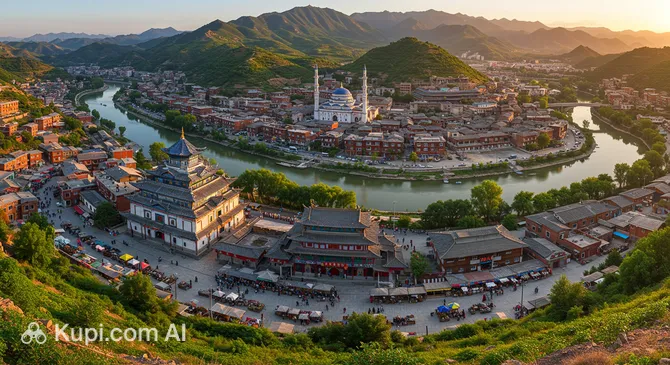
Linxia City is a fascinating cultural crossroads in Gansu Province, located in Northwest China. The city is widely known by the poetic name "Little Mecca," as it has served for centuries as a vital center of Islamic culture and education for the Hui people. Here, traditional Chinese architecture and Muslim heritage blend harmoniously, creating a unique atmosphere unlike any other region in the country.
Linxia City. Illustration.
Source: Kupi.com AI
Situated in the picturesque Daxia River valley at an altitude of about 1,900 meters, Linxia was once a significant hub on the legendary Silk Road. The city's rich history is reflected in its ethnic diversity: over half of the population are Hui people, whose customs and traditions define the rhythm of life in this peaceful and authentic place. With a population of about 355,000, the city maintains the cozy atmosphere of a regional center.
For travelers, Linxia is primarily attractive for its atmosphere: here you can see majestic mosques with pagoda-style roofs, bustling oriental bazaars, and ancient quarters. This destination is perfect for those seeking immersion in the living culture of China's ethnic minorities and wishing to see the country from an unusual perspective. We invite you to discover this "city of Islamic culture," where local hospitality and ancient traditions create an unforgettable impression.
Weather Overview
The climate in Linxia City is distinctly continental, with significant seasonal temperature variations. Due to its location at an altitude of approximately 1,917 meters above sea level, the air here is thin and clean, but summers are never exhaustingly hot, while winters remain dry and frosty.
Expect pleasant, warm summers with July highs around +25°C and cool nights. Winters in the region are harsh: in January, the thermometer often drops to -12°C and below. Precipitation falls mainly in the summer months and early autumn, with August and September considered the wettest. To better plan your wardrobe, we recommend checking the detailed weather in the city before your trip.
Sandstorms are possible in Linxia during the spring due to its proximity to desert regions, so travelers may need protective masks. The best time to visit is from May to October, when temperatures are most comfortable for city walks and trips to the famous Bingling Grottoes.
Average monthly temperature
Average monthly precipitation
Interesting Facts
China's "Little Mecca": Linxia earned this nickname due to its vast number of mosques and its role as a major center of Islamic learning for Chinese Muslims for many centuries.
Home of Royal Ceramics: Unique specimens of Neolithic painted pottery, which historians call the "Kings of Painting," were found in this region. Many of them now grace the halls of the National Museum of China.
UNESCO Heritage: The city is home to the unique genre of folk songs called Hua’er (Flower Songs). These are emotional improvisations recognized as intangible cultural heritage of humanity.
Land Dock: Due to its strategic position at the crossroads of routes to Tibet, Sichuan, and Central China, Linxia was historically called the "Dry Port of Western China."
Giant Reservoir: Right next to the city is Liujiaxia—the largest reservoir in Northwest China, formed by a powerful dam in deep mountain gorges.
How to Get There
Linxia City enjoys good transport accessibility despite the lack of its own airport. The city is an important transit hub in Gansu Province, making it easy to reach from major regional centers. Lanzhou serves as the primary transport hub for trips to Linxia, with regular trains and buses departing from there.
The nearest major air hub is Lanzhou Zhongchuan International Airport, located approximately 120 kilometers away. From there, you can reach Linxia by taxi or intercity bus, a journey of about 2 hours. More detailed information on routes and tickets can be found in the section describing how to get to Linxia.
Railway travel is the most convenient and fastest way to get around. Modern high-speed trains connect Linxia with Lanzhou, with a travel time of only 40–60 minutes. Regular trains cover this distance in 1.5–2 hours. Bus service is also well-developed: buses run frequently from the provincial capital, and the trip along the high-quality G30 highway takes about an hour and a half to two hours.
While Linxia City is not a typical tourist metropolis, it hides real architectural and historical gems. One of the main attractions is the South Gate Mosque—a majestic structure where Islamic motifs are intricately combined with elements of traditional Chinese architecture. Also worth visiting is the Dagongbei Mosque, which serves as an important spiritual center for local Muslims.
For those who appreciate the aesthetics of old China, the People’s Red Garden (Liumin Hongyuan) is a must-visit. This picturesque space combines the classical gardening traditions of the Middle Kingdom with local flair, offering visitors relaxation among elegant pavilions and quiet alleys. Within the city itself, the East Villa and the unusual Butterfly House are also of interest, impressing visitors with their detailed finishes and wood carvings.
In the immediate vicinity of Linxia lies one of the most impressive sites in all of Northwest China—the Bingling Grottoes. These Buddhist temples, carved into steep cliffs above the Yellow River as early as 420 AD, house hundreds of statues and frescoes. A trip to the caves usually includes a boat ride across the majestic Liujiaxia Reservoir, making the excursion even more exciting and grand in scale.
Local Cuisine
A gastronomic journey to Linxia City is primarily an exploration of the rich halal traditions of the Hui people. Local food is characterized by being hearty, rich in spices, and expertly prepared meat. The staples here are mutton and beef, cooked in dozens of ways, from rich soups to tender grilled meats.
Be sure to try the famous beef noodles (niurou mian) and mutton skewers (yangrou chuan)—small, fragrant kebabs sprinkled with cumin and chili flakes. It is also worth tasting Hui baozi dumplings with meat fillings and local layered flatbreads. The city's food scene is concentrated in markets and small family-run establishments in the center, where the food is always fresh and portions are generous.
As for drinks, various types of green tea and medicinal herbal infusions are popular in Linxia. A special place is held by the local yogurt, often sold in clay pots. It is important to remember that due to strict Muslim traditions, alcohol is absent from most local establishments. This is more than compensated for by a variety of sweets based on nuts, honey, and dried fruits, which can be bought on every corner.
Travel Tips
Visiting Linxia will be an unforgettable experience if you take into account a few practical nuances of life in this unique corner of Gansu. We have prepared tips to help you feel confident and comfortable.
Clothing and Dress Code: Since Linxia is a center of Muslim culture, choose modest clothing that covers your shoulders and knees when visiting mosques and religious quarters. In summer, bring masks or scarves for dust protection, and in winter, very warm clothes, as the climate here is continental and harsh.
Finances: Be sure to set up WeChat Pay or Alipay before your trip. International cards are rarely accepted. Cash yuan will be useful for small purchases at markets.
Communication: English is practically not spoken in Linxia. Download a good offline translator and save the addresses of your hotel and attractions in Chinese beforehand.
Transport: Use the Didi app for getting around the city. It is reliable, and the price is known in advance. For trips to Lanzhou, choose high-speed trains.
Health: The city is located at an altitude of nearly 2,000 meters. You may experience slight shortness of breath in the first few days; drink more water and do not overexert yourself. Pharmacies are common, but medicine names will be in Chinese.
Local Etiquette: Be polite and respect local traditions. Greet people with a nod. In Muslim areas, avoid public displays of affection and the consumption of alcohol.
What to Avoid: Do not try to bring alcohol into halal restaurants and avoid starting conversations on sensitive political or religious topics.
Additional Tip: Try to visit the morning market—it's the best time to see the city's life as it is and try the freshest food.
Linxia is a city that rewards the attentive and respectful traveler with its sincerity and unique atmosphere. Have a pleasant journey!
Entertainment & Nightlife
Entertainment in Linxia is predominantly cultural and quiet, shaped by conservative traditions and the prevalence of Muslim culture. You won't find noisy nightclubs or bars serving alcohol here; instead, social life after sunset moves to teahouses, small cafes, and the streets around the mosques, where locals gather for leisurely conversation.
The main evening attractions are the night markets and halal food quarters. The atmosphere here is lively and welcoming: the scents of spices, grilled meat, and fresh flatbreads create a unique local flavor. Strolling through these areas is the best day and evening activity for a tourist wanting to feel the city's true rhythm. During holidays, you can catch performances by masters of Hua’er—traditional folk songs included in the UNESCO heritage list.
If you crave more conventional urban entertainment, such as modern cinemas or large shopping complexes, locals usually head to neighboring Lanzhou. Nevertheless, Linxia offers something more valuable—the opportunity to spend a quiet evening in a park or enjoy a folklore performance, making a stay here truly peaceful and authentic.
Parks & Museums
The green zones of Linxia harmoniously complement its architectural appearance, offering residents and guests places for leisurely strolls. Longevity Hill Park and Baohan Park are popular relaxation spots where you can enjoy views of the city from above and see locals practicing gymnastics or playing board games. For longer nature walks, South Longshan Forest Park, located on the mountain slopes surrounding the valley, is ideal.
The People’s Red Garden holds a special place, combining the functions of a park and a cultural site. Its architectural ensemble in the style of the Ming and Qing dynasties provides a beautiful backdrop for photography and quiet contemplation. The city's greenery, though moderate, creates a pleasant microclimate and offers a break from the hustle and bustle of the commercial quarters.
The city's museum component is closely linked to its ethnic and historical heritage. While there are few large classical museums, history is preserved by cultural centers at mosques and local exhibitions dedicated to Neolithic ceramics and the art of Hua’er songs. For those wanting larger-scale historical displays, the best choice is a visit to the Bingling Grottoes complex, which is a giant open-air museum in its own right.
Getting Around
The transport system in Linxia is simple and efficient for a city of its size. The main types of public transport here are buses and shuttle taxis, which cover both central districts and the outskirts. Routes are designed so that you can get from one part of the city to another in 20–40 minutes. Bus fares are minimal and fixed.
For more comfortable trips, tourists often use taxis. The Didi app is popular in the city, allowing you to call a car and pay for the ride online. Taxi prices in Linxia are very reasonable, and thanks to the compactness of the city center (about 88 sq. km), trips are inexpensive. Since there is no metro in the city, taxis are the primary way to move quickly, especially in the evening.
Within neighborhoods and for short distances, locals actively use electric scooters and bicycles. The center of Linxia is quite walkable, as the main attractions are located relatively close to one another. However, if you plan a trip to the mountain parks or the reservoir, it's better to use an organized excursion or the services of a private driver.
Accommodation
The hotel sector in Linxia is primarily geared toward pilgrims, transit travelers, and those seeking cultural immersion. You won't find massive five-star hotel chains here, but the city offers a wide selection of high-quality budget and mid-range accommodation options. Most hotels are in the 2–3 star category and are known for their cleanliness and traditional hospitality.
The city center is considered the most convenient area to stay, especially around the Dagongbei Mosque. By staying here, you will be within walking distance of the main attractions, markets, and the best halal restaurants. Small guesthouses in ethnic quarters are also popular, allowing you to fully experience the atmosphere of "Little Mecca."
Accommodation prices in Linxia remain very affordable compared to China's major metropolises. We recommend booking hotels in advance if your trip coincides with major Islamic holidays or folk song festivals, when the influx of pilgrims and tourists increases significantly. For searching and booking, it's best to use popular Chinese services, first ensuring that the hotel is licensed to accommodate foreign citizens.
Nearby Cities
Thanks to its location, Linxia City serves as an excellent starting point for exploring the picturesque surroundings and neighboring settlements of Gansu Province. The region around the city offers a wonderful blend of natural beauty and ancient monuments, which can easily be visited on a day trip.
Just 15 kilometers away is Suonan, and a bit further are the small towns of Lajia and Taoyang. These places allow you to see the rural life of the province and enjoy mountain landscapes. Another popular destination is Yongjing County, home to the famous reservoir and the path to the cave temples.
City
Population
Distance
Suonan
23 499
15 km
Lajia
12 045
48 km
Taoyang
109 300
62 km
Liuquan
44 765
63 km
Nanfengcun
71 479
72 km
Don't forget the proximity to the provincial capital, Lanzhou. It is a great option for those seeking the energy of a large city: there you can find major shopping centers and modern museums. Traveling around Linxia will give you the chance to see authentic, non-touristy China in all its diversity.
Shopping & Souvenirs
Shopping in Linxia is primarily a hunt for authentic ethnic goods and local delicacies. You won't find the usual giant shopping malls with global brands here, but the city will delight you with its colorful oriental bazaars and small shops in the Hui quarters. Most trading activity is concentrated in the city center, especially on the streets leading to the main mosques.
The primary souvenir from Linxia is the famous painted pottery, made in the traditions of the Neolithic Yangshao and Majiayao cultures. You should also bring back high-quality handmade items: embroidered skullcaps, Muslim rugs, and traditional clothing. Food lovers will appreciate the selection of fresh spices, elite tea varieties, and halal sweets for which local markets are famous.
Typical store hours are from 9:00 AM to 8:00 PM, though markets start much earlier. Most places accept payment systems popular in China, like WeChat Pay and Alipay; however, it's advisable to have some cash (yuan) for small shops on the outskirts or food markets. Bargaining at bazaars is appropriate and even encouraged if done politely and with a smile.