Support

Wu Wang Zai Ju Inscription

About

The Wu Wang Zai Ju Inscription (不忘在莒) is a significant historical monument located in Xiamen, China. This phrase, carved in stone by order of Chiang Kai-shek, translates as "Don't forget what happened in Ju!". It serves as a powerful reminder of historical events and carries deep cultural significance for the region.
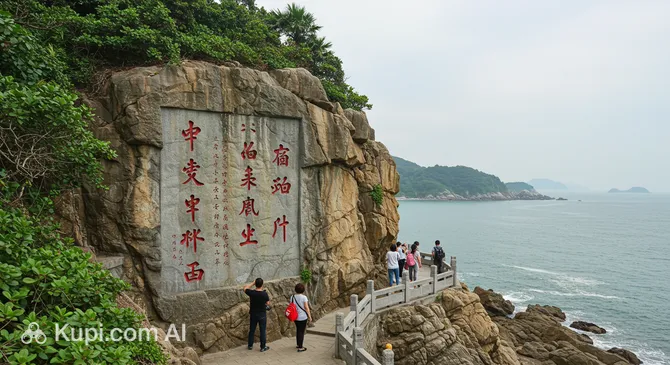
Wu Wang Zai Ju Inscription. Illustration.
Source: Kupi.com AI

Traveler photos:

Representing a skillful work of calligraphy, the Wu Wang Zai Ju Inscription is carved into natural stone, making it not only historical evidence but also a work of art. It is one of Xiamen's interesting cultural and historical landmarks, attracting attention with its authenticity and connection to the past.

The meaning of the inscription is rooted in the ancient Warring States period of Chinese history. It refers to a time when one of the states was located in an area called Ju and calls for remembering the lessons of the past. This makes the monument especially interesting for those delving into the study of Chinese history.

The Wu Wang Zai Ju Inscription will be of particular interest to travelers fond of Chinese history, traditional calligraphy, and cultural heritage. A visit to this place offers a chance to touch an important page of the past and appreciate the skill of ancient stone carvers.

Contacts

Since the Wu Wang Zai Ju Inscription is an open-air historical monument, it typically does not have specific contact details such as a phone number or email address. To find the exact location and get up-to-date information on access, it is recommended to contact tourist information centers in Xiamen or explore the city's official tourism portals.

How to contactContact
Address891
Phone number+886 8 231 3100
Websitekinmen.travel

What to Do

Visitors to the Wu Wang Zai Ju Inscription can, first and foremost, examine this example of traditional Chinese calligraphy carved in stone in detail. This is a great opportunity to take memorable photos of the historical monument. For those interested in the history and culture of China, this place is of particular interest as it allows them to touch an important layer of the country's historical heritage.

Viewing the Wu Wang Zai Ju Inscription is not just about contemplating ancient characters, but also an opportunity to feel a connection with the past. Many travelers also focus on exploring the surrounding area. Often, near such iconic sites, other historical or cultural monuments can be found that will complement the impressions of the visit.

A visit to the Wu Wang Zai Ju Inscription can be successfully combined with a more extensive tour of the city of Xiamen. Xiamen itself is known for its rich historical and cultural heritage, offering tourists many other attractions and interesting locations that will make your journey even more fulfilling and educational.

Getting There

To reach the Wu Wang Zai Ju Inscription, your journey begins with an arrival in the city of Xiamen, located in Fujian Province in southeastern China. Xiamen is conveniently connected to other regions: you can fly into Xiamen Gaoqi International Airport or arrive by train at one of the city's railway stations.

Once you are in Xiamen, getting to the Wu Wang Zai Ju Inscription itself from the city center is easy. Since the landmark is within the city limits, you can use local public transport. Xiamen's bus routes are quite extensive and can take you to the necessary area, from where the inscription is just a short distance away.

An alternative to the bus is, of course, a taxi. This is a more comfortable and generally faster way to get directly to the site, especially if you value your time or are traveling in a small group. A taxi ride from central Xiamen will allow you to reach this historical monument without transfers.

Nearest city: Xiamen

History & Facts

The Wu Wang Zai Ju Inscription, which translates to "Don't forget what happened in Ju!", carries a deep historical context rooted in the distant Warring States period (475-221 BC). During those turbulent times, the territory of modern China was fragmented into many competing states, and Ju was one of those principalities or a strategically important area. Thus, the phrase carved in stone is not just words, but a direct reminder of specific events of that era and the lessons that had to be learned from long-standing internal conflicts.

The initiator of this iconic inscription was Chiang Kai-shek, one of the key and highly influential figures in 20th-century Chinese history. For him, these words held special symbolic and mobilizing significance. By placing this inscription, he likely sought not only to memorialize significant historical events but also to pass on an important message to future generations about the need to remember the lessons of the past, the importance of resilience, and national unity. This transforms the monument from a simple historical artifact into a kind of cultural and historical legacy.

The Warring States period, to which the Wu Wang Zai Ju Inscription refers, was a time of not only bloody conflicts but also colossal political, military, and philosophical changes. It was during this era that the foundations of many teachings and strategies were laid, which ultimately led to the unification of China under the Qin dynasty in 221 BC. Thus, the inscription in Xiamen becomes a kind of bridge between antiquity and later historical milestones, reminding us of the cyclical nature of history and the importance of preserving historical memory for a deep understanding of the present.

Time Needed

To view the Wu Wang Zai Ju Inscription itself and soak in its historical significance, most visitors will need relatively little time — about 30 to 60 minutes. This will be enough to carefully examine the calligraphy, take photos, and look at the information boards, if any are nearby.

However, if you plan not just to see the inscription but to explore the surrounding area in more detail, perhaps take a walk around or visit other nearby attractions in Xiamen, you should allow more time for your visit. In this case, it is recommended to set aside 2–3 hours. This will allow you to enjoy the atmosphere of the place without rushing and perhaps discover something else interesting in this part of China.

Working Hours

Exact information on the opening hours of the Wu Wang Zai Ju Inscription is generally not established, as it is an open-air historical monument. Access to such sites is usually free and not limited to specific visiting hours, allowing you to view it at any convenient time during daylight hours. Most likely, the attraction is accessible year-round.

Advance ticket booking or registration to view the Wu Wang Zai Ju Inscription is usually not required. However, if you are planning your visit as part of an organized tour of Xiamen or want to get the most up-to-date access information, it is recommended to check details on the official tourism websites of Xiamen or at local tourist information centers just before your trip.

Open 24 hours

Nearby

Visiting the Wu Wang Zai Ju Inscription is a wonderful opportunity to touch history, but your acquaintance with Xiamen will be incomplete without exploring what lies nearby. Seeing the nearest attractions will not only broaden your horizons but also allow you to form a more complete picture of the cultural and natural wealth of this corner of China.

Exploring the surroundings will allow you to dive deeper into the atmosphere of the city of Xiamen and discover its multifaceted character. Every additional attraction will enrich your impressions and make your trip even more memorable. Below is a list of some interesting places located near the Wu Wang Zai Ju Inscription.

NameDistance
Taiwu Mountain Scenic Area1.4 km
Golden Lake Plaza2.7 km
Shamei Old Street3 km
Chen Jinglan Western-style Mansion3.9 km
Kinmen National Park6.8 km
Mashan Observation Post7.2 km
Yuanto Meat Jerky Kinmen Agricultural Concept Store8.7 km

Have you reached the end of the page?

So the route has been studied inside and out