Support

A-Ma Temple

About

The A-Ma Temple is an ancient and revered Chinese temple located in Macau. It is dedicated to the sea goddess Mazu, also known as A-Ma, who is considered the patroness of sailors and fishermen. This temple is one of Macau's most significant historical and religious landmarks, attracting both pilgrims and tourists interested in traditional Chinese culture and architecture.
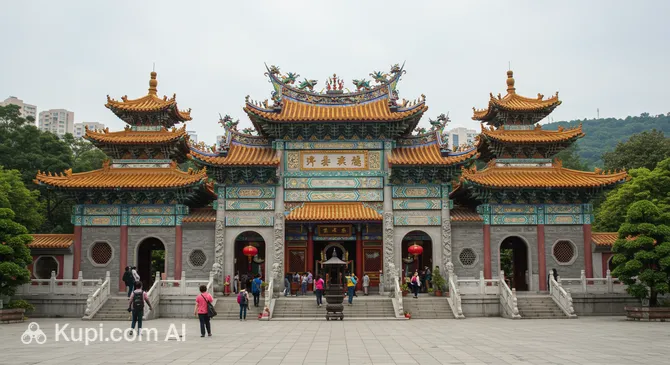
A-Ma Temple. Illustration.
Source: Kupi.com AI

Traveler photos:

The A-Ma Temple is an impressive complex consisting of several prayer halls, pavilions, and gates, harmoniously integrated into the landscape at the entrance to Macau's inner harbor. Each part of the complex is dedicated to various deities. Visitors can explore these structures, decorated with traditional carvings, intricate ornaments, and bright paintings, immersing themselves in an atmosphere of tranquility and spirituality.

Surprisingly, the A-Ma Temple existed even before the founding of the city of Macau itself. It is believed that the main part of the temple structures was built as early as the late 15th century. Moreover, it was this temple that gave the city its name: the Portuguese, hearing the name "A-Ma Gau" (meaning "Abode of the Goddess A-Ma") from locals, transformed it into "Macau." Despite its venerable age, the A-Ma Temple remains an active religious center today, where traditional rites and ceremonies are held, offering a unique opportunity to experience centuries-old traditions.

Getting There

Getting to the A-Ma Temple, located in the southwestern part of the Macau Peninsula, is quite simple. If you are already in Macau, an extensive public transport network is at your service. Numerous bus routes pass in close proximity to the temple, making it easily accessible from anywhere in the special administrative region. You can also always use taxi services, which will take you directly to the entrance of the temple complex.

For those planning to visit the temple from the city of Zhuhai in mainland China, the journey begins with a border crossing. You will need to pass through one of the border checkpoints connecting Zhuhai and Macau. After successfully passing through border control, you will be in Macau, where you can use local public transport or a taxi to reach the A-Ma Temple, following the signs or using navigation apps.

A taxi ride from central Macau to the temple usually doesn't take long, depending on traffic. If you prefer public transport, check the latest bus route numbers going toward the temple at information stands or ask locals. This is not only an economical but also an interesting way to see the city on your way to one of its main shrines.

Nearest city: Zhuhai

History & Facts

Temples dedicated to A-Ma, the patron goddess of seafarers and fishermen (also known as Mazu), hold an important place in the culture of coastal China. It is believed that one of the most famous such temples, closely linked to the history of the entire region, was built as early as 1148. Initially, such shrines were built so that fishermen could ask for the goddess's blessing and protection before heading out to sea, especially in times when large settlements did not yet exist in these lands. The veneration of A-Ma is deeply rooted in the traditions of local residents, and her temples have become an integral part of maritime heritage.

A striking testament to the historical significance of the A-Ma cult is the origin of the name Macau, a city located in close proximity to Zhuhai. Legend has it that when Portuguese seafarers first arrived at the shores where the ancient temple in honor of A-Ma stood, they asked the locals for the name of the place. The response was "A-Ma-Gau" (meaning "Bay of A-Ma"), and this name eventually transformed into "Macau." With permission from the Guangdong authorities, the Portuguese founded a city here, which soon turned into a vibrant trade hub.

Thanks to this set of circumstances and its strategic position, Macau, and with it the entire surrounding region, including Zhuhai, became a unique meeting point for Eastern and Western civilizations. This port played a key role in trade relations between China, Japan, India, and Europe. In this context, A-Ma temples serve not just as religious sites, but as silent witnesses to centuries of history and cultural exchange that influenced the development of the entire region.

Nearby

Visiting the A-Ma Temple is undoubtedly a highlight, but Zhuhai has much more to offer for the curious traveler. Exploring the surroundings of the temple will allow you to dive deeper into the city's atmosphere, discover hidden gems, and gain a more complete understanding of its culture and history.

Don't limit yourself to just one iconic site. Walking through nearby streets, visiting other attractions, or simply observing the daily life of locals can lead to unexpected discoveries and make your trip to China even more rewarding and memorable. Near the A-Ma Temple, you will find many interesting sites to complement your experience:

NameDistance
Macau Tower0.9 km
SKY 211 km
Senado Square (Zhuhai)1.2 km
St. Dominic's Church1.3 km
Ruins of St. Paul's1.6 km
Monte Fort1.7 km
Kun Iam Ecumenical Centre2.1 km

Have you reached the end of the page?

So the route has been studied inside and out