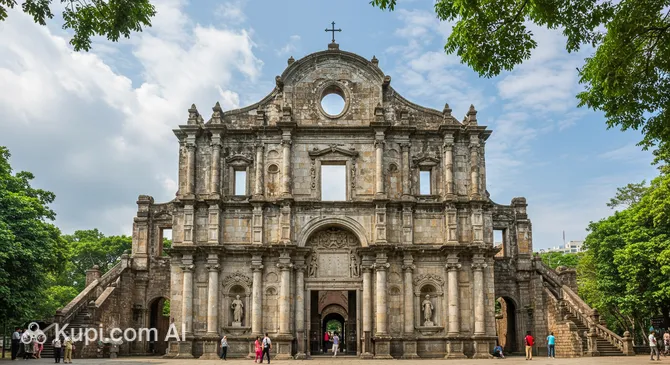
While traveling through the city of Zhuhai, be sure to set aside time for a trip to neighboring Macau to see its main symbol—the Ruins of St. Paul's. This majestic stone facade is all that remains of a 17th-century Catholic church that was once the largest in East Asia. Situated at the top of a hill, the ruins and the monumental staircase leading to them create an impressive sight and serve as a kind of "city altar," attracting tourists from all over the world.
Ruins of St. Paul's. Illustration.
Source: Kupi.com AI
Traveler photos:
The cathedral's facade is a unique monument where European and Asian cultural traditions intertwine. The project was designed by an Italian Jesuit, and exiled Japanese Christians participated in the construction. In the stone carvings, you can see not only Catholic saints and biblical scenes but also oriental motifs: Japanese chrysanthemums and even a Chinese dragon. This synthesis of cultures makes the ruins an outstanding example of Macau's rich history as a meeting point for East and West.
A visit to the Ruins of St. Paul's, a UNESCO World Heritage site, will be one of the highlights of your trip to this part of China. Getting from Zhuhai to Macau is quite simple and doesn't take much time, making this attraction an ideal option for a day trip. It is a wonderful opportunity to touch history and take unforgettable photos against the backdrop of one of Asia's most recognizable monuments.
Contacts
The Ruins of St. Paul's is an open historical monument, so it does not have traditional contact information like a phone number or email for tourists. The attraction is located in the heart of Macau's historic center and is easily accessible on foot from other iconic landmarks, such as Senado Square. You can reach the ruins from other parts of the city using bus routes 7, 7A, 8, 17, and 18.
The facade itself is available for viewing 24/7, while the Museum of Sacred Art and Crypt located behind it is open to visitors daily, usually from 9:00 AM to 6:00 PM, with free admission. It is best to check official Macau tourism websites for the most up-to-date opening hours and any potential changes before your visit.
A visit to the Ruins of St. Paul's begins with a climb up a wide stone staircase that leads directly to the majestic facade. This is the perfect spot to take striking photos with one of Macau's main symbols. As you get closer, it is worth taking a close look at the details of the intricate carvings and bas-reliefs, which blend Christian and Oriental motifs. Behind the facade lies the small Museum of Sacred Art and Crypt, where surviving artifacts, fresco fragments, and church relics telling the history of the site are on display. Occasionally, various cultural events and exhibitions are held in the plaza by the ruins.
Exploring the ruins is only part of the experience. A walk through the surrounding area will allow you to dive deeper into the unique atmosphere of Macau. You will find ancient streets with colonial architecture, perfect for leisurely strolls. In numerous shops and stalls, you can find local souvenirs, and in cozy cafes, you can try famous Portuguese and Cantonese dishes, such as almond cookies or egg tarts. Thus, a visit to the ruins turns into a full cultural and gastronomic adventure.
Getting There
The Ruins of St. Paul's are located in the heart of Macau's historic center, making them a very accessible attraction for travelers based in the neighboring city of Zhuhai. A trip from Zhuhai to Macau and back easily fits into a single day, allowing you to enjoy this unique monument without rushing.
The easiest and most popular way to reach the ruins is by crossing the border via the Gongbei Port land crossing, which connects Zhuhai and Macau. After passing through border control, you will find yourself in Macau, from where you can take a taxi or a city bus to the historic center. Many bus routes pass near the main attractions, including the Ruins of St. Paul's. You can also take advantage of free shuttle buses from major hotels and casinos that run from the border crossing throughout the city.
Once in the center of Macau, finding the ruins is quite easy. They are within walking distance of the famous Senado Square. Simply follow the numerous signs leading to the city's main symbol. The entire route is a pleasant stroll through colorful streets. Additionally, you can walk to the ruins directly from the Gongbei border crossing, which takes about 30-40 minutes.
Nearest city: Zhuhai
History & Facts
The history of the Ruins of St. Paul's dates back to the 17th century. The cathedral was built in 1638 by Italian Jesuits with the active assistance of Japanese Christians who had sought refuge in Macau. At the time, it was the largest Christian building in all of East Asia. The building was part of a large religious complex that also included St. Paul's College—the first Western-style university of its kind in the region, which trained missionaries for service across Asia.
The fate of the cathedral changed tragically in 1835 when a massive fire, starting in the college, almost completely destroyed the grand building. Only the monumental stone facade and the staircase leading up to it survived from the entire complex. After the fire, it was decided not to rebuild the church, and over time, its ruins became something more than just the remains of a building. They became a powerful symbol of resilience and the unique fusion of Eastern and Western cultures that defines the spirit of Macau.
Recognition of the monument's global significance came in 2005, when the Ruins of St. Paul's were included in the UNESCO World Heritage list as part of the Historic Centre of Macau. This status highlights their exceptional cultural value as a testament to the region's rich history. Today, the ruins serve not only as a main attraction but also as a reminder of the centuries-long dialogue between civilizations that took place on the soil of modern China.
Time Needed
For a standard tour of the Ruins of St. Paul's, a typical tourist will need about 1–1.5 hours. This is enough time to climb the famous staircase, take memorable photos against the majestic facade, carefully examine its unique bas-reliefs, and visit the small Museum of Sacred Art and Crypt located behind it. Admission to the museum is free, allowing you to learn about the history of this iconic place at no extra cost.
However, if you want to dive deeper into the atmosphere of Macau's historic center, it is worth setting aside more time. Viewing the ruins can easily be combined with a leisurely walk through the surrounding colorful streets, such as the famous Love Lane. Here you can browse souvenir shops, try local delicacies like the famous Portuguese egg tarts, and simply enjoy the unique charm of the area. In this case, your adventure may take from 2 to 3 hours or even longer, turning into a full-scale cultural and gastronomic excursion.
Working Hours
One of the main advantages of the Ruins of St. Paul's is their accessibility. Since the main part of the attraction is an open facade, it can be viewed 24/7 and completely free of charge. This is especially convenient for tourists planning a day trip from Zhuhai. However, to visit the Museum of Sacred Art and Crypt located behind the facade, you should follow their operating hours—typically, they are open to visitors daily from 9:00 AM to 6:00 PM. Entry to the museum is also free, and no prior booking is required.
The attraction is open year-round. Nevertheless, keep in mind that the museum's schedule may change depending on the season and public holidays. Occasionally, on Tuesdays, the museum may close earlier, after 2:00 PM. Therefore, it is highly recommended to check current information on official Macau tourism portals before your visit to avoid any inconvenience and plan your time effectively.
9:00 – 18:00
Nearby
Visiting the Ruins of St. Paul's is just the beginning of discovering Macau's unique historical heritage. The ruins themselves are the heart of a district that has been part of the UNESCO World Heritage list since 2005. To truly feel the atmosphere of this place, it is worth dedicating time to a leisurely walk through its surroundings. This will allow you to see how harmoniously European and Chinese cultures intertwine here, creating a unique character.
Just a few steps from the majestic cathedral facade, narrow cobblestone streets begin, leading to other iconic sites. Walking through them is an opportunity to discover ancient temples, colonial squares, cozy cafes with local delicacies, and many other interesting spots. Most attractions are within walking distance, making exploration of the area convenient and exciting.