Support

Danmarks Forsorgsmuseum

About

Danish Welfare Museum
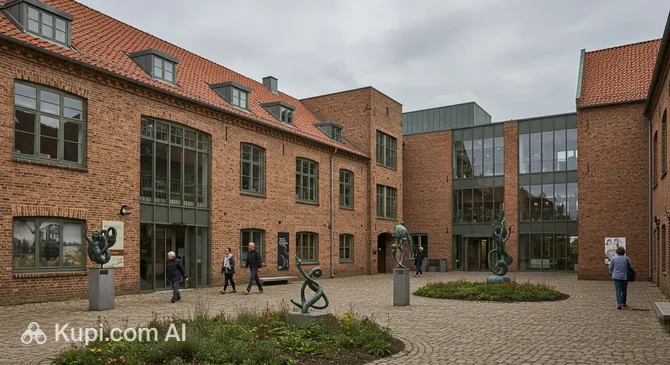
Danish Welfare Museum. Иллюстрация. Источник: Kupi.com AI

The Danish Welfare Museum (Danmarks Forsorgsmuseum) is a unique historical space located in the picturesque town of Svendborg. Occupying the building of a former poorhouse and workhouse built in 1872, it is the best-preserved complex of its kind in the entire Scandinavian region. Within its red-brick walls, the history of how Denmark has cared for its most vulnerable citizens over the centuries comes to life.

The museum's exhibition is exceptionally authentic. Visitors can see preserved bedrooms, dining halls, bathing facilities, and even the gardens where the residents worked. Unlike many other museums, the atmosphere of a strict institution has been maintained: courtyards enclosed by barbed wire serve as a reminder that social assistance in the past often came at the cost of personal freedom.

The significance of this site is highlighted by its role in understanding the modern Scandinavian social welfare model. In 2025, the museum was honored with the Havfrueprisen award for its outstanding contribution to the development of the tourism of the future. It is a place that prompts reflection on human dignity and the evolution of social protection—from harsh workhouses to the modern welfare state.

Contacts

For more information about special exhibitions or to book group tours, you can use the institution's official contact details.

How to contactContact
AddressGrubbemøllevej 13, 5700 Svendborg, Denmark
Phone+45 62 21 02 61
Websitewww.forsorgsmuseet.dk

What to Do

A visit to the museum is a deep immersion into the lives of people who found themselves in difficult situations during the 19th and 20th centuries. You can walk through the authentic corridors of the workhouse, look into common dormitories, the laundry room, and even isolation cells. The sound and light effects that accompany the exhibition make a particular impression, helping you literally hear the echoes of the past. Be sure to pay attention to the exhibition telling the story of seven children from a poor family—their fates allow you to see the social welfare system through the lens of personal tragedy.

For families with children aged 8 to 12, the museum has prepared a special interactive exhibition called "ANBRAGT". In an accessible and engaging way, using examples of famous characters like Pippi Longstocking, the exhibition tells the story of children living in foster families and orphanages. This helps young visitors understand important social topics without unnecessary heaviness, developing empathy and an interest in history.

Beyond the indoor spaces, it is worth strolling through the courtyards and visiting the vegetable garden, once tended by the residents. Today, it is maintained by volunteers, preserving its historical appearance. The museum often hosts temporary exhibitions dedicated to current social issues, making every visit unique. Visitors note that this place evokes a strong emotional response and provides plenty of food for thought.

Getting There

The museum is located at Grubbemøllevej 13 in the town of Svendborg. This is a port town on the island of Funen, famous for its accessibility and picturesque views. If you are traveling from Copenhagen, the train journey takes about 2 hours, offering pleasant views of the Danish countryside along the way.

From the central railway station, Svendborg Station, the museum is about a 15–20 minute walk. It is a pleasant stroll through city neighborhoods. If you prefer comfort or are traveling with luggage, a taxi ride from the station will take no more than 5 minutes. The town also has a developed bus network connecting the main attractions.

For those traveling by car, parking spaces are provided near the museum complex. The drive from Odense takes about 35–40 minutes via Highway 9. Svendborg is also conveniently connected by ferry to neighboring islands, making the museum an excellent stop as part of a larger tour of southern Denmark.

Ближайший город: Svendborg

History & Facts

The museum's history is inextricably linked to the Svendborg Kjøbstads Fattig- og Arbejdsanstalt building, erected in 1872. At the time, this complex was considered exemplary and progressive: it featured central heating, running water, and private hygiene facilities, which were a rarity for the homes of ordinary citizens. However, behind this external well-being lay the harsh reality of social discipline.

People who ended up here—the poor, orphans, or those in need of "re-education"—received shelter, food, and medical care, but in return, they were completely deprived of their civil rights. Residents could not vote, marry without permission, and were required to perform heavy physical labor. The complex was designed to fully control the lives of its wards, including high walls topped with barbed wire.

In the 20th century, the institution changed its name and status several times, becoming more focused on social support; however, the buildings gradually fell into disrepair. In 1974, the poorhouse in Svendborg closed its doors, becoming the last functioning institution of its type in the country. Immediately after its closure, Svendborg Museum took over the site, preserving the interiors in their original, somewhat somber state.

Today, the Danish Welfare Museum is not just an architectural monument but a powerful educational center. In 2024, the museum celebrated the 50th anniversary of its work in preserving the memory of those who lived on the "margins" of society, and in 2025, it was awarded the prestigious Havfrueprisen for its contribution to the development of meaningful tourism.

Time Needed

To thoughtfully explore the exhibition and feel the atmosphere of the place, most visitors need about 2 hours. This is enough time to see the main living and working areas, as well as view the multimedia materials.

If you plan to study the temporary exhibitions in detail or are traveling with children who will enjoy the interactive zone, it is worth allowing a bit more time—up to 2.5–3 hours. The museum invites slow contemplation, so visiting in a rush is not recommended.

Working Hours

The museum welcomes visitors according to a steady schedule, making it easy to plan a visit during the day. Please note that Monday is a closing day.

  • Tuesday: 10:00 – 16:00
  • Wednesday: 10:00 – 16:00
  • Thursday: 10:00 – 16:00
  • Friday: 10:00 – 16:00
  • Saturday: 10:00 – 16:00
  • Sunday: 10:00 – 16:00

It is recommended to arrive no later than one hour before closing to have time to see the main parts of the complex.

DayWorking hours
ПонедельникЗакрыто
Вторник10:00 – 16:00
Среда10:00 – 16:00
Четверг10:00 – 16:00
Пятница10:00 – 16:00
Суббота10:00 – 16:00
Воскресенье10:00 – 16:00

Nearby

Svendborg is a town with a rich maritime and cultural heritage, so after visiting the Welfare Museum, it is worth taking some time to explore its surroundings. A stroll through the historic center or the port area will offer a change of scenery and allow you to see the town from different perspectives.

NameDistance
Naturama0.3 km
King of Kebab0.4 km
Restaurant Resumé0.5 km
Kahytten Svendborg0.7 km
Kammerateriet0.9 km
Svendborg Sports Center1.8 km

Reached the end of the page?

That means the route is fully explored