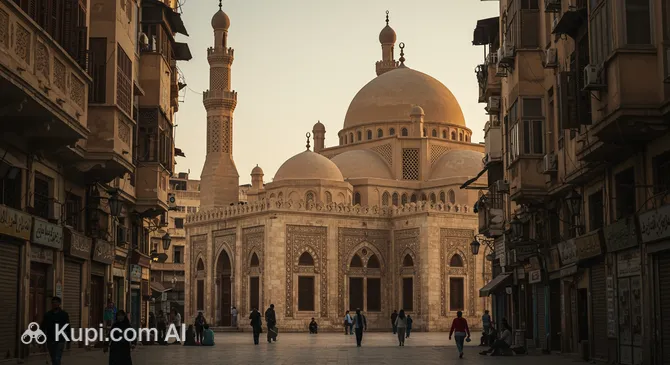
The El-Nabi Daniel Mosque in Alexandria holds centuries of history and is one of the city's iconic shrines. The current mosque building was erected in 1790, though it stands on the site of an earlier, smaller mosque. That, in turn, was built over the tomb of a Kurdish Islamic scholar who lived in Alexandria in the 15th century. Interestingly, the architectural roots of the complex go even deeper into history—researchers trace them back to the 13th century, to the era of Mongol control of Mosul in 1260 AD.
Like many ancient structures, the El-Nabi Daniel Mosque has undergone periods of renovation and reconstruction. Historical evidence indicates that after the 1775 construction of El-Maghribi, the mosque's condition became deplorable a century later. This required intervention, and the well-known city builder El-Kahakhni carried out a large-scale reconstruction. He not only overhauled the mosque but also demolished the dilapidated houses surrounding the complex, which helped preserve this important religious and historical site.
The mystery and historical depth of this place have attracted the attention of not only believers but also researchers. For instance, the famous archaeologist Heinrich Schliemann, known for his excavations of Troy, showed great interest in the mosque. In 1888, he even applied to the authorities for permission to conduct archaeological research on the mosque grounds, hoping to find traces of ancient civilizations or confirmation of local legends. However, his request was denied, and the secrets that may be held within the mosque's underground chambers remained unrevealed to him.
A special and perhaps most intriguing layer of lore associated with the El-Nabi Daniel Mosque is the persistent legend that the lost tomb of Alexander the Great might be located here. This theory has captivated the minds of researchers and enthusiasts for centuries. In 1990, Professor Abdel Aziz of Cairo Islamic University even claimed that his calculations indicated the sarcophagus containing the great commander's body is hidden beneath the ruins of this very mosque. The Egyptian Antiquities Service officially recognizes more than 140 documented attempts to find Alexander's tomb, and many of these searches have focused around or directly within the area of the El-Nabi Daniel Mosque, fueling the enduring interest in this sacred and mysterious site.