Support

National Museum of Egyptian Civilization

About

The National Museum of Egyptian Civilization (NMEC) is one of the most significant and modern cultural sites not only in Cairo but in all of Egypt. Located in the historic Fustat district, this vast complex offers visitors a unique opportunity to trace the country's entire centuries-old history in one place. Its collection includes about 50,000 exhibits covering the period from prehistoric times to the present day, which sets it apart from other museums focused primarily on the Pharaonic era.
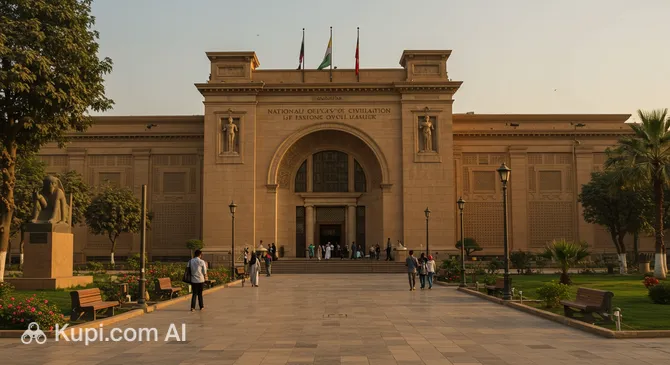
National Museum of Egyptian Civilization. Illustration.
Source: Kupi.com AI

Traveler photos:

The museum's exhibition is organized chronologically and thematically, allowing guests to gain a comprehensive understanding of the development of Egyptian civilization. Here you can see not only ancient artifacts but also items from the Greco-Roman, Coptic, Islamic, and modern periods of Egyptian history. This creates a sense of complete immersion in the country's rich cultural heritage, demonstrating its continuity and diversity.

One of the main jewels of the museum is the Royal Mummies Hall, where the remains of 22 kings and queens, including legendary rulers such as Ramesses II and Hatshepsut, rest in specially created conditions. The solemn "Pharaohs' Golden Parade" in 2021, during which the mummies were moved here, was a global event. A visit to this hall, designed to resemble the Valley of the Kings, leaves an unforgettable impression and allows you to touch the great past.

Contacts

If you are planning a visit or would like to clarify details, such as current opening hours, ticket prices, or the schedule of temporary exhibitions, it is recommended to contact the museum administration directly or visit its official website. All necessary information is available through the following contacts.

How to contactContact
AddressFustat, Ein as Seirah, Old Cairo, Cairo Governorate 4245001, Egypt
Websitewww.nmec.gov.eg

What to Do

A visit to the National Museum of Egyptian Civilization is a unique opportunity to take a fascinating journey through the different eras of the country's rich history. The main exhibition will guide you through unique artifacts reflecting all stages of Egypt's development: from prehistoric times, the Pharaonic era, and the Greco-Roman period to the Coptic, Islamic, and modern eras. Unlike other museums, here you can trace a continuous line of cultural and lifestyle development over millennia.

The main point of attraction for many visitors is the Royal Mummies Gallery. Here, in a specially created atmosphere reminiscent of ancient tombs, rest the mummies of Egypt's great rulers. This face-to-face encounter with legendary pharaohs and queens leaves a profound and unforgettable impression. In addition, guests can explore thematic sections dedicated to important aspects such as the role of the Nile, the development of writing, social structure, as well as the beliefs and philosophy of the ancient Egyptians.

The National Museum of Egyptian Civilization is not just a repository of antiquities but a living cultural center. Temporary exhibitions, informative lectures, and educational events are regularly organized here, making it interesting for both adults and young visitors. Tours and interactive programs will help you dive deeper into the context of the exhibits and better understand the greatness of one of the world's oldest civilizations.

Getting There

The National Museum of Egyptian Civilization is located in the historic Fustat district, in the southern part of Cairo. The easiest and most convenient way to reach it is by taxi or one of the popular ride-sharing apps. A trip from the city center, for example, from Tahrir Square, or from the Giza area usually doesn't take much time. The museum is a well-known attraction, so drivers find their way easily, and navigation maps show its location accurately.

For those who prefer public transport, the metro is a good option. The nearest stations—El-Malek El-Saleh and Mar Girgis—are on Line 1 (the blue line) of the Cairo Metro. A short taxi ride is required from either of these stations to the museum entrance. City buses also stop near the museum, but this method can be challenging for tourists unfamiliar with the local system: routes and stops are not always marked in English, making navigation difficult.

Many tour companies include a visit to the National Museum of Egyptian Civilization in their sightseeing tours. This is a great option for those who want to see several key sites in one day—for example, combining a museum visit with a trip to the Giza Pyramids or a walk through Old Cairo—without worrying about logistics. If you are traveling by rental car, there is convenient parking for visitors on the museum grounds.

Nearest city: Cairo

History & Facts

The history of the National Museum of Egyptian Civilization is a story of a modern dream come true. The idea for its creation arose in the early 21st century, and the foundation stone was laid in 2002. The project developed gradually: a partial opening for visitors took place in February 2017, culminating in the grand official opening of the entire complex on April 3, 2021. This event marked the emergence of a new iconic landmark on the world's cultural map.

The construction of this ambitious project took place with full support from UNESCO, which provided technical and advisory assistance at all stages. No less important was the choice of location—the ancient district of Fustat. This is not just a point on the map of Cairo, but the site where one of the first capitals of Egypt was once located. This location gives the museum special historical depth, symbolically linking it to the country's centuries-old heritage.

One of the most striking facts in the museum's history is undoubtedly the "Pharaohs' Golden Parade," timed to coincide with its official opening. In April 2021, the world watched a solemn procession during which 22 mummies of kings and queens were moved from the old Egyptian Museum to their new home. This grand event not only became the museum's hallmark but also emphasized its main mission: to be a modern and worthy guardian of a great history for future generations.

Time Needed

When planning a visit to the National Museum of Egyptian Civilization, you should expect that a full tour will take 2 to 4 hours. This time is usually sufficient to leisurely explore the main exhibition, which covers the entire history of Egypt from prehistoric times to the present day, and give proper attention to the most iconic exhibits.

If your time is limited, you can focus on the key halls, which will take about an hour and a half to two hours. However, to get the most out of your visit, especially if you plan to see the famous Royal Mummies Gallery, it is worth setting aside more time. Visiting this unique part of the museum, as well as participating in guided programs that offer a deeper dive into the history of the artifacts, brings the total duration of the visit to the 3-4 hour range.

Working Hours

The National Museum of Egyptian Civilization is generally open to visitors daily. Standard opening hours are 9:00 AM to 5:00 PM, with ticket counters typically closing at 4:00 PM. Please note that on public holidays, during Ramadan, or for special occasions, the schedule may change. Therefore, it is strongly recommended to check the current information on the museum's official website before your trip.

To avoid queues, especially during the peak tourist season, tickets can be purchased online in advance. The museum is open year-round, making it accessible for visiting at any time of year, whether you are planning a trip to Cairo in summer or winter. On some days, such as Fridays, additional evening hours may be available.

9:00 – 17:00

Nearby

Visiting the National Museum of Egyptian Civilization is a highlight in itself, but exploring its surroundings can make your journey through Cairo even more rewarding. The Fustat district, where the museum is located, is one of the oldest in the city and holds many other historical and cultural treasures. A walk nearby will allow you to dive deeper into the atmosphere of Egypt's capital and see how modernity intertwines with centuries-old heritage.

In the immediate vicinity of the museum are other iconic sites that certainly deserve attention. From ancient mosques and citadels to picturesque parks and palaces, you can easily create an interesting full-day itinerary, complementing your visit to the NMEC with new impressions.

NameDistance
Ibn Tulun Mosque2.2 km
Cairo Citadel2.5 km
Manial Palace2.8 km
Nile Plaza Hotel3.6 km
Abdeen Palace Museum3.8 km
Museum of Islamic Art4 km
Al-Azhar Mosque4.4 km

Have you reached the end of the page?

So the route has been studied inside and out