Support

Saqqara Necropolis

About

The Saqqara Necropolis is an extensive ancient burial site located approximately 25-30 kilometers south of Cairo, the capital of Egypt. This iconic location owes its name to the ancient Egyptian god of the dead, Sokar, the patron of necropolises. For centuries, Saqqara served as the primary resting place for pharaohs, their families, and nobility, particularly during the Old Kingdom era, leaving behind a priceless legacy for researchers and travelers.
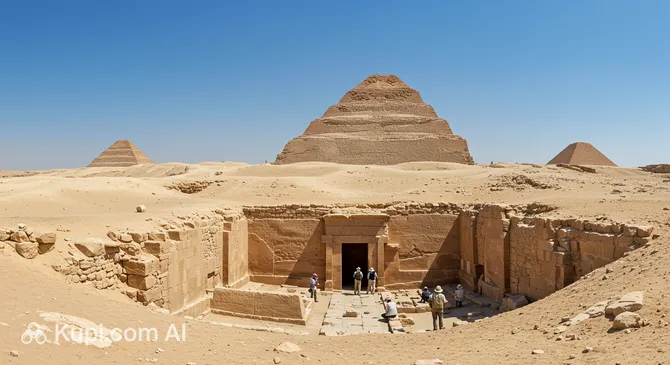
Saqqara Necropolis. Illustration.
Source: Kupi.com AI

Traveler photos:

This impressive archaeological complex covers a significant area: the Memphis necropolis, of which Saqqara is a part, stretches approximately 7 kilometers from north to south, with its width ranging from 500 to 1,500 meters. Visitors can spend hours exploring this historical site, immersing themselves in the atmosphere of antiquity and discovering the secrets of vanished civilizations.

The crown jewel of Saqqara is undoubtedly the famous Step Pyramid of Pharaoh Djoser. This monumental structure is considered the oldest stone pyramid ever built in Egypt and represents a revolutionary step in the development of funerary architecture. In addition to the Djoser pyramid, there are ten other smaller royal pyramids on the necropolis grounds, as well as numerous mastabas—tombs of high officials with a characteristic rectangular base, decorated with reliefs and paintings depicting the life and beliefs of the ancient Egyptians.

Visiting the Saqqara Necropolis is a unique opportunity to touch the origins of Egyptian civilization, witness the evolution of pyramid construction firsthand, and feel the grandeur of one of antiquity's most mysterious cultures. This is a must-visit place for everyone interested in history and archaeology.

Contacts

For the most up-to-date information on opening hours, ticket prices, and how to get to the Saqqara Necropolis, it is recommended to check the official tourism portals of Egypt or inquire at tourist information centers in Cairo. As it is an extensive archaeological site, direct telephone contacts for visitors may be unavailable or less common than for standard museums. Usually, visitors reach the necropolis from Cairo by taxi or as part of an organized tour, which is the most convenient way to visit this historical site located some distance from the city.

How to contactContact
AddressBadrshein, Giza Governorate 3352001, Egypt
Websiteegymonuments.gov.eg

What to Do

A visit to the Saqqara Necropolis offers a unique opportunity to immerse yourself in the world of ancient Egyptian funerary traditions. The central attraction that draws every visitor's attention is the Step Pyramid of Djoser. This grand structure with its rectangular base is not only the oldest surviving Egyptian pyramid but also the key point of the entire necropolis. You can walk around it, examine the unique architecture, and imagine how it towered over the desert millennia ago. In addition to the Djoser pyramid, other royal pyramids are located within the necropolis, including the tombs of Pharaohs Teti, Pepi I, and Pepi II, which are also open for viewing and study.

Of particular interest to researchers and curious tourists is the Serapeum—a mysterious underground structure dedicated to the cult of the sacred Apis bull, associated with the god Serapis. Visitors can walk through the corridors of this unique complex where enormous sarcophagi once stood. Interestingly, statues of great Greek philosophers were installed on the road to the Serapeum during the Hellenistic period, adding another cultural layer to the site.

Besides the royal pyramids and the Serapeum, an integral part of a tour of Saqqara is exploring the numerous mastabas—tombs of noble Egyptians. These structures consist of an above-ground memorial temple and an underground burial chamber connected to the surface by a vertical shaft, sometimes over ten meters deep. Inside the mastabas, you can see well-preserved reliefs and paintings depicting scenes from daily life, religious rituals, and offerings to the gods. Some of these tombs have quite extensive and branched catacombs, reflecting the ancient Egyptians' desire for the most secure and deep burial possible.

Getting There

Saqqara Necropolis is located approximately 25-30 kilometers south of Cairo, making it relatively accessible for a day trip from the capital of Egypt. There are several ways to reach this unique archaeological complex, and the choice depends on your preferences for comfort, time, and budget.

The most convenient and popular option for many tourists is booking an organized tour from Cairo. Such tours often include transfers directly from your hotel, guide services, and visits to other iconic sites in the area, such as the Giza pyramids and the ancient city of Memphis. This saves time on logistics planning and provides maximum information during the visit.

If you prefer a more independent journey, you can use taxi services. The trip from downtown Cairo to the Saqqara Necropolis takes about 45-60 minutes, depending on traffic. It is recommended to agree on the fare with the driver in advance or use taxi booking apps with fixed rates. This method offers more flexibility in planning your sightseeing time.

For the most budget-conscious and adventurous travelers, there is an option using public transport. First, you need to take the metro to one of the southern outskirts of Cairo, and then transfer to a local microbus (marshrutka) heading towards Saqqara. Keep in mind that this method takes more time, may be less comfortable, and requires certain navigation and local communication skills, as information in English may be limited.

Nearest city: Cairo

History & Facts

The history of the Saqqara Necropolis dates back to antiquity, beginning during the 1st Dynasty of Ancient Egypt. It was then that the first mastabas—precursors to the pyramids—appeared on this land. However, the necropolis gained true fame and lasting significance during the 3rd Dynasty. Around 2667-2448 BC, Pharaoh Djoser built his famous step pyramid here, which not only predated the Great Pyramids of Giza by several centuries but also became the first monumental stone structure of its kind in history, launching a whole era in ancient Egyptian architecture.

Throughout the Old Kingdom, the Saqqara Necropolis served as the primary royal burial ground. Pharaohs of the 6th Dynasty were buried here with particular frequency. Interestingly, even after the reign of Pepi II, when pharaohs ceased to be buried in Saqqara, the necropolis did not lose its importance. Burials of less noble but still important figures continued throughout all subsequent periods, right up to the Roman era. This testifies to the profound sacred status that Saqqara maintained for millennia.

Remarkably, even the changing of capitals and great conquests could not shake the sacred authority of the Saqqara Necropolis. When the capital of Egypt moved to Thebes in the New Kingdom, and even after the country was conquered by Alexander the Great and later by Gaius Julius Caesar, Saqqara continued to be revered. Furthermore, with the advent of Christianity and the gradual decline of the ancient Egyptian religion, this site was not forgotten. Copts, Egyptian Christians, built the Monastery of Saint Jeremiah here, and the ancient necropolis temporarily became a Christian cemetery, demonstrating a unique continuity of cultures and beliefs on this land.

Time Needed

When planning a visit to the Saqqara Necropolis, it is worth allocating at least half a day, and ideally around 4-5 hours. This is an extensive archaeological complex, and it takes time to truly appreciate its scale and significance. A rushed tour will not allow you to fully enjoy the atmosphere of this ancient site.

The territory of the necropolis is indeed vast—it stretches for several kilometers. It contains many unique objects, each of which deserves attention. Naturally, the centerpiece is the famous Step Pyramid of Djoser, but in addition to it, other pyramids, numerous mastabas (tombs of the nobility) with interesting reliefs and paintings, and the mysterious Serapeum await you. Moving between these sites will also take some time.

If you want to not just see the ancient structures but also gain a deeper understanding of their history and meaning, consider visiting the Saqqara Necropolis with a guide. A professional storyteller will help you navigate the area, point out the most interesting details, and share fascinating facts, which will make your tour even more enriching. In this case, the duration of your visit may increase slightly, but it will be justified by the knowledge and impressions gained.

Working Hours

The Saqqara Necropolis is typically open to visitors daily, but opening hours may vary by season. Generally, the complex is open from the morning, starting around 8:00 or 9:00 AM, and closes in the afternoon, around 4:00 or 5:00 PM. During the winter months and the month of Ramadan, hours may be shorter. Since this is a popular tourist site, it is recommended to purchase tickets on-site upon arrival. However, to avoid queues, especially during peak tourist season, or if you plan to visit specific, separately charged tombs, it may be helpful to check the possibility of pre-booking through travel agencies or when booking a tour.

The attraction is open year-round, but for the most accurate and up-to-date information regarding opening hours, ticket prices, and potential restrictions on visiting certain parts of the complex, it is highly recommended to check the official tourism portals of Egypt or consult local tourist information centers in Cairo just before your trip. This will help you plan your visit in the best possible way and avoid unforeseen situations.

Open 24 hours

Nearby

A visit to the Saqqara Necropolis is undoubtedly an immersion into the depths of ancient Egyptian history. However, to make your journey through Cairo and its surroundings even more rewarding and memorable, it is worth paying attention to other attractions located nearby. Exploring nearby historical and cultural sites will provide a more complete picture of Egypt's rich heritage.

By expanding your itinerary, you can see other facets of this amazing country, compare architectural styles of different eras, and simply gain more vivid impressions. There are several interesting places around the Saqqara Necropolis that will complement your understanding of the grandeur of Ancient Egypt and modern life in Cairo. Here are some of them:

NameDistance
Frank & Co11.2 km
Great Sphinx of Giza14.1 km
Giza Necropolis14.6 km
Great Pyramid of Giza14.6 km
National Museum of Egyptian Civilization15.8 km
Manial Palace17.8 km
Wadi Degla Protectorate17.8 km

Have you reached the end of the page?

So the route has been studied inside and out