Support

Ibn Tulun Mosque

About

The Ibn Tulun Mosque is one of the oldest and most majestic mosques in Cairo, the capital of Egypt. It is rightfully considered a jewel of Islamic architecture and is perhaps the oldest mosque in Fustat (Old Cairo) to have preserved its original appearance since the mid-9th century. Situated on a small hill called Jebel Yashkur, which translates to the "Hill of Thanksgiving," it draws the eye with its monumental presence and is an iconic historical site.
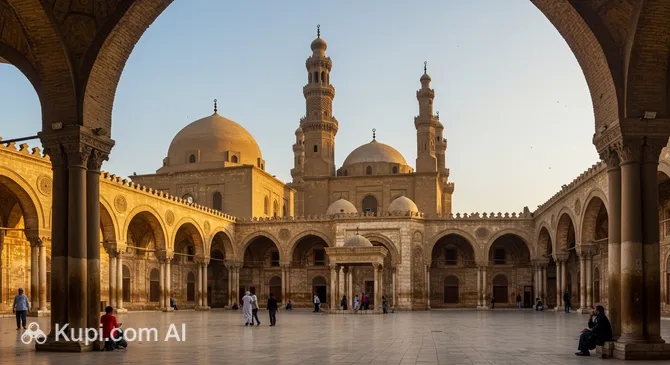
Ibn Tulun Mosque. Illustration.
Source: Kupi.com AI

Traveler photos:

The architectural ensemble of the Ibn Tulun Mosque covers an impressive area of about 2.5 hectares and outwardly resembles an impregnable fortress. One of its unique features is the outer enclosure wall (ziyada), which symbolically separates the sacred space of the mosque from the bustle of the city. This detail emphasizes the creators' desire for seclusion and spiritual focus within the complex.

The Ibn Tulun Mosque is famous not only for its scale but also for architectural solutions that were innovative for their time. Many researchers believe that it was here that the pointed arch was used for the first time in Islamic architecture, predating the appearance of a similar element in European Gothic by almost two centuries. This fact makes the mosque more than just a religious building; it is an important monument in the history of world architecture and a must-visit for anyone interested in culture and history.

Contacts

Since the Ibn Tulun Mosque is a prominent historical monument, direct contact details such as a phone number or email address are typically not published. For the most up-to-date information on opening hours, potential tours, and visiting rules, we recommend checking the official travel resources of Cairo or inquiring locally.

The mosque is located in the old part of Cairo, on Jebel Yashkur Hill. It can be reached by taxi—simply give the driver the mosque's name—or by using public transport heading to this district.

How to contactContact
AddressAhmed Ibn Tolon Sq., Tolon, El Sayeda Zeinab, Cairo Governorate 4261342, Egypt
Websiteegymonuments.gov.eg

What to Do

Visitors to the Ibn Tulun Mosque are immersed in the atmosphere of the 9th century as they explore its unique Islamic architecture. Special attention is drawn to the famous minaret with its external spiral staircase, reminiscent in style of the minaret of the Great Mosque of Samarra—a wonderful opportunity to take memorable photos and appreciate the scale of the structure. Art and architecture enthusiasts will find it interesting to examine the archivolts of the large and small arches, as well as the column capitals decorated with elegant, stylized floral patterns, which are classic examples of Islamic decorative art.

Walking through the spacious courtyard of the mosque allows you to feel its grandeur and tranquility. You can imagine how believers have gathered here for centuries. The inner galleries with numerous arches create an impressive interplay of light and shadow, inviting quiet contemplation. This is a place where history literally comes to life before your eyes, offering a chance to touch the ancient culture of Egypt.

Directly adjacent to the mosque is another interesting site—the Gayer-Anderson Museum. It is housed in two historical homes that once adjoined the outer wall of the mosque and even had direct access inside through special doorways. Today, most of these passages are sealed, but two of them lead to the museum, offering visitors a unique glimpse into the lives of wealthy Cairo residents of past eras. A visit to this museum is a wonderful addition to your tour of the mosque itself, expanding your understanding of life in this historic district.

Getting There

Reaching the Ibn Tulun Mosque, located in the historic heart of Cairo, is relatively straightforward, though it may require some planning, especially if it's your first time in the city. The mosque is situated in the Old Cairo district, known for its distinctive narrow streets and lively atmosphere. Several convenient ways are available for tourists to reach this iconic landmark of Egypt.

The most comfortable and often fastest option for many travelers is taking a taxi or using a ride-sharing app (such as Uber or Careem, which are widely available in Cairo). A ride from central areas like Tahrir Square or other tourist zones usually doesn't take long, but traffic jams should always be considered. It is recommended to have the mosque's name (Ibn Tulun Mosque or مسجد أحمد بن طولون), perhaps even written in Arabic, to simplify communication with the driver. If you use a regular taxi, it's best to agree on the fare in advance.

For those who prefer more economical options, consider public transport. Cairo has a metro system, and although there is no direct exit at the mosque, the nearest station is Sayyida Zeinab (Line 1). From there, you will need to walk to the Ibn Tulun Mosque (about 15–20 minutes) or take a short taxi ride. Bus routes also pass through Old Cairo, but navigating them without knowing the local language can be difficult. Regardless, if choosing public transport, it's wise to study the map and route beforehand.

Nearest city: Cairo

History & Facts

The history of the Ibn Tulun Mosque is inextricably linked with the name of Ahmad ibn Tulun, the ambitious Abbasid governor of Egypt who effectively ruled the country independently from 868 to 884. It was by his order that the construction of this grand structure began. According to historical records, particularly the writings of the historian al-Maqrizi, construction of the mosque started in 876 AD. A surviving plaque within the mosque itself indicates the exact completion date—the year 265 of the Hijri calendar, which corresponds to 879 AD in the Gregorian calendar.

The site chosen for the mosque, Jabal Yashkur (which translates to the "Hill of Thanksgiving"), is shrouded in an interesting legend. Local traditions say that this is where Noah's Ark found its resting place after the Great Flood, rather than on the well-known Mount Ararat. This myth gives the site a special aura, linking it to ancient biblical stories and adding another layer to the mosque's rich cultural heritage.

One of the mosque's most recognizable features is its unique minaret with a spiral external staircase. A beautiful legend is associated with its creation: it is said that Ibn Tulun, absently winding a piece of parchment around his finger during a meeting with ministers and being asked about his inattention, proudly replied that he was designing the most unusual minaret in the world. This story highlights the creative and perhaps somewhat eccentric nature of the ruler.

However, despite the picturesque legend of Ibn Tulun designing the minaret himself, many historians hold a different view. Researchers note that the mosque and its famous minaret were likely built at different times. There is a scholarly opinion that the minaret acquired its current form much later, during a major reconstruction of the mosque in the 13th century, initiated by Sultan Lajin. This does not diminish its architectural value but adds intrigue to the story of its creation.

Time Needed

A typical visitor should set aside approximately 1–2 hours to see the Ibn Tulun Mosque in Cairo. This time is usually enough to leisurely walk through the vast courtyard, appreciate the grandeur of the arcades, examine the details of the unique architecture, and, of course, climb the famous minaret with its external spiral staircase. The climb itself can take about 15–20 minutes, including time to enjoy the panoramic views.

If you plan a deeper dive into the history and architectural features, enjoy photography, or simply want to soak in the atmosphere of this ancient place without rushing, your visit may last longer. For instance, a detailed study of the ornaments, calligraphy, and construction details will take more time. It's also worth noting that the Gayer-Anderson Museum is located right next to the mosque and is connected to it. If you decide to visit it as well, the total time spent at this complex will naturally increase, potentially up to 3–4 hours.

Overall, for most tourists, one and a half to two hours is the optimal time to get a complete impression of the Ibn Tulun Mosque and take memorable photos without feeling rushed. Plan your visit so you have enough time to absorb the spirit of this historical monument in Egypt.

Working Hours

The Ibn Tulun Mosque is typically open to visitors daily. Generally, visiting hours for tourists are from morning until evening, but they may change, especially during religious holidays or special events. It is best to check the exact opening hours on the day before your visit via official Cairo tourism portals or directly on-site, as information may be updated.

Pre-booking tickets or making a reservation to visit the Ibn Tulun Mosque is usually not required. Entry for tourists typically involves a fee; the exact ticket price, as well as current opening hours, should be confirmed on the official tourism portals of Cairo or on-site. The attraction is open year-round, but for the most comfortable visit, it is also recommended to check for up-to-date information, especially if your trip coincides with major religious holidays.

9:00 – 16:00

Nearby

Visiting the Ibn Tulun Mosque is undoubtedly a highlight, but exploring its surroundings can significantly enrich your experience of Cairo. The Old City, where the mosque is located, holds many other treasures, and a short walk or a quick ride will reveal new facets of the history and culture of Egypt's capital.

Exploring nearby attractions allows you to dive deeper into the atmosphere of this ancient metropolis, seeing the contrasts and connections between different eras and architectural styles. It is an excellent opportunity to form a more complete and multifaceted impression of Cairo. Below is a list of some interesting places located near the Ibn Tulun Mosque, along with approximate distances.

NameDistance
Cairo Citadel1 km
Abdeen Palace Museum1.6 km
Museum of Islamic Art1.8 km
Manial Palace1.9 km
Nile Plaza Hotel2.1 km
National Museum of Egyptian Civilization2.2 km
Al-Azhar Mosque2.3 km

Have you reached the end of the page?

So the route has been studied inside and out