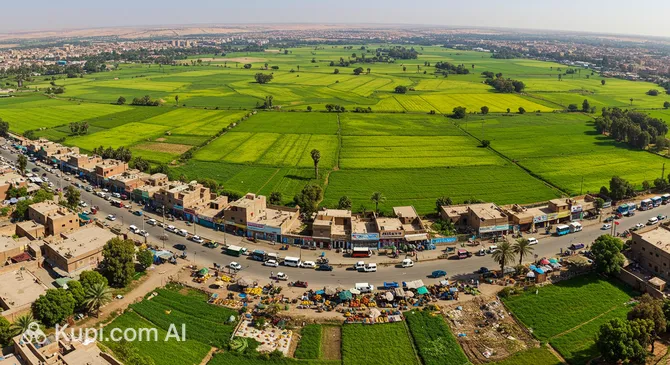
Kafr el-Dawwar is a major industrial hub in Egypt, located in the Beheira Governorate. Situated on the eastern outskirts of Alexandria, the city is an important industrial center that grew around textile production. Although it is not a typical tourist resort, it possesses a unique atmosphere of a working-class town with monumental factory complexes.
Geographically, the city is well-positioned in the Nile Delta, which historically fostered its development. Today, it is home to over 260,000 people, and the pulse of city life is set by the textile industry. Exploring the history of this region reveals how closely it is intertwined with the country's industrialization and social movements in Egypt.
Kafr El Dawwar. Illustration.
Source: Kupi.com AI
The city's main features are its majestic industrial buildings, such as the Misr Fine Spinning and Weaving company, founded back in 1938. Visiting this place allows you to see Egypt from a different, less glossy, but very authentic side, where labor traditions meet the modern rhythm of life.
Kafr el-Dawwar invites those interested in industrial heritage who want to see the real, living Egypt far from the standard tourist routes.
Weather Overview
The weather in Kafr el-Dawwar is shaped by its location in the Nile Delta, giving the city a mild Mediterranean climate. Winters here are damp and cool, while summers are hot and dry. The average temperature in January is about +15°C, while in August, the thermometer often rises above +31°C.
An important feature is the industry's impact on the atmosphere: a high concentration of factories can exacerbate the feeling of heat and humidity in the summer. For more precise data, check the detailed weather in Kafr el-Dawwar by month.
Precipitation is most likely between December and February; for the rest of the year, rain is very rare. The best time to visit the city is spring and autumn, when the temperature is most comfortable for walking and exploring industrial architecture.
Average monthly temperature
Average monthly precipitation
Interesting Facts
In 1820, the Mahmoudiyah Canal was built through the territory of the future city, connecting Alexandria to the Nile, which served as a powerful stimulus for the development of the entire district.
In 1882, the famous Battle of Kafr el-Dawwar took place here: Egyptian troops led by Ahmed Urabi Pasha held off the British army's advance on Cairo for five weeks.
Founded in 1938, the textile company Misr Spinning, Weaving & Beida Dyers turned the city into one of the largest industrial centers not only in Egypt but in the entire region.
In the mid-20th century, due to the massive concentration of the proletariat, the city became one of the key centers of the labor and communist movement in the country.
Following the July Revolution of 1952, large-scale labor strikes broke out in the city, becoming an important milestone in modern Egyptian political history.
How to Get There
The transport accessibility of Kafr el-Dawwar is due to its proximity to the country's most important logistics hubs. The city is located on the route between Cairo and Alexandria, making it easily reachable by both car and public transport. Detailed information on routes can be found in the section on how to get to the city.
The city does not have its own airport, so travelers usually use the air hubs in neighboring Alexandria. From there, you can reach Kafr el-Dawwar by taxi or bus in just 45–60 minutes, considering possible traffic in the Nile Delta.
The railway is one of the most convenient ways to travel. The Kafr el-Dawwar railway station receives trains coming from Alexandria and the capital. Minibuses (microbuses) that run between the cities of the region are also a popular and budget-friendly way to get around, although they are often overcrowded.
Station
Passenger traffic
Distance
Alexandria railway station
8
23 km
El-Marg
4
159 km
El-Marg
4
159 km
Port Said railway station
5
207 km
Main Attractions
Since Kafr el-Dawwar is primarily an industrial center, it does not offer a classic set of attractions like ancient temples or luxury museums. The main point of interest for travelers is the monumental complexes of textile enterprises. The Misr Fine Spinning and Weaving factory is a true monument to mid-20th-century industrial architecture.
For researchers and historians, the city is attractive as a site of key events in the history of the labor movement. The central squares and bustling local bazaars allow you to immerse yourself in the daily life of Egyptians and feel the rhythm of a city that never stops for tourists but lives at its own natural pace.
Those seeking world-class historical monuments should keep in mind the proximity of Alexandria. Just 20–30 kilometers from the city are famous museums, the Citadel of Qaitbay, and beautiful Mediterranean beaches, making Kafr el-Dawwar a convenient point for a brief introduction to the industrial heart of the region.
Local Cuisine
The gastronomy of Kafr el-Dawwar is a mirror of the traditional cuisine of the Nile Delta. You won't find refined Michelin-starred restaurants here, but you can taste real Egyptian food. The basis of the diet consists of hearty and simple dishes such as ful medames (mashed fava beans) and falafel, which are prepared here with great care.
Thanks to the relative proximity to the coast, fresh fish and seafood can often be found in local markets and small shops. Be sure to try the traditional Egyptian bread aish, served hot straight from the oven. The food culture here is centered around small street cafes and home-style diners where local factory workers eat lunch.
The main drink in the city is strong black tea, often served with mint, as well as aromatic Oriental coffee. If you want to enjoy a more diverse menu and high-level service, it is worth heading for dinner to the restaurants of Alexandria, which offer Mediterranean cuisine.
Travel Tips
A trip to Kafr el-Dawwar requires some preparation, as the city is not a popular tourist destination. These tips will help make your visit more comfortable and safe.
Clothing: Choose modest and closed clothing made of natural fabrics to feel comfortable in the industrial city and respect local traditions. Be sure to bring comfortable closed-toe shoes for walking on dusty streets.
Transport: The best way to get around is by taxi via apps or a rented car. Avoid local minibuses during peak hours when workers are commuting to or from shifts.
Finances: Always carry cash in Egyptian pounds in small denominations. ATMs can be rare in the city, and cards are only accepted in very large organizations.
Health and Safety: Avoid walking alone after dark, especially in industrial areas and on the outskirts. Drink only bottled water.
Communication: English is not widely spoken here. Learn a few basic phrases in Arabic or install an offline translator. It is better to buy a SIM card in advance at the airport or in Alexandria.
Local Etiquette: Egyptians are friendly but value politeness. Always say hello before asking a question, and do not forget about manners in communication.
What to Avoid: Do not take photos of industrial facilities or government buildings without permission — this can cause problems with security or the police.
Extra Tip: Plan your visit so that you return to Alexandria before dark to avoid traffic jams and transport difficulties.
Following these simple rules will allow you to safely experience the real life of an Egyptian industrial center and gain a unique experience.
Entertainment & Nightlife
Entertainment in Kafr el-Dawwar is predominantly local and oriented toward the daily needs of its residents. The city has virtually no nightlife in the Western sense: there are no noisy clubs, bars, or discos. Evening activity is concentrated in traditional Egyptian cafes, where men gather to drink tea, smoke shisha, and discuss the news to the sound of the television.
Daytime leisure for residents and visitors often involves walking through the busy streets and visiting local markets. The atmosphere here is imbued with industrial energy, and most establishments close quite early. For those looking for modern entertainment centers, cinemas, or fine dining, the best solution is a trip to neighboring Alexandria.
In Alexandria itself, nightlife buzzes along the Mediterranean coast, offering tourists a wide range of venues for every taste. Kafr el-Dawwar remains a place for quiet observation of the real, unadorned life of an Egyptian working-class city.
Parks & Museums
Green spaces in Kafr el-Dawwar are limited, as the urban environment is dedicated to industrial needs. Small squares and parks serve as resting spots for residents, but they are not full-fledged recreational facilities for tourists. Due to active factory operations, air quality can be specific, making long outdoor walks not always comfortable.
Museum activity is not developed in the city itself, and you will not find classic galleries here. Nevertheless, the industrial complexes themselves from the early and mid-20th century can be viewed as an open-air museum telling the story of the country's industrial rise.
For cultural enlightenment and classic museum exhibits, it is best to head to neighboring Alexandria. There, you will find the magnificent National Museum and archaeological monuments preserving the heritage of the Greco-Roman era and Islamic culture.
Getting Around
The public transport system in Kafr el-Dawwar is oriented toward the needs of the local population and workers. The main means of transport are minibuses (microbuses). They do not have a strict schedule, and routes are often determined by current demand. During peak hours, these vehicles can be very overcrowded, which should be considered when planning trips.
Taxis are common in the city, but tourists are advised to agree on the fare in advance, as meters are rarely used. If you have internet access, it is better to call a car via the Uber or Careem apps — this will ensure a fixed price and a higher level of comfort.
Railway services connect Kafr el-Dawwar with major cities in the country, which is convenient for long-distance travel. For moving within the city, be prepared for chaotic traffic and a lack of developed pedestrian infrastructure, so renting a car with a driver may be the safest option.
Accommodation
Finding accommodation directly in Kafr el-Dawwar can be a challenge for a tourist, as specialized hotel infrastructure is practically non-existent here. The city is industry-oriented, and most housing options are flats and apartments intended for long-term rent by local workers or specialists.
If you are planning a visit, it is recommended to consider staying in Alexandria, which offers a wide range of hotels — from budget hostels to luxury five-star hotels on the seafront. From Alexandria, Kafr el-Dawwar can be easily reached as a day trip.
For those who must stay exactly in the city, it is worth looking for private apartments through popular booking services or negotiating with local landlords. Keep in mind that conditions in such options can be quite modest, so it is better to plan an overnight stay in more tourist-friendly areas of the region.
Nearby Cities
Kafr el-Dawwar can serve as a starting point for short trips to interesting places in northern Egypt. Its proximity to the Nile Delta and the Mediterranean coast opens up excellent opportunities for travelers to explore the region.
The undisputed leader for trips is the great Alexandria. Located just 22 kilometers away, it beckons with its Corniche, library, and ancient heritage. It is also worth visiting the coastal town of Abu Qir, famous for its history and excellent fish restaurants on the bay.
Exploring the surroundings of Kafr el-Dawwar will allow you to see the contrast between the country's industrial heart and its historical gems. Even a short trip to neighboring cities will provide plenty of new impressions and help you better understand the multifaceted culture of Egypt.
Shopping & Souvenirs
Shopping in Kafr el-Dawwar primarily involves visiting authentic local markets and textile shops. The city is famous for its fabric production, so you can find high-quality Egyptian cotton and ready-made clothing at good prices here. Prices in the bazaars are often significantly lower than in large tourist centers.
Main shopping spots are concentrated in the city center and along the main streets, where small shops sit alongside street vendors' stalls. Here you can buy fresh fruits, vegetables, and traditional spices. Keep in mind that payment in most places is accepted only in cash in Egyptian pounds.
For those accustomed to modern shopping centers and international brands, it is recommended to go to Alexandria. There you will find large malls with entertainment zones and food courts, where shopping will be more familiar and comfortable for a foreign tourist.