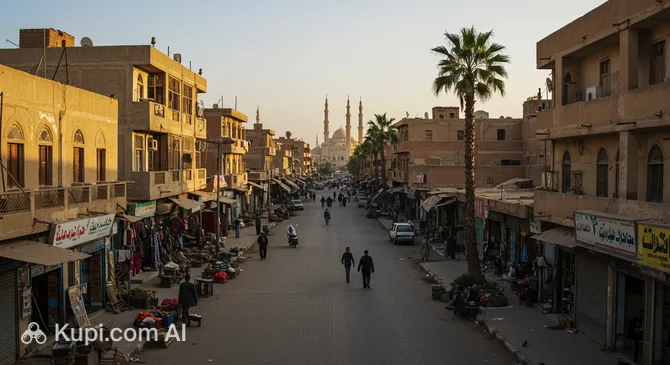
Damanhur is a colorful administrative center of the Beheira Governorate, located in the heart of the western Nile Delta. Situated at the crossroads between Cairo and Alexandria, the city is steeped in the atmosphere of authentic, non-touristy Egypt. With a population of about 244,000 people, it lives at the rhythm of a major transport and agricultural hub, where the everyday bustle of markets coexists with the quiet of provincial neighborhoods.
Damanhur. Illustration.
Source: Kupi.com AI
The city boasts a truly impressive heritage, with roots reaching back to Predynastic times. Researchers of the city's history note that Damanhur was the capital of the seventh nome of Lower Egypt and, according to some reports, became the first place in the world to start minting coins. Today, it is a place where you can see life in the Nile Delta without any filters: green house arches and lively streets create a unique landscape for this regional "residential center."
Despite not having the status of a world-class resort, Damanhur attracts visitors with its authenticity and the hospitality of its locals. The Nobel Prize winner in chemistry, Ahmed Zewail, was born here, which is a source of special pride for the townspeople. Visiting this city is an invitation to look behind the scenes of tourist routes and feel the real pulse of the modern Egyptian province.
Weather Overview
Damanhur is dominated by the subtropical climate of the Nile Delta, characterized by hot summers and mild, pleasant winters. Due to the proximity to the river and numerous canals, increased air humidity is observed, which should be considered when planning long walks. Detailed weather in the city is presented in monthly summaries, but the general trend remains constant: plenty of sun and rare precipitation.
The summer months, especially July and August, bring heat with daytime temperatures in the 33–36°C range, and sometimes the thermometer reaches 40°C. Winter in the city is very comfortable: in January, the average maximum is around 18–20°C, and at night the temperature rarely drops below 10°C. This time is considered ideal for visiting, as the heat subsides and the air becomes fresher.
Precipitation in the region is rare and occurs mainly between December and March. Expect a sunny and dry summer, when the probability of rain is practically zero, and brief showers during the winter period. Dense urban development and greenery around houses help keep things cool in the shade; however, in open areas, the sun can be quite active throughout the year.
Average monthly temperature
Average monthly precipitation
Interesting Facts
Damanhur is one of the country's oldest cities, known since the Predynastic period of Ancient Egypt; in ancient times, it held the status of the capital of the 7th nome of Lower Egypt.
The city claims to be the first place in world history where the minting of its own coins was introduced.
The great scientist Ahmed Zewail was born here; he received the Nobel Prize in Chemistry in 1999 for his studies of the transition states of chemical reactions.
The city's name has deep roots: it comes from the Ancient Egyptian "Demi-en-Hor," which means "City of Horus" (the ancient Egyptian god of the sky and the sun).
In ancient times, Damanhur was strategically located on the banks of a canal that provided a connection between Lake Mariout and the western branch of the great Nile.
How to Get There
Damanhur is a vital transport hub of the Western Delta, making it easily accessible from Egypt's largest cities. Due to its location on the main highway connecting Cairo and Alexandria, travelers can choose between rail links and road transport. Detailed information on routes is available on the how to get to the city page.
The nearest major air hubs are in Alexandria, from where Damanhur can be reached by taxi or train in just 1–1.5 hours. For those arriving from Cairo International Airport, the journey will take about 2–3 hours depending on road conditions, which can be unpredictable in the Nile Delta due to heavy traffic.
Rail transport is perhaps the most convenient way to visit. Regular trains pass through the city, connecting the capital and the Mediterranean coast. Railway stations such as Kubra Helou (serving the direction to Tanta) and Kubra el-Felah (connecting with Rosetta and Desouk) are key points for transfers within the region.
Station
Passenger traffic
Distance
Alexandria railway station
8
57 km
El-Marg
4
129 km
El-Marg
4
129 km
Port Said railway station
5
176 km
In addition to trains, share taxis (minibuses) are extremely popular. They depart once full and connect Damanhur with almost all neighboring provincial centers. This is a fast and budget-friendly option, though one should be prepared for cramped conditions and the typical chaos of Egyptian roads.
Main Attractions
Although Damanhur is not a typical tourist center with an abundance of ancient ruins, it offers guests a chance to get acquainted with the architecture and culture of the modern Egyptian province. One of the city's most prominent landmarks is the Damanhur Opera House—an elegant building that serves as the region's main cultural beacon. It hosts rare but significant concerts and theatrical performances that reflect the spirit of classical Egyptian art.
The city's spiritual life is centered around its majestic mosques. The At-Tuba Mosque and Al-Habashi Mosque stand out with their minarets against the city skyline. These structures are interesting not only as religious sites but also as examples of Islamic architecture, where one can observe the daily traditions of the local residents.
The center of social life is the square featuring the Midan Fountain. This is a popular meeting spot surrounded by shops and cafes. Nearby is the Municipal Library—an important educational institution that preserves an atmosphere of academic tranquility amidst the noisy city. For a traveler who values authenticity, a walk through the central markets and streets of the city is the best way to understand the character of this Nile Delta transport hub.
Local Cuisine
The gastronomic face of Damanhur is the quintessence of Nile Delta flavors. Local cuisine relies on fresh products grown on the region's fertile lands. Be sure to try bolti fish (tilapia), which is traditionally fried here and served with aromatic rice. The proximity to canals and the Nile ensures the freshness of seafood, which is an important part of the locals' diet.
For breakfast or a quick snack, classic Egyptian dishes are ideal: ful (a hearty fava bean mash) and taameya (the local version of falafel made from fava beans). It is impossible to imagine a walk through the city without a portion of kushari—a unique mix of rice, pasta, lentils, and chickpeas topped with a spicy tomato sauce and fried onions. This filling and cheap dish can be found in numerous eateries in the city center.
Dining culture in Damanhur is closely linked to street food and markets. The most authentic cafes are located near central squares and stations. It is customary to end a meal with strong tea with mint or aromatic Turkish coffee. There are few specific tourist restaurants here, but in local establishments, you are guaranteed to get the same dishes at the same prices as the residents, immersing yourself in the true gastronomic atmosphere of Egypt.
Travel Tips
A visit to Damanhur will be a fascinating immersion into the real Egyptian province if you use these practical tips.
Clothing and Dress Code: Choose clothes made of natural fabrics such as cotton or linen to better handle the heat and humidity of the Delta. Given the conservative nature of the region, it is best to avoid overly revealing outfits, especially when visiting mosques or markets.
Footwear: Wear comfortable closed-toe shoes. The city streets can be dusty and the sidewalks are not always even, so comfort while walking should be your priority.
Transport: Use tuk-tuks or taxis to get around the city, but be sure to agree on the fare in advance with the driver, as meters are practically not used here.
Finances: Always carry a sufficient supply of cash in Egyptian pounds (EGP). Cards are rarely accepted, and it's best to look for ATMs in large bank branches in the center.
Health: Drink only bottled water and avoid ice in drinks at street cafes. Do not forget sunscreen even in cloudy weather.
Connectivity: Buy a local SIM card (e.g., Vodafone or Orange) immediately upon arrival in Egypt. Finding Wi-Fi in cafes in Damanhur itself can be difficult.
Etiquette: Greet locals with the phrase "As-salamu alaykum." In response to hospitality, a polite smile and the word "Shukran" (thank you) are enough.
What to avoid: Do not photograph government buildings, police, or military facilities—this may cause unnecessary questions from local authorities.
Damanhur is a city for those who seek sincerity and are not afraid of the noise of lively streets, so just relax and enjoy its unique energy!
Entertainment & Nightlife
Nightlife in Damanhur differs significantly from metropolitan Cairo or the resort city of Alexandria. The city follows a conservative provincial schedule, so you won't find loud nightclubs or bars in the Western sense here. The main evening entertainment for locals is visiting traditional cafes, where long conversations are held over a cup of tea or coffee. The atmosphere in such establishments is calm and friendly, with most activity concentrated in the city center and near the railway stations.
Cultural leisure is largely tied to the Damanhur Opera House. This is one of the few places in the city where evening performances, folk music concerts, or theatrical plays might take place. However, the schedule of events is not always regular, so tourists should check the program in advance. For those seeking more energetic entertainment, the best option is a trip to neighboring Alexandria, which can be reached in about an hour.
Daytime entertainment includes strolling through lively markets and central squares. This is a great way to observe the local flavor and spontaneous soccer matches organized by young people right on the city streets. Safety in the city is at a good level, but after dark, it is better to stick to well-lit central streets and use taxis to move between districts.
Parks & Museums
In Damanhur, cultural and recreational infrastructure is primarily oriented toward the needs of local residents rather than mass tourism. The role of the main cultural center is fulfilled by the Municipal Library. This is not just a book repository but an important social space where you can feel the city's intellectual atmosphere and learn about its heritage in the quiet of the reading rooms.
Regarding parks, there are few classic, extensive green zones in Damanhur. Due to the dense construction of the Nile Delta, the city's greenery is mainly represented by small squares and cozy green islands around residential and administrative buildings. Trees are planted along the main streets, providing necessary shade during the hot summer months, softening the climate and cleaning the air.
For outdoor relaxation, residents often choose the banks of local canals, which serve as natural recreational areas. Nevertheless, the lack of large parks is compensated for by the general abundance of vegetation in the surrounding region—the Nile Delta is considered one of the most fertile and greenest places in the world. To visit large-scale museum exhibitions or botanical gardens, residents and guests of the city most often travel to neighboring Alexandria.
Getting Around
The transport system in Damanhur is typical for the densely populated cities of the Egyptian Delta. The backbone of public transport consists of minibuses, which locals call "mashrou'." They run along all the city's main arteries and connect the center with the outskirts. This is the fastest way to get around, though keep in mind that they can be overcrowded during peak hours and road traffic becomes chaotic.
Within the central districts, motorized rickshaws (tuk-tuks) are very popular, as they can squeeze through the narrowest streets and traffic jams. This is a convenient option for short trips, but the price should be agreed upon in advance. For more comfortable travel, you can use the services of a regular taxi. It is worth noting that familiar international ride-hailing apps work with limitations here, so you often have to hail a car right on the street.
Walking through the center of Damanhur is a great way to feel the city's rhythm; however, heavy traffic requires extra caution when crossing streets. Bicycles are also seen, but due to the lack of dedicated lanes and general road congestion, this mode of transport is chosen only by the most experienced travelers. The payment system is cash only everywhere, and the fare remains one of the lowest in the region, making moving around the city accessible to every traveler.
Accommodation
The hotel infrastructure in Damanhur is quite modestly developed, as the city mainly serves as an administrative and transport center rather than a tourist destination. Travelers should look for budget accommodation options and guesthouses, which are most often concentrated in the central part of the city, within walking distance of the railway stations.
For those planning to stay longer, renting private apartments is the most accessible option. This is a common practice among transit passengers and professionals coming to the region on business. There are no luxury hotels from international chains in the city, so for high-level service and five-star comfort, tourists usually head to neighboring Alexandria.
It is better to book accommodation in Damanhur in advance through international services, although the selection there may be limited. If you plan to visit during local holidays, you should arrange for a place to stay several weeks in advance. At other times, prices remain consistently low and are geared toward the local market, making a stay here very economical for budget travelers.
Nearby Cities
Damanhur is an ideal starting point for exploring the lesser-known but charming corners of the Nile Delta. Thanks to the developed transport links, it is easy to make day trips from here to neighboring towns, each with its own unique character.
Just 19 kilometers away is the city of Desouk, known for its magnificent mosque and picturesque views of the Nile. It is also worth visiting Ar-Rahmaniya, which is very close by and allows you to see the diversity of life in the Egyptian province. For history buffs, a trip to Sa El-Hagar, where the ruins of ancient Sais (the former capital of Egypt) are located, will be of interest.
Furthermore, the proximity to Alexandria (about 70 km) makes it possible to quickly swap the quiet atmosphere of Damanhur for the Mediterranean breeze and the grandeur of ancient monuments. Regular trains and minibuses allow for very flexible planning of such trips, with a return to Damanhur by evening.
Shopping & Souvenirs
Shopping in Damanhur is, above all, an immersion in the atmosphere of an Eastern bazaar. There are no huge shopping malls with glass windows here, but the central streets turn into an endless market where you can find absolutely everything: from household items to high-quality Egyptian cotton. The main commercial activity is concentrated around the square with the Midan Fountain and near the railway stations.
In the local markets, it is worth paying attention to textiles and fabrics—the Beheira region is famous for its agricultural traditions, and textile goods here are of good quality at low prices. Damanhur is also an excellent place to buy fresh spices, nuts, and local sweets. Food markets are impressive for their variety of fruits and vegetables grown in the fertile Nile Delta.
Shops usually operate from morning until late evening, often closing for a break during the hottest time of the day. Payment is almost always in cash in Egyptian pounds, so it is worth taking care of changing large bills in advance. If you are looking for specific souvenirs or branded items, it is better to head to Alexandria for those, but for purchasing authentic local goods, Damanhur is perfectly suited.