Support

The Museum of Natural Science

About

The Museum of Natural Sciences (Muséum des Sciences Naturelles d'Angers) is a fascinating window into the natural world, located in the heart of the city of Angers. The museum occupies two majestic 19th-century historical buildings, harmoniously connected by a charming French-style garden. This site is rightfully considered one of the most important scientific and educational centers that France takes pride in.
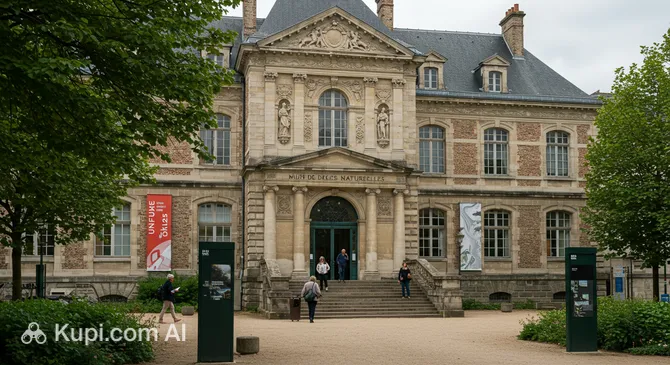
Museum of Natural Sciences
Museum of Natural Sciences. Иллюстрация. Источник: Kupi.com AI

Inside lies a colossal collection of exhibits — with estimates reaching 830,000 objects. Here, you can see everything from 3,000 brightly feathered stuffed birds to rare minerals and skeletons of extinct creatures. The museum's pride is one of the planet's oldest inhabitants — the Paradoxides trilobite, which is hundreds of millions of years old.

The exhibition is divided into themed halls, each telling its own story. In the paleontology hall, you will journey back to the era of dinosaurs; in the zoology hall, you'll discover the diverse fauna of the region, including collections of insects and spiders; while the departments of botany and ethnology offer a new perspective on the connection between humans and nature. It is a place where science meets art, leaving an unforgettable impression on every visitor.

Contacts

To ensure your visit is as comfortable as possible, we have prepared up-to-date contact information. You can check exhibition details in advance or book a group tour by contacting the staff directly.

Below are the main contact details and the official web resource where news about temporary exhibitions and special events is published.

How to contactContact
Address43 Rue Jules Guitton, 49100 Angers, Франция
Phone+33 2 41 05 48 50
Websitemusees.angers.fr

What to Do

A visit to the museum is an exciting journey through the ages. Start your exploration in the paleontology hall, which houses fossils from the Loire Valley. Examining these ancient remains, you can imagine what this region looked like millions of years ago. Be sure to stop by the zoology section: the collection of stuffed birds from Maine-et-Loire and exotic parrots is striking in its richness of color and the skill of the taxidermists.

For those who aren't afraid of small creatures, Gustave Abot's entomology cabinet is of particular interest. Here, you can spend hours studying thousands of species of beetles and butterflies, as well as local collections of spiders and shells. The museum is interactive in its approach: you literally trace the path of evolution as you move from one display to the next, discovering new facets of our planet's biodiversity.

Don't miss the chance to relax in the French garden that connects the museum's buildings. It is the perfect spot for a short break between viewing the zoological and botanical exhibitions. If you still have energy, be sure to visit the Gaston Allard Arboretum, which serves as a living supplement to the museum's herbaria and allows you to fully enjoy the plant kingdom.

Getting There

Getting to this scientific center in Angers is quite simple, as it is located in the central part of the city at 43 Rue Jules Guitton. If you arrive at the central railway station, Angers-Saint-Laud, the walk to the museum will take about 15–20 minutes through picturesque streets.

Public transport fans can use tram lines A or B. You should get off at the Quai de la Fosse or Hôtel de Ville stops, from which it is no more than a 10-minute walk to the entrance. Also nearby are the TAN network buses (routes No. 1, 3, 4, and 6), stopping at Jules Guitton or the city hospital (Hôpital).

If you prefer a taxi, the ride from the main city center attractions will take only a few minutes. For those traveling by car from Angers-Loire Airport, the journey is about 25 kilometers via the D323 or D952; you can leave your car in paid parking lots in the city center or look for available spots in the surrounding blocks.

Ближайший город: Angers

History & Facts

The history of this place dates back to the French Revolution. In 1790, Gabriel Eleonore Merlet de la Boulaye was given an important task: to collect valuable books and natural science collections from the region's nationalized estates. Although some of the finds were damaged during the siege of 1793, a natural history cabinet was created by 1795 through the efforts of Joseph-Etienne Renou to educate students at the Central School of Maine-et-Loire.

The museum officially opened its doors to the general public on May 5, 1801. Since then, its holdings have grown steadily thanks to generous donations from great scientists. For instance, in 1806, the famous naturalist Etienne Geoffroy Saint-Hilaire donated rare fossils to the museum, and in the late 19th century, Alphonse Milne-Edwards enriched the collection with exotic taxidermy birds.

For a long time, the collections were divided: the paleontology section occupied the 13th-century Old Town Hall (recognized as a historical monument), while the zoology section was housed in the elegant Demarie-Valentin mansion. It wasn't until 1990 that they were reunited into a single complex, and in 1991, they were linked by a cozy inner garden, creating a cohesive space for immersion into the natural world.

Significant contributions to the institution's development were made by its directors Georges Bouvet and Olivier Couffon. Thanks to their enthusiasm, unique Paleolithic artifacts were acquired, including mammoth teeth and ancient tools found at the Roc-en-Pail site, making the museum one of the region's most important scientific centers.

Time Needed

To explore all the themed halls without rushing and enjoy a walk through the inner garden, an average tourist will need about 1.5 to 2.5 hours. This is usually enough time to see the main paleontological finds and the zoological collection.

If you are a botany enthusiast or traveling with children who will likely want to linger by the insect displays, it is worth allowing a bit more time. Don't forget to also set aside 15–20 minutes to visit the adjacent Gaston Allard Arboretum if you decide to complement your visit with a study of flora.

Working Hours

The museum welcomes visitors from Tuesday to Sunday. The doors are open from 10:00 AM to 6:00 PM, allowing you to comfortably plan your visit for either the morning or the afternoon. Please note that Monday is a day off when the exhibitions are closed to the public.

Before your trip, we recommend checking the museum's official website, as the operating schedule may change slightly on public holidays or during the changeover of temporary exhibitions.

DayWorking hours
понедельникЗакрыто
вторник10:00–18:00
среда10:00–18:00
четверг10:00–18:00
пятница10:00–18:00
суббота10:00–18:00
воскресенье10:00–18:00

Nearby

After visiting the Museum of Natural Sciences, don't be in a hurry to leave the area. The surroundings are rich in historical monuments and interesting locations that will help you fully experience the atmosphere of this ancient French city.

Just a few steps away, you will find majestic abbeys, medieval castles, and modern amusement parks. We have compiled a list of nearby attractions to include in your itinerary:

NameDistance
Jardin des Plantes of Angers0.2 km
Les Fils à Maman Angers0.3 km
Jardin du Mail0.3 km
La Cour0.5 km
Cahupa0.5 km
Le Pas Sage0.6 km
Collegiate Church of Saint Martin0.7 km

Reached the end of the page?

That means the route is fully explored