Support

Arles Amphitheatre

About

The Arles Amphitheatre (Arènes d'Arles) is an outstanding monument of ancient Roman architecture and one of the primary symbols of the city of Arles, located in the south of France. This magnificent site was built at the end of the 1st century AD, during the reign of the Flavian dynasty, and was intended for mass spectacles such as gladiatorial combat and chariot racing. Modeled after the famous Colosseum in Rome, it continues to impress today with its grandeur and state of preservation.

The monumentality of the amphitheatre is reflected in its dimensions: the elliptical arena measures 136 meters in length and 109 meters in width, and the stands were capable of seating more than 20,000 spectators. The building's facade consists of two tiers, each decorated with 60 arches, totaling 120 arched spans. This sophisticated design not only gave the structure an imposing look but also ensured quick and easy access for the public to their seats.
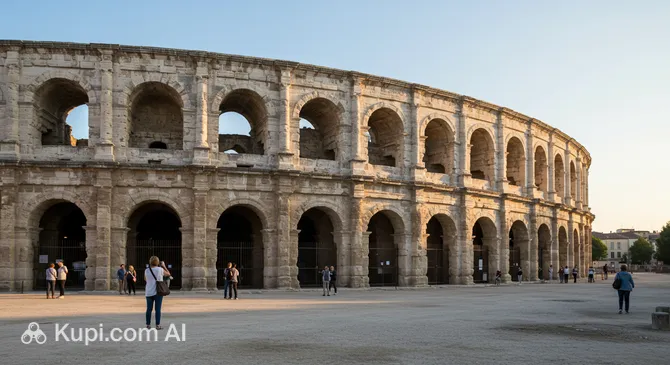
Arles Amphitheatre. Illustration.
Source: Kupi.com AI

Traveler photos:

Today, the Arles Amphitheatre is one of the most visited attractions in Provence and is recognized as a UNESCO World Heritage site as part of the city's ensemble of Roman monuments. The arena continues its centuries-old history, serving as a unique venue for concerts, theatrical performances, and traditional bullfights. Visiting this place is an opportunity to touch history and feel the atmosphere of antiquity that lives within the walls of this magnificent building.

Contacts

The Amphitheatre in Arles is not only a precious historical monument but also an active venue for various events. To ensure your trip goes smoothly, it is important to have the latest information. We recommend checking the current opening hours, ticket prices, and event schedules on the city's official tourism resources.

The most reliable information can be found on the Arles Tourisme website or by contacting them directly upon arrival. This will help you avoid any surprises related to temporary closures for concerts, festivals, or traditional bullfights.

How to contactContact
Address1 Rdpt des Arènes, 13200 Arles, France
Phone number+33 891 70 03 70
Websitewww.arenes-arles.com

What to Do

A visit to the Arles Amphitheatre is a true immersion into history. Every guest can wander freely through its ancient galleries and arched passages, imagining how Roman citizens gathered here thousands of years ago. Be sure to climb to the upper tiers or one of the medieval towers: from there, you can enjoy breathtaking panoramic views of the historic rooftops of Arles and the Rhône River. To better understand the past of this site, you can join a guided tour where experts share fascinating stories about life in the Roman Empire and the gladiatorial battles that took place in this arena.

The amphitheatre remains the center of the city's cultural life today. During the summer season, the arena comes alive with various events: large-scale historical reenactments, concerts, theatrical productions, and even modern interpretations of ancient games are held here. A special local flavor is added by traditional Provençal festivals and the famous Arles bullfights, which return the amphitheatre to its original purpose as a venue for mass spectator events.

Getting There

The Arles Amphitheatre is conveniently located in the heart of the historic center of Arles, making it easily accessible on foot. It is within walking distance of the main tourist streets, so if you are staying in the center, getting there is easy—simply follow the signs to this magnificent structure, which is visible from afar.

If you are traveling through France by public transport, you can reach Arles by train from major cities such as Marseille, Avignon, or Nimes. The train station is about a 15-minute walk from the amphitheatre, allowing you to combine your journey with a pleasant stroll through the city. Regular bus services from other towns in Provence are also available for travelers.

For those who prefer to travel by car, the drive to Arles is also very convenient. There are public parking lots in the city, and numerous signs pointing to the historic center and the amphitheatre itself will help you easily find your way to this outstanding landmark.

Nearest city: Arles

History & Facts

The history of the Amphitheatre is inextricably linked to the heyday of Arles as a thriving Roman colony, known in antiquity as Arelate. At that time, the city was an important administrative and commercial center, and the amphitheatre served as the main arena for grand spectacles. It hosted not only traditional gladiatorial bouts and chariot races but also lavish celebrations, such as the victory games of Emperor Trebonianus Gallus in 255 and games hosted by Emperor Constantine to celebrate the birth of his son.

With the fall of the Roman Empire, the fate of the amphitheatre changed dramatically. It was transformed into a veritable fortress to protect the city's inhabitants. An entire medieval quarter grew within its massive walls: more than two hundred houses and even two chapels were built inside. Four defensive towers erected along the perimeter turned the former arena into an impregnable castle, which served as a refuge for the local population during the turbulent Middle Ages.

The revival of the amphitheatre as a historical monument began only in the 19th century. A key role in its salvation was played by the writer and inspector of historical monuments, Prosper Mérimée. It was thanks to his initiative that a large-scale restoration began, during which the internal buildings were demolished. In 1840, the amphitheatre was recognized as a national historic treasure of France, ensuring the preservation of this unique structure for future generations.

Time Needed

When planning a visit to the Arles Amphitheatre, you should expect it to take between one and a half to two hours. This time is generally sufficient for a self-guided tour of the main parts of this grand structure. You will have enough time to stroll leisurely through the ancient galleries, climb to the upper tiers for magnificent views of Arles, and take memorable photos.

If you want to gain a deeper understanding of the amphitheatre's history, it is worth setting aside a bit more time. For a thorough exploration or to participate in a guided tour, about 2 hours is recommended. Additionally, the length of your visit may increase if you decide to attend one of the cultural events regularly held at the arena—whether it's a concert, a theatrical performance, or a traditional bullfight. In such cases, a visit could take half a day or even an entire evening.

Working Hours

The Arles Amphitheatre is open to visitors year-round, although its opening hours vary depending on the season. To plan your visit, it is worth checking the current schedule. Generally, during the high season, from May to September, the arena is open from 9:00 to 19:00. In the shoulder seasons of March, April, and October, the hours are slightly shorter—from 9:00 to 18:00. During the winter months, from November to February, you can visit the amphitheatre from 10:00 to 17:00.

It is important to remember that the amphitheatre is not just a museum but also an active venue for cultural events such as concerts, festivals, and traditional bullfights. Because of this, the arena may be temporarily closed for event preparation or hosting. Therefore, it is highly recommended to check the current schedule and potential changes on the official Arles tourism website before your trip. Booking tickets online in advance can also be helpful, especially during the height of the tourist season, to avoid queues.

9:00 – 19:00

Nearby

Visiting the Amphitheatre is undoubtedly the highlight of the itinerary for many travelers coming to Arles. However, the true charm of this city lies in its compactness and incredible concentration of historical treasures. A walk around the amphitheatre's surroundings will allow you to dive deeper into the atmosphere of antiquity and make even more discoveries.

Many iconic sites are literally a few steps away from the famous arena, making Arles feel like an open-air museum. You can easily plan a full day's route simply by moving from one landmark to another. Below is a list of interesting sites located in the immediate vicinity.

NameDistance
Roman Theatre of Arles0.2 km
Le Criquet0.2 km
Cryptoporticus of Arles0.3 km
Arles Obelisk0.3 km
Réattu Museum0.3 km
La Croisière0.3 km
Church of St. Trophime0.3 km

Have you reached the end of the page?

So the route has been studied inside and out