Support

Vienne Ancient Roman Theatre

About

Imagine the majesty of the ancient world embodied in stone: the Ancient Theatre of Vienne is one of the most significant and magnificently preserved monuments of the Gallo-Roman era. Located in the charming city of Vienne, this architectural masterpiece is a source of pride carefully preserved by France.
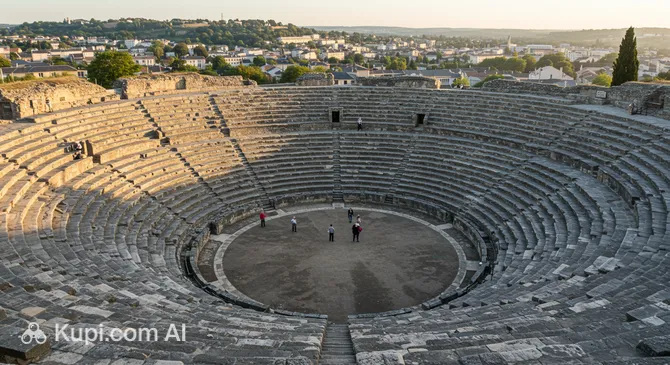
Ancient Theatre of Vienne
Ancient Theatre of Vienne. Иллюстрация. Источник: Kupi.com AI

Built between 40 and 50 AD on the steep slopes of Pipet Hill, the theater once accommodated up to 13,000 spectators. In its time, it was considered the second largest in Gaul, surpassed only by the theater in Autun. Its classic semi-circular shape (hemicycle) is perfectly integrated into the landscape, demonstrating the superb skill of ancient builders and engineers.

Today, after meticulous restoration carried out in the last century, the Ancient Theatre remains not just a cold museum exhibit, but a living cultural venue. Its powerful vaulted galleries and stone steps continue to welcome thousands of guests who come here to touch two thousand years of history and enjoy unique open-air acoustics.

Contacts

To plan your visit and check the latest event information, you can use the official communication channels. This attraction is very popular, as evidenced by its high rating of 4.7/5 based on thousands of traveler reviews.

Below are the main contact details for communication and navigation:

How to contactContact
Address7 Rue de Goris, 38200 Vienne, France
Phone+33 4 74 78 71 17
Websitewww.theatreantiquevienne.com

What to Do

Once inside this colossal structure, the first thing to do is experience the scale of ancient architecture for yourself. You can freely walk along the 46 tiers of stone steps that were once filled with thousands of Roman citizens. Be sure to climb to the very top rows: from there, a stunning panoramic view of the city and the bends of the Rhône River unfolds.

Exploring the vaulted galleries is another must-do activity. These cool corridors allow you to feel the engineering genius of antiquity and imagine how crowds of spectators moved through the theater centuries ago. Attentive visitors can spot remnants of decorative finishes and architectural fragments of the ancient stage wall.

If your trip coincides with the summer season, try to attend one of the concerts or performances. The most iconic event here is the international Jazz à Vienne festival. Listening to world-class music while sitting on steps that remember ancient actors is an absolutely unique experience that is impossible to forget.

A visit to the theater can easily be complemented by exploring other cultural treasures of the city. Nearby are the Museum of Fine Arts and archaeological zones, allowing you to create a rich itinerary and fully immerse yourself in the atmosphere of Roman Gaul in just one day.

Getting There

The majestic Ancient Theatre of Vienne is located at: 7 Rue de Goris, 38200 Vienne, France. The city is situated in the picturesque Auvergne-Rhône-Alpes region, just 30 kilometers south of Lyon, making it an excellent destination for a day trip.

Travelers arriving by car can use the A7 motorway, which connects Lyon and Marseille; the drive from central Lyon takes about 30–40 minutes. It is also very convenient to reach by train: regular services depart from Lyon's train stations, with a travel time of just 20–30 minutes.

Since the theater is located in the central part of the city, it is an easy walk of just a few minutes from the railway station. If you prefer comfort or are carrying heavy luggage, you can use taxi services directly from the station or from any point in the city center to quickly reach the main entrance.

For precise navigation, it is recommended to use the GPS coordinates 45.5248586, 4.8785727, which will lead you directly to the historical complex on the hillside.

Ближайший город: Vienne

History & Facts

The construction of this grand structure dates back to 40–50 AD. Architects of the time faced a difficult task: fitting a classic Latin stone theater into the steep terrain of Pipet Hill. The result was a unique system of powerful vaulted galleries that not only supported the steps but also provided efficient logistics for thousands of spectators.

At its peak, the theater could hold up to 13,000 people, making it one of the largest in the Roman Empire. It served not only as a stage for comedies and dramatic plays but also as an important venue for civic assemblies and official ceremonies. Interestingly, the top of the hill above the theater was transformed into a sacred esplanade with temples, visually extending the architectural ensemble.

The monument's fate was not easy: after centuries of neglect, it was only rediscovered by the world in 1908. Until that point, the massive ruins were mistakenly identified as an amphitheater. Extensive restoration work under the direction of architect Jules Formigé continued from 1922 to 1938, restoring the structure to its former glory.

The grand reopening of the restored site took place in 1938 in the presence of French President Albert Lebrun. Today, the site is officially included in the list of French Historical Monuments, carefully preserving the legacy of ancient Gaul for future generations.

Time Needed

To leisurely explore every corner of the ancient structure, a typical visitor will need between 1 and 2 hours. This time is quite sufficient to climb the stone steps, explore the cool vaulted galleries, and take impressive photos against the backdrop of the ancient scenery.

If you decide to climb to the very top tiers, a breathtaking panorama of the city and surrounding hills will open up before you, which is well worth staying a bit longer for. The atmosphere of the place invites contemplation, so many tourists prefer to spend extra time here simply enjoying the silence and the majesty of history.

It is worth considering that during major festivals, such as the famous jazz forum, your stay here could extend for the entire evening. On such days, the theater fills with special energy, transforming from a silent monument into the living heart of modern culture.

Working Hours

The attraction is open for visits daily, making it easy to include in any travel itinerary. The theater operates with a small break in the middle of the day, which should be taken into account when planning your walk.

The operating schedule for the Ancient Theatre of Vienne for the entire week is as follows:

  • Monday — Sunday: 09:30 – 12:45 and 13:30 – 18:00.
A consistent schedule for all days of the week ensures maximum convenience for travelers, allowing them to choose any convenient day to discover the ancient heritage.

9:30 – 12:45, 1:30 – 18:00

Nearby

A visit to the ancient theater is just the beginning of your discovery of the region's rich heritage. A stroll through the surrounding area will allow you to dive deeper into the atmosphere of antiquity and see how Roman history intertwines with later architectural styles.

Within walking distance of the theater are unique temples, defensive towers, and archaeological sites that together form the city's unified cultural landscape.

NameDistance
Pipet Belvedere0.1 km
Archaeological Gardens of Cybele0.2 km
Bar of the Town Hall Vienne0.3 km
Apéri'Klub0.5 km
Picanha0.5 km
KLUB0.6 km
Saint-Romain-en-Gal Archaeological Museum and Sites0.8 km

Reached the end of the page?

That means the route is fully explored