Support

Arco di Augusto

About

A journey back through the centuries begins at the eastern entrance to the historical center of Aosta, where guests are greeted by the majestic Arch of Augustus. This ancient Roman triumphal monument is considered one of the primary landmarks that Italy takes pride in within its northern region.
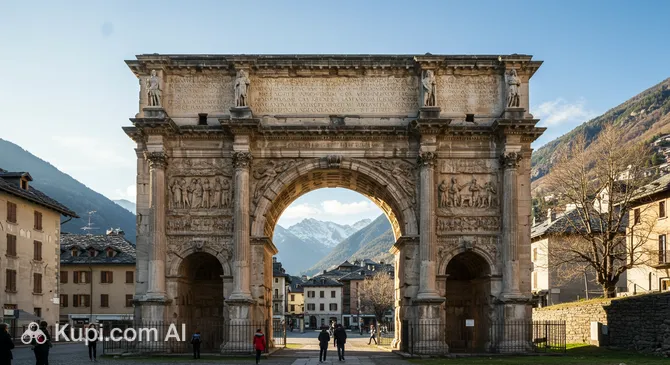
Arch of Augustus
Arch of Augustus. Иллюстрация. Источник: Kupi.com AI

Erected more than two thousand years ago, the arch serves as a monumental reminder of the power of the Roman Empire. The structure is built in a strict classical style: a single deep vault, powerful columns, and noble stone create an image of timeless strength. It doesn't just decorate the city but also emphasizes its status as the "Rome of the Alps."

Today, this iconic historical site attracts both lovers of ancient architecture and casual travelers. Thanks to its excellent state of preservation, the Arch of Augustus allows visitors to see firsthand the craftsmanship of ancient builders and feel the scale of events that took place here at the dawn of our era.

Contacts

To clarify information about tourist routes or the current state of the site, you can use the official contact details of the city service:

How to contactContact
AddressPiazza Arco D'Augusto, 11100 Aosta AO, Italy
Phone+39 0165 3001

What to Do

Once at the foot of the arch, the first thing to notice is the Roman masonry craftsmanship. Examining the massive stone blocks, you can appreciate how precise the calculations of the ancient engineers were. This is the perfect spot for atmospheric photos: against the backdrop of the snow-capped Alpine peaks, the ancient columns look particularly striking.

An interesting detail is the wooden replica of a cross installed at the top. Local legend has it that the original, created in the 15th century, protected the city from the flooding of the Buthier River. Today, the original stone cross can be seen in the city museum, but even the copy on the arch itself serves as a reminder of the close link between ancient traditions and the Christian period of the city's history.

From here, it is very convenient to start a long walk: a wide pedestrian street leads directly from the arch to the famous Praetorian Gate. Following this route, you can literally follow the path of ancient triumphants, admiring the cozy cafes and souvenir shops of modern Aosta along the way.

Getting There

Finding this majestic monument is easy: it is located on Piazza Arco D'Augusto, right at the eastern entrance to the city's historical core. Most tourists prefer to get here on foot, enjoying the atmosphere of the Alpine town. From the central train station, the walk takes only 10–15 minutes.

For those who prefer public transport, there are bus stops in the immediate vicinity of the square connecting this part of the city with other districts. If you are traveling by car, look for parking zones located around the perimeter of the historical center.

Travelers arriving from neighboring towns in the Aosta Valley region can take regional trains or buses — the transport network here is excellent, and the arch itself often serves as the starting point for walking tours.

Ближайший город: Aosta

History & Facts

The history of this structure dates back to 25 BC, when Emperor Octavian Augustus ordered the founding of the colony of Augusta Praetoria. The monument was erected to commemorate the final victory of the Roman legions over the local Salassi tribe, which secured the empire's power in this strategically important Alpine region.

Architecturally, the arch is notable because it was not part of the fortress walls but stood as a standalone symbol of triumph. Its span, nearly 9 meters wide, was designed for solemn processions. Researchers believe that in ancient times, the inner part of the vault was decorated with bright paintings, which, unfortunately, have not survived the passage of time.

Over the centuries, the monument's appearance has been updated with new details. In the 15th century, a cross was placed at the top, and later, a characteristic slate roof was added. This "roofing" seems unusual for an ancient monument, but it was precisely what helped protect the ancient masonry from the destructive effects of precipitation in the harsh mountain climate.

Time Needed

To leisurely examine the details of the bas-reliefs and appreciate the scale of the structure, 20–30 minutes is usually sufficient. This time is enough to take great photos and read the information plaques.

However, if you plan to continue along the pedestrian street and visit neighboring Roman monuments, we recommend setting aside about 1 hour to explore this part of the city. This will allow you to immerse yourself in the historical atmosphere without needing to check your watch.

Working Hours

As the Arch of Augustus is part of the city's architectural ensemble and is located in an open space, it is available for viewing 24 hours a day. You can come here early in the morning to avoid the crowds or late in the evening.

At night, the monument is illuminated, giving the ancient stones a special, mystical appearance. Visiting schedule: Monday — Sunday, 24 hours a day.

Круглосуточно

Nearby

Aosta is a true open-air museum, and visiting the arch is just the beginning of your immersion into the ancient era. A walk from this monument toward the city center will show you how harmoniously the Roman heritage intertwines with later buildings.

Below are the most interesting sites located within walking distance:

NameDistance
Stone Bridge (Pont de Pierre)0.1 km
Collegiate Church of Saints Peter and Ursus0.2 km
Eden Bistrot0.3 km
Porta Praetoria0.4 km
Roman Theatre of Aosta0.5 km
Panificio Meridionale Da Ciccio0.5 km
Brasserie Busseyaz0.7 km

Reached the end of the page?

That means the route is fully explored