Support

Chiesa Collegiata dei Santi Pietro e Orso

About

In the heart of the city of Aosta lies one of the most significant testimonies to medieval faith and art — the Collegiate Church of Saints Peter and Orso. This unique complex, located in sunny Italy, is a magnificent ensemble that combines the austerity of the Romanesque style with the elegance of the Gothic. Built on the site of an early Christian temple from the 5th century, the church has remained the spiritual center of the Aosta Valley region for centuries.
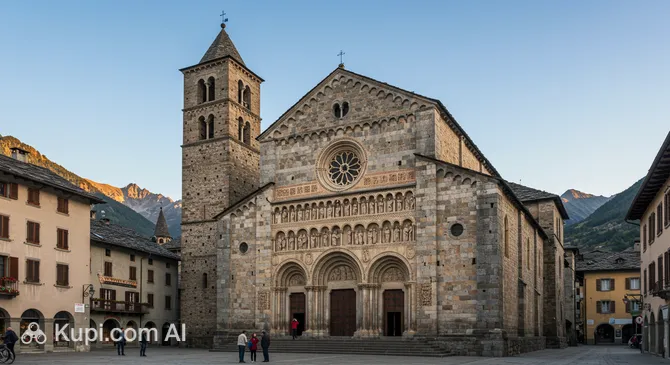
Collegiate Church of Saints Peter and Ursus
Collegiate Church of Saints Peter and Ursus. Иллюстрация. Источник: Kupi.com AI

The main architectural landmark of the complex is the imposing 12th-century Romanesque bell tower, which stands over 40 meters tall. It rises proudly above the monastery walls, serving as a reminder of the times when the cloister was an important refuge for pilgrims. Inside the church, true treasures are hidden: rare 11th-century Ottonian frescoes and a masterfully executed mosaic depicting biblical scenes.

A special atmosphere of peace is created by the adjacent monastery with its famous courtyard. This place attracts art lovers with its marble capitals, each of which tells a separate story from the lives of saints or medieval folklore. The complex is a living monument of history, preserving the spirit of the Carolingian era and the Early Middle Ages.

Contacts

To inquire about mass schedules or special events, you can contact the parish administration directly. Current contact details for the site are provided below.

How to contactContact
AddressVia Sant'Orso, 14, 11100 Aosta AO, Italy
Phone+39 0165 262026
Websitewww.parrocchiasantorso.it

What to Do

A visit to the complex should begin with a careful examination of the church interior. Be sure to look up at the upper parts of the naves to spot fragments of 11th-century frescoes — these are among the oldest examples of Romanesque painting in Europe. In the presbytery, your attention will be drawn to a black-and-white 12th-century mosaic depicting the mythical battle of Samson with the lion.

For lovers of quiet and architectural detail, spending time in the monastic cloister is highly recommended. Examining the carved marble capitals that adorn the courtyard columns becomes a captivating quest: you can find images of prophets, fantastic animals, and scenes from the life of Saint Orso. Do not miss the opportunity to descend into the underground crypt, which holds the mystical atmosphere of an ancient basilica from the first millennium.

If you are lucky enough to be here at the end of January, you will experience the famous Saint Orso Fair (Fiera di Sant'Orso). During this time, the square around the church is filled with artisans from across the region showcasing products made of wood, leather, and stone, allowing you to fully immerse yourself in the living culture and traditions of the local people.

Getting There

The attraction is located at Via Sant'Orso, 14, within easy walking distance of the city's historical core. If you are already strolling through the central streets, the walk from Piazza Vittorio Emanuele II (Piazza Chanoux) will take no more than 10–15 minutes. The route passes through picturesque alleys and past ancient Roman walls.

For those who prefer public transport, buses run from the Aosta railway station to the Sant'Orso stop. The trip takes only 5–10 minutes. If you are arriving by car, it is most convenient to leave your vehicle in the parking lots near Porta Praetoria, as the complex is situated in a limited traffic zone (ZTL).

Travelers from other regions of Italy typically arrive via Turin or Milan by train or intercity bus. The travel time is approximately 2–3 hours, after which the church can be easily reached on foot or by taxi.

Ближайший город: Aosta

History & Facts

The history of this site is rooted in deep antiquity: the current building was erected on the foundations of an early Christian basilica from the 5th century, which was located in a necropolis outside the walls of the Roman city. The construction of the main Romanesque structure began at the initiative of Bishop Anselm I at the turn of the 10th and 11th centuries, making the complex one of the oldest in the region.

In 1132, Augustinian monks settled here, turning the complex into an important stop on the famous Via Francigena pilgrimage route. During this period, the massive Romanesque bell tower, standing over 40 meters high, was built. It served not only religious purposes but was also part of the defensive system of the monastic walls.

Significant changes occurred in the 15th century under the patronage of Giorgio di Challant, the governor of Aosta. It was under his leadership that the interior acquired Gothic features, including elegant vaults and carved wooden stalls. Of particular value is the main bell, cast in France in 1589 — it is still considered the largest in the entire province.

Time Needed

To leisurely explore all the treasures of the complex, a typical visitor will need about 1.5–2 hours. Most of this time is spent studying the church's interior decorations, including the unique frescoes, and descending into the underground crypt where the foundations of the ancient basilica can be seen.

Don't forget to set aside at least 30 minutes for a stroll through the monastic cloister. Examining the skillful capitals of the columns and relaxing in the silence of the inner garden is an essential part of the experience. If you plan to climb the bell tower or join one of the rare guided tours, you should allow for a bit more time in your schedule.

Working Hours

The Collegiate Church of Saints Peter and Orso is hospitably open to parishioners and tourists daily and around the clock. This allows you to choose the most comfortable time for a visit, whether it's early morning for solitary prayer or the evening hours to see the architectural lighting of the facade.

The complex's operating schedule:

  • Monday – Sunday: daily (24 hours).

Круглосуточно

Nearby

The complex's location in the heart of the ancient city allows tourists to easily combine a visit to the church with a tour of other iconic Roman and medieval monuments. Just a few steps away, the history of a great empire and ancient Italy comes to life.

A walk through the surrounding area will reveal perfectly preserved triumphal arches, ancient theaters, and majestic towers that have guarded the peace of this Alpine region for centuries.

NameDistance
Eden Bistrot0.1 km
Roman Theatre of Aosta0.2 km
Porta Praetoria0.2 km
Arch of Augustus0.2 km
Stone Bridge (Pont de Pierre)0.4 km
Roman Cryptoporticus0.6 km
Aosta Cathedral0.6 km

Reached the end of the page?

That means the route is fully explored