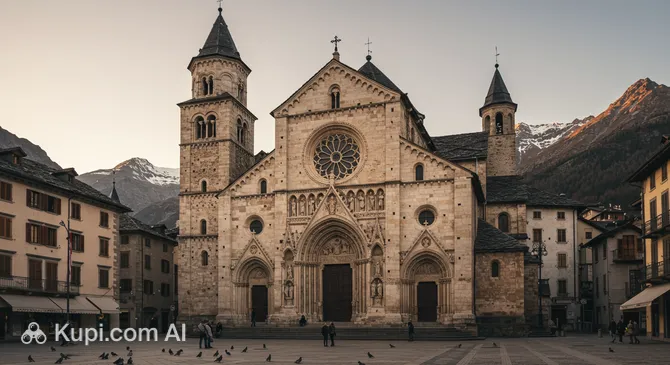
Nestled among Alpine peaks in the heart of the ancient city of Aosta, the Aosta Cathedral (Cattedrale di Santa Maria Assunta e San Giovanni Battista) rises majestically. This grand temple is more than just a religious site; it is a true architectural palimpsest where layers of history spanning over fifteen hundred years intertwine. The cathedral serves as the primary sacred symbol of the region and is a recognized masterpiece combining Romanesque, Gothic, and Renaissance styles.
Aosta Cathedral. Illustration.
Source: Kupi.com AI
Traveler photos:
One of the building's most striking features is its unusual facade, which consists of two parts: a richly decorated Renaissance atrium from 1526 featuring frescoes and terracotta statues, and a stark 19th-century Neoclassical pediment. Inside, a solemn Gothic interior awaits visitors, where precious artifacts are kept under high vaults: from 12th-century medieval mosaics to magnificent carved wooden choir stalls.
For travelers visiting Italy, this cathedral will be a discovery thanks to its unique 11th-century crypt and rare Ottonian-era frescoes hidden in the attic space. It is a place where you can literally touch the origins of Christianity in the Alps and feel the unbreakable connection of time while walking through the quiet aisles of this monumental structure.
Contacts
To inquire about services or special events, you can use the official communication channels. The Cathedral is always open to parishioners and visitors of the city.
A visit to the cathedral should begin with a close look at its unique facade. Examine the terracotta sculptures and vibrant early 16th-century frescoes in the atrium—they depict biblical stories with astonishing detail. Once inside, be sure to notice the fragments of the mosaic floor from the 12th–13th centuries, which feature mythical creatures and calendar cycles, as well as the exquisite Gothic stained glass windows that fill the space with colorful reflections.
Art lovers will be especially impressed by the carved wooden choir stalls from the 15th century—the intricate craftsmanship of the masters of that time is truly imaginative. Don't miss the opportunity to descend into the 11th-century crypt. Its stark Romanesque architecture, with ancient capitals and remains of an early Christian temple from the 4th century, creates an indescribable atmosphere of antiquity and peace.
If you are lucky, you might hear the sound of the cathedral organ or attend a mass to appreciate the building's magnificent acoustics. For photography enthusiasts, the cathedral offers an endless variety of angles: from the monumental bell towers reaching into the sky to the delicate details of the portal and the rose window on the facade. After exploring the interior, it is pleasant to stroll through the adjacent Piazza Papa Giovanni XXIII, enjoying views of the historic center.
Getting There
Finding the city's main sanctuary is easy, as it is located in the very heart of the pedestrian historical center at Piazza Papa Giovanni XXIII. If you are already walking through the old town, it is just a 5-minute walk from the famous Roman Theatre and no more than 10 minutes at a leisurely pace from the Arch of Augustus.
For those using public transport, the most convenient option is the Star or SVAP bus lines, which go to the Aosta Centro stop. From there, the cathedral is about a five-minute walk. If you arrive in the city by train, the Aosta railway station is approximately one kilometer away, which is a pleasant 15-minute walk through the central streets.
Travelers by car should note that the cathedral is located in a limited traffic zone (ZTL). It is recommended to leave your car in parking lots near Porta Praetoria or Piazza Chanoux and then continue on foot. From major cities like Turin or Milan, Aosta can be reached via the scenic A5 motorway in about 1.5–2 hours.
Nearest city: Aosta
History & Facts
The foundation of this majestic structure dates back to antiquity. At the end of the 4th century, on the site of the current cathedral near the Roman Forum, the Domus Ecclesiae emerged—an early Christian church that became the first evidence of the spread of the new faith in Italy within the Valle d'Aosta region. Archaeological excavations have confirmed the presence of ancient baptisteries and a nave that formed the basis for future reconstructions.
A radical transformation of the temple occurred in the 11th century under the leadership of Bishop Anselm I. It was then that the building acquired its Ottonian style features: a basilical plan with three naves and two powerful bell towers that still tower over the city today. One of the most valuable finds from this period are the unique frescoes in the roof space, considered a masterpiece of medieval European art.
In the following centuries, the cathedral's architectural appearance continued to evolve. In the 15th century, Gothic vaults and an elegant cloister were added, and in the early 16th century, a magnificent Renaissance atrium decorated with terracotta statues was built. The final touch was the Neoclassical pediment erected in 1848. Thus, Aosta Cathedral represents a stone chronicle capturing almost all architectural eras of Europe.
Time Needed
To fully experience the majesty and tranquility of this place, an average tourist will need about 1.5–2 hours. This is enough time to carefully examine the details of the facade, study the rich interior decoration of the naves, and descend into the ancient crypt that holds secrets from the first centuries of Christianity.
If you plan to visit the museum treasury, stay for an organ concert, or simply sit in silence enjoying the acoustics and the play of light on the Gothic stained glass windows, it is worth setting aside about 3 hours for the visit. The cathedral fits perfectly into a walking tour of the city center, allowing for a peaceful break between exploring ancient ruins.
Working Hours
Aosta Cathedral is hospitably open to visitors every day. On weekdays and Saturdays, the doors of the temple are open from 6:30 AM to 12:00 PM in the morning and from 3:00 PM to 7:00 PM in the afternoon. On Sundays, the morning opening begins slightly later—from 7:00 AM to 12:00 PM, while the evening hours remain the same (3:00 PM – 7:00 PM).
Please note that sightseeing may be limited during masses to avoid disturbing the service. The crypt and main halls are accessible within the general schedule; however, operating hours may change slightly on major religious holidays.
Day
Working hours
Monday
6:30 – 12:00, 3:00 – 19:00
Tuesday
6:30 – 12:00, 3:00 – 19:00
Wednesday
6:30 – 12:00, 3:00 – 19:00
Thursday
6:30 – 12:00, 3:00 – 19:00
Friday
6:30 – 12:00, 3:00 – 19:00
Saturday
6:30 – 12:00, 3:00 – 19:00
Sunday
7:00 – 12:00, 3:00 – 19:00
Nearby
The cathedral's location in the historical core of the city makes it an ideal starting point for immersing yourself in the region's rich Roman and medieval heritage. A stroll through the surrounding streets allows you to move from one era to another in just a few minutes.