Support

Stone Bridge (Pont de Pierre)

About

Walking through the eastern outskirts of Aosta, it is impossible to miss the majestic structure that has stood for millennia. The Stone Bridge (Pont de Pierre) is a true masterpiece of ancient Roman engineering, preserved in the heart of the Aosta Valley region. Italy is famous for its ancient monuments, but this site is unique for how harmoniously it is integrated into the modern urban landscape.
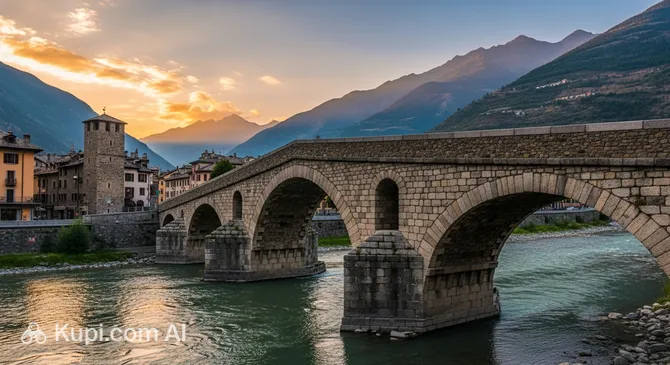
Stone Bridge (Pont de Pierre)
Stone Bridge (Pont de Pierre). Иллюстрация. Источник: Kupi.com AI

Structurally, the bridge is a powerful single-span arch over 17 meters long. It was built from puddingstone — a special type of natural conglomerate — while Roman concrete filling ensured the strength of the structure. Remarkably, the bridge was originally built to cross the Buthier River, but over the centuries, nature took its course: the riverbed shifted, and today the ancient arch stands "on dry land," which gives it an even more mysterious and monumental appearance.

For tourists, the Pont de Pierre is not just a historical ruin, but a place where you can literally touch the stones that saw the legions of Emperor Augustus. The flat profile of the arch with massive keystones is a classic example of Roman style that has survived the centuries in virtually its original form.

Contacts

For those planning a visit to this ancient monument, the following contact information will be useful. The site is a publicly accessible architectural landmark.

How to contactContact
AddressVia Ponte Romano, 12, 11100 Aosta AO, Италия
Websitewww.regione.vda.it

What to Do

A visit to the Pont de Pierre offers a unique opportunity to literally walk in the footsteps of history. You can walk across the surface of the ancient structure, examining the massive masonry and studying how tightly the puddingstone blocks fit together. It is an excellent spot for those interested in architecture who want to see firsthand why Roman structures have stood for thousands of years.

For photography enthusiasts, the bridge is a magnificent subject: the ancient stone against the backdrop of the snowy Alpine peaks of the Aosta Valley creates a stunning contrast. Although the river no longer flows beneath the bridge, the surrounding area is well-maintained and perfect for quiet reflection on the passage of time. You can sit nearby and watch how ancient heritage coexists with the rhythm of the modern city.

A visit to the bridge is often part of a larger walking tour of Aosta's Roman monuments. After viewing the bridge, be sure to check the information plaques explaining its role in the empire's road network. In the warmer months, it is pleasant to take a short break here during an excursion, enjoying the fresh mountain air and the silence of this historical corner.

Getting There

The ancient Roman bridge is located in the eastern part of the city at Via Ponte Romano, 12. It is easy to find: a walk from the city's central square, Piazza Émile Chanoux, takes only 10–15 minutes. The urban layout here is very compact, making a walking route the most pleasant and logical way to reach your destination.

If you prefer public transport, local buses stop near Via Ponte Romano. You can also use a taxi from the center or rent a bike, which is quite popular among tourists during the warmer months. For drivers, Place ID ChIJEdKVsa4giUcRnGPTp0ufEPw serves as a point of reference; however, it is better to look for parking in designated lots in the center and then continue on foot.

For those arriving from other regions, the nearest major airports are in Turin (TRN) and Milan (MXP). From there, the city can be reached by train or bus in about 2–3 hours. The journey passes through picturesque Alpine valleys, setting the mood for an encounter with the region's ancient history.

Ближайший город: Aosta

History & Facts

The construction of this engineering masterpiece dates back to the second half of the reign of Emperor Augustus (between 30 BC and 14 AD). The bridge appeared shortly after the founding of the Roman colony Augusta Praetoria and became a vital link in the empire's transport network. Its strategic importance cannot be overstated: this was the meeting point for the transalpine routes leading to Gaul via the Great and Little St Bernard Passes.

The builders of the time used advanced technologies: the segmental arch was made of durable puddingstone, and the interior was filled with legendary Roman concrete. This construction provided incredible durability. The bridge served as the main crossing over the turbulent Buthier River, connecting the colony with the outside world and ensuring the uninterrupted movement of legions and trade caravans.

The most surprising fact in the history of the Pont de Pierre is related to nature itself. Over time, the Buthier River changed its course and now flows elsewhere. However, the bridge remained in its place, untouched by centuries and floods. Today, it is recognized as part of the rich UNESCO heritage and serves as a living testimony to Roman craftsmanship, having survived for millennia with almost no reconstruction.

Time Needed

To leisurely inspect the bridge, take commemorative photos, and read the information stands, 30–45 minutes is usually sufficient. It is a compact site that easily fits into any walk through the historical center.

If you plan a full historical route through the city's Roman heritage, including the triumphal arch and the theater, it is worth setting aside about 1.5–2 hours. This will allow you to enjoy the architectural details without rushing and feel the grandeur of the ancient era.

Working Hours

Since the Stone Bridge is part of the urban landscape and an outdoor historical monument, it is accessible 24 hours a day, 7 days a week. There are no entrance gates or ticket offices, so you can come here early in the morning to catch the soft light for photos, or late in the evening when the stones are illuminated by city lights.

Nevertheless, to get up-to-date information regarding possible temporary restrictions or restoration work, it is recommended to check the official website of the region or the city of Aosta before your trip.

Круглосуточно

Nearby

Exploring the surroundings of the ancient bridge will allow you to dive deeper into the atmosphere of antiquity and the Middle Ages. Other iconic landmarks that define the unique character of the old town are just a few steps away.

A walk through this area feels like a journey through time, where Roman theaters sit alongside sturdy medieval towers and castles. We recommend setting aside time to visit the following sites:

NameDistance
Arch of Augustus0.1 km
Panificio Meridionale Da Ciccio0.4 km
Collegiate Church of Saints Peter and Ursus0.4 km
Porta Praetoria0.5 km
Eden Bistrot0.5 km
Roman Theatre of Aosta0.6 km
Brasserie Busseyaz0.6 km

Reached the end of the page?

That means the route is fully explored