Support

Unité d'Habitation

About

Unité d’Habitation, also known as the "Marseille Unit" or "Cité Radieuse," is an iconic residential building located in the city of Marseille, France. Designed by the eminent architect Le Corbusier, this structure on Boulevard Michelet is one of the most striking examples of 20th-century modernist and functionalist architecture, attracting architecture enthusiasts from all over the world.
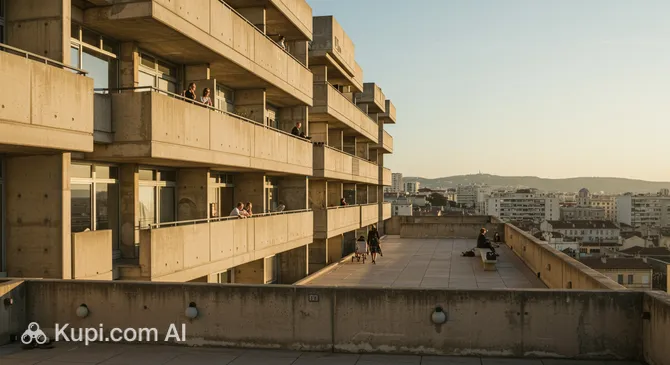
Unité d'Habitation. Illustration.
Source: Kupi.com AI

Traveler photos:

As a massive 18-story block, the building contains 337 apartments of various layouts, designed to house approximately 1,600 people. Unité d’Habitation was envisioned by Le Corbusier not merely as an apartment building, but as a complete "vertical city," providing its residents with everything necessary for a comfortable life.

The concept, revolutionary for its time, combined not only living spaces under one roof but also shops, a nursery school, and sports and cultural facilities, including a swimming pool and a gymnasium on the roof. This approach to organizing urban space became iconic and had a significant impact on the subsequent development of architecture and urban planning, making Unité d’Habitation more than just a residential complex—it is a true architectural manifesto.

Contacts

To obtain up-to-date information on visiting Unité d’Habitation, including opening hours and available tours, it is recommended to contact the administration directly. This will help you plan your visit and learn about all available options.

How to contactContact
Address280 Bd Michelet, 13008 Marseille, France
Websitewww.marseille-citeradieuse.org

What to Do

A visit to Unité d’Habitation in Marseille is a unique opportunity to experience the living heritage of modernist architecture and personally appreciate the revolutionary ideas of the famous Le Corbusier. Tourists can walk through the internal "streets" of this "vertical city," soaking in the special atmosphere of the residential complex. Of particular interest are the preserved original apartments, some of which are open for tours or converted into museum spaces, offering a glimpse into mid-20th-century daily life and design solutions.

One of the main attractions of Unité d’Habitation is its roof terrace. From here, breathtaking panoramic views of Marseille and the endless Mediterranean Sea unfold. But it is more than just an observation deck: the roof also features public spaces envisioned by Le Corbusier for the residents—a nursery school, a gym, and even an open-air amphitheater. This spot is perfect for taking impressive photos and relaxing while admiring the surroundings.

Inside the complex itself, you can find small shops, cozy cafes, and even a hotel. These infrastructure elements allow you to fully experience the "city within a house" concept that Le Corbusier sought to bring to life. For anyone interested in architecture, design, and the history of urban planning, a visit to Unité d’Habitation will be an unforgettable experience and provide a deeper understanding of the innovative approach of one of the 20th century's greatest architects.

Getting There

There are several ways to reach the famous Unité d’Habitation residential complex in Marseille. The building is located in the southern part of the city at 280 Boulevard Michelet, making it accessible by public transport as well as by car or taxi.

Public transport is the most convenient option for many tourists. The nearest metro station is "Rond-Point du Prado" on line M2. From this station, you can reach Unité d’Habitation by taking bus No. 21, 22, 23, or 45. You will need to get off at the "Le Corbusier" stop, which is located in the immediate vicinity of the building.

If you prefer to travel by car, Unité d’Habitation is easy to reach, and there is parking available near the complex. A taxi ride from the center of Marseille is also a comfortable, though more expensive, option.

While it is theoretically possible to walk from the city center, the journey takes about 40 minutes. Given that Unité d’Habitation is located in a residential area somewhat removed from the main historical landmarks, using public transport or a taxi is a more practical solution for most visitors.

Nearest city: Marseille

History & Facts

Unité d’Habitation in Marseille, often referred to as the "Housing Unit," is one of the most significant and revolutionary architectural works of the 20th century, born out of acute post-war necessity. After World War II, France faced a serious housing crisis, and in 1945, the Ministry of Reconstruction initiated a search for innovative solutions. It was then that the prominent architect Le Corbusier proposed his bold concept: instead of traditional low-rise blocks, a single multifunctional building—a true "city within a city." This approach allowed not only for the most efficient use of land but also ensured equal conditions for all residents, including abundant sunlight and, in Marseille's case, sea views.

Construction of the Marseille "Unité" began in 1947 and proved to be a real challenge. The project, which was ahead of its time, faced a wave of criticism, technical difficulties, and even legal disputes. Many were skeptical of the "vertical village" idea and the use of raw concrete ("béton brut"), which later became a hallmark of the Brutalist style. However, thanks to Le Corbusier's unwavering faith in his project and the support of certain government officials, the building was successfully completed in 1952, becoming a symbol of revival and innovation.

The uniqueness of "Unité d’Habitation" lies not only in its scale but also in the principles it embodies. Here, Le Corbusier implemented his "Five Points of Modern Architecture," including pilotis (supporting columns) that lift the building off the ground, an open floor plan for apartments, ribbon windows for better light, and a flat roof terrace. The roof housed a nursery school, a sports ground, and a pool, while inside the building itself, "shopping streets" featured stores and services. The Marseille "Housing Unit" became the prototype for a series of similar buildings not only in France but also in other European countries, exerting a massive influence on the development of mass housing and 20th-century architectural thought.

Time Needed

When planning a visit to Unité d’Habitation in Marseille, you should count on approximately 1-2 hours to explore this iconic architectural complex. This time is usually sufficient to get a general impression of Le Corbusier's famous creation and his concept of the "housing unit."

During this period, you can leisurely inspect the building from both the outside and inside, walk along its famous internal "streets" intended for public use, and head up to the roof terrace. Visiting the roof is highly recommended, as it offers panoramic views of the city and the sea. A small museum or exhibition space dedicated to the project's history may also be available for visiting within the building. If you have a deep interest in mid-20th-century architecture or the work of Le Corbusier, you might want to stay a little longer for a more detailed study of all aspects of this unique structure.

Working Hours

The opening hours of the Unité d’Habitation residential complex in Marseille can vary. Generally, access for visitors is open from approximately 10:00 AM to 6:00 PM. However, it is worth noting that operating hours may change depending on the season, as well as for specific areas within the complex, such as the museum, observation deck, or hotel, if they are open to the public.

Before planning your visit, it is highly recommended to check the current schedule on the official Unité d’Habitation website or contact the administration by phone. This will help avoid misunderstandings and allow you to plan your visit effectively, as well as find out if advance booking or registration for tours is required.

9:00 – 18:00

Nearby

Visiting Unité d’Habitation is undoubtedly a highlight of any trip to Marseille. However, to fully immerse yourself in the atmosphere of this unique place and the city as a whole, it is worth setting aside time to explore its surroundings. A stroll through the nearby neighborhoods will allow you to see more than just the famous architectural landmark and gain a more complete understanding of life in this part of France.

There are many interesting locations near Unité d’Habitation that can enrich your cultural itinerary and offer new experiences. From bustling sports complexes to picturesque parks and coastal areas, the surroundings offer various options for leisure and discovering Marseille.

NameDistance
Le Black Stone Pub0.5 km
Vélodrome Stadium0.9 km
Parc Borély1.2 km
Prado Beach2 km
Marseille Grand-Est Ice Rink2.3 km
SENSAS Marseille2.8 km
Notre-Dame de la Garde3.2 km

Have you reached the end of the page?

So the route has been studied inside and out