Support

Porte d'Auguste

About

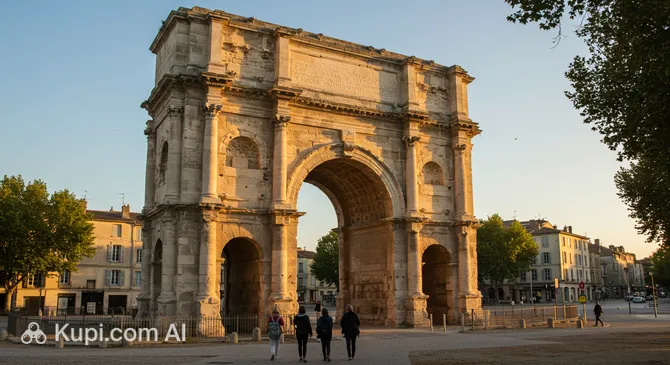
Have you ever wondered what the grand entrance to one of Roman Gaul's most prosperous cities looked like? The Gate of Augustus (Porte d'Auguste) is a majestic triumphal arch and a monument of ancient architecture located in the city of Nîmes. Built at the end of the 1st century BC, this structure served as the primary portal into the city on the famous Via Domitia, which connected Italy and Spain through the southern part of modern-day France.
Porte d
Porte d'Auguste. Иллюстрация. Источник: Kupi.com AI

This monument represents a rare example of a tetrapylon—a gate oriented in four directions. The architecture of the structure is impressively elegant: the corners are adorned with Corinthian columns supporting a classical entablature, and the structure is crowned by a rotunda. The use of the Corinthian order and marble facing emphasizes the ceremonial status of the building, which was erected in honor of Emperor Augustus.

Today, the Gate of Augustus is a vital part of the city's Roman ensemble, alongside landmarks such as the Maison Carrée. It is not merely a set of historical ruins, but a living testament to the power and cultural influence of the Roman Empire in the Provence region. Visitors are drawn not only by the gate's historical significance but also by its remarkable state of preservation, which allows for a detailed look at the ancient reliefs.

Contacts

For those planning a visit to the ancient Roman monument, the primary contact information is provided below:

How to contactContact
Address25B Bd Amiral Courbet, 30000 Nîmes, France

What to Do

The main activity at the Gate of Augustus is, undoubtedly, contemplating the ancient architecture. Visitors can walk right up to the monument to examine the Corinthian columns and surviving fragments of ancient decor in detail. The arch looks particularly striking at sunset, when the warm rays of the sun highlight the stone's texture, and evening illumination lends the structure a magical appearance.

After viewing the monument, it is pleasant to stroll along the lively Boulevard Amiral Courbet. Here, you can feel the true rhythm of a southern French city while enjoying views of the surrounding gardens and historic buildings. Since access to the gate is open 24/7, many tourists prefer to come early in the morning or late in the evening for a quiet walk without the usual bustle.

Photography enthusiasts will find many great angles here to capture the monumentality of Roman architecture. A visit here is easily combined with a stop at cozy nearby cafes serving Provençal cuisine, or a walk to other iconic Nîmes sites that are within easy walking distance.

Getting There

Reaching this historical location in Nîmes is quite straightforward. The Gate of Augustus is located at 25B Bd Amiral Courbet, just 500 meters from the famous Maison Carrée temple. If you are arriving by train, the Gare de Nîmes station is approximately 1.5 km from the landmark. This distance can be covered in about 20 minutes on foot, or you can take tram line A and get off at the "Musée de la Romanité" stop.

For travelers who prioritize comfort and speed, a taxi is an excellent option. You can call a car via local mobile apps or find one at official taxi ranks in the city center or by the station. The ride from central districts will take only a few minutes. If you are traveling by rental car, there are parking spaces available along Boulevard Amiral Courbet.

For those arriving from other regions via Montpellier-Méditerranée Airport (about 50 km away), it is most convenient to reach the city by train or by car via the A9 motorway. Additionally, the VélOlo bike-sharing system is popular in Nîmes, allowing you to easily move between ancient monuments throughout the historic center.

Ближайший город: Nimes

History & Facts

The Gate of Augustus was built during the reign of Emperor Augustus, at the turn of the 1st century BC and the 1st century AD. This was the era of Rome's "Golden Age," when architecture became a powerful tool for broadcasting the empire's grandeur. The structure was designed as a tetrapylon—a monumental gateway with four passages—which underscored Nîmes' status as one of the most significant cities in Gaul.

The architectural style of the gate clearly demonstrates the transition to the ornate Corinthian order, which became dominant during that period. The use of graceful columns and a rich entablature links this monument to other masterpieces of the era, such as the Temple of Mars Ultor in Rome. Notably, the structure retained elements of Hellenistic influence, harmoniously blending them with rugged Roman monumentality.

In antiquity, this gate served not only as a grand entrance but also as part of the massive city walls. It symbolized the triumph of Roman rule and engineering genius. It was during this same period that grand projects like the Pont du Gard aqueduct were constructed in the region, testifying to the incredible scale of Emperor Augustus' urban development in Provence.

Interestingly, the Gate of Augustus stands on a high pedestal that was once faced with marble and decorated with reliefs. Despite the passing centuries, the structure has preserved its symmetry and majesty, remaining one of the finest examples of Augustan architecture preserved outside of Italy.

Time Needed

To leisurely explore the Gate of Augustus, appreciate the skill of the ancient builders, and take quality photographs, 30–45 minutes is usually sufficient. This allows enough time to study the details of the Corinthian columns and imagine what the grand entrance to the city looked like thousands of years ago.

If you plan to include the gate as part of a walking tour through Nîmes' historic center, combined with a visit to nearby boulevards and cafes, you should set aside about 1–2 hours. Since the site is outdoors, access is always open, making it easy to fit into any sightseeing schedule.

Working Hours

The Gate of Augustus is part of the city's open-air architectural landscape, meaning it is accessible for viewing at any time. You can visit this attraction 24 hours a day (around the clock) any day of the week, from Monday to Sunday.

This schedule makes the site ideal for those who prefer evening strolls under the beautiful city lights or want to take photos at dawn when there are no other tourists at the monument.

Круглосуточно

Nearby

Exploring the ancient heritage of Nîmes doesn't stop at the gate. A walk through the surrounding area will allow you to dive deeper into the atmosphere of the ancient Roman city and see how history intertwines with the modern day.

NameDistance
Nîmes Natural History Museum0.2 km
La Piazzetta0.2 km
Nîmes Clock Tower0.4 km
Les Halles de Nîmes0.4 km
Nîmes Arena0.5 km
Pradier Fountain0.5 km
Nîmes Arènes Aparthotel0.6 km

Reached the end of the page?

That means the route is fully explored