Support

La Tour de la Babote

About

Among the picturesque streets that Montpellier is famous for stands the majestic Tour de la Babote. It is not just an architectural monument, but a rare surviving fragment of the ancient fortress walls that once securely protected the city's historic core—the L’Écusson quarter. France carefully preserves such relics, and this tower, standing about 53 meters tall, was officially recognized as a historic monument at the beginning of the last century.
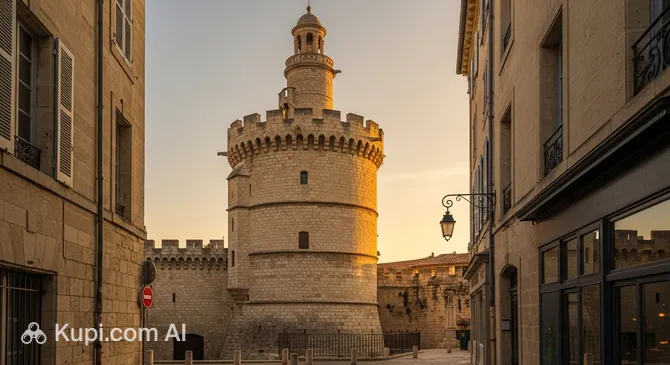
Babote Tower
Babote Tower. Иллюстрация. Источник: Kupi.com AI

The uniqueness of this structure lies in its fascinating "double" history. Founded in the 12th century as a purely defensive outpost, the tower underwent a remarkable transformation in the 18th century. Its upper part was rebuilt as an astronomical observatory, crowned with a dome for a telescope. This harmonious blend of medieval austerity and Enlightenment rationalism makes it one of the city's most recognizable landmarks.

Today, life continues to pulse within the walls of Tour de la Babote. It houses the Federation of Popular Astronomy of Southern France. The tower serves not only as a reminder of its military past but also as an active center of science, where celestial observations and educational events are held, attracting both locals and curious travelers alike.

Contacts

For more information about special events and the possibility of visiting the interior, you can use the official contact details.

How to contactContact
Address17 Bd de l'Observatoire, 34000 Montpellier, Франция
Phone+33 4 67 60 60 60
Websitewww.montpellier.fr

What to Do

A visit to the Tour de la Babote is best started with a leisurely external inspection. Standing at its base, it's easy to spot the difference in masonry: the massive lower tiers preserve the memory of medieval battles, while the upper section reflects the elegant style of the Enlightenment. It’s a great spot for atmospheric photos, especially in the rays of the setting sun when the stone takes on a warm golden hue.

The tower is of particular interest to fans of technical history and bold ideas. It is here that one can recall the first parachute jump, which, according to legend, was made from its roof. While walking nearby, try to imagine this breathtaking event, which became an important milestone in the history of aviation.

If you are lucky enough to attend an event by the Astronomy Federation, be sure to take a look inside. During public lectures or stargazing nights, visitors can touch the mysteries of the cosmos using modern equipment in a historic setting. Additionally, the tower offers impressive panoramic views over the rooftops of old Montpellier, making a wonderful addition to your visit.

Getting There

Finding this historical site is easy, as it is located in the heart of the city at 17 Bd de l'Observatoire. If you are already strolling through the historic center of L’Écusson, the walk from the famous Place de la Comédie will take only 10–15 minutes at a pleasant pace.

For those who prefer public transport, Montpellier offers an excellent tram network. Lines 1, 2, 3, or 4 will work—you should get off at the Observatoire stop, which is in the immediate vicinity of the tower. Local buses connecting different parts of the city also stop nearby.

Travelers arriving from Montpellier-Méditerranée Airport (MPL) will find it most convenient to take a special shuttle or train to the central station, and from there reach the tower by tram or on foot. If you are traveling by car, it is recommended to leave it at one of the park-and-ride lots, as the city center is largely pedestrianized and parking on Boulevard de l'Observatoire may be limited.

Ближайший город: Montpellier

History & Facts

The tower owes its appearance to the turbulent 12th century, when it was erected as part of a powerful defensive system around the city's old center. Back then, L’Écusson was protected by 25 similar structures, but only two guardians have survived to this day in their original form—Tour de la Babote and the Tour des Pins. Over the centuries, its role changed from purely military to scientific and even communication-based.

A new chapter in the tower's history began in the 1740s. An astronomical observatory was built on its medieval foundation by order of the Royal Scientific Society. This turned a military facility into one of France's leading scientific centers of the time. The observatory was active until the French Revolution, leaving behind a rich scientific legacy.

One of the most exciting legends in the history of aeronautics is also associated with the tower. It is believed that on December 26, 1783, Sébastien Lenormand made his famous jump from here with a prototype parachute. While historians still debate the details of this event, Tour de la Babote has firmly secured its status as the birthplace of modern parachuting.

In the 19th century, the building served the needs of the telegraph department, and in 1927, it was officially recognized as a historic monument. Today, it continues to serve science as the home of the Federation of Popular Astronomy, making it a unique example of tradition spanning nearly nine centuries.

Time Needed

To view the Tour de la Babote from the outside, appreciate the architectural contrast between the rugged medieval base and the elegant 18th-century extension, and take some commemorative photos, you will need about 30 to 40 minutes. This is an ideal stop during a walking tour of the center.

If your goal is to get inside during thematic lectures or astronomical observations organized by the amateur society, you should set aside 1.5 to 2 hours in your schedule. Such an immersion allows you not only to see the interiors but also to touch living science within the walls of an ancient monument.

Working Hours

The area around the tower is available for outside viewing daily and around the clock; however, the official operating hours for visiting the site are from 07:00 to 01:00 all week. This allows you to see the landmark both in bright daylight and under spectacular evening lighting.

Keep in mind that access to the interior rooms and telescopes is limited by the schedule of the Astronomy Federation. Before visiting, it is recommended to check the city's official website or confirm the lecture schedule on-site to ensure your visit coincides with opening hours.

07:00–01:00

Nearby

The tower's location in the central part of the city makes it easy to combine your visit with other interesting locations. Just a few steps away, the cozy streets of the old town begin, filled with cafes and souvenir shops, while a bit further out you'll find modern entertainment centers that will appeal to fans of active recreation and science.

Below are some interesting places in the vicinity that can complement your Montpellier itinerary:

NameDistance
Gazette Café0.2 km
Place de la Comédie0.3 km
Bonobo Centre Ville0.4 km
Escape Game and Night Club Montpellier0.5 km
Coldrip Food and Coffee0.5 km
Musée Fabre0.6 km
Pavillon Populaire0.6 km

Reached the end of the page?

That means the route is fully explored