Support

Musée de Grenoble

About

Founded at the very end of the 18th century, the Grenoble Museum is rightfully considered one of the most prestigious and oldest art collections that France is proud of. Situated in a picturesque location on the banks of the Isère River, the museum occupies an ultra-modern building that blends harmoniously into the historic landscape of the city of Grenoble.
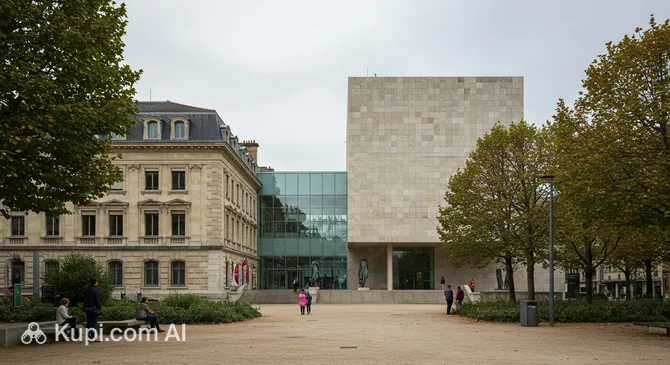
Grenoble Museum
Grenoble Museum. Иллюстрация. Источник: Kupi.com AI

This unique cultural space brings together different eras and civilizations under one roof. It houses more than 900 works of art: from the mysterious antiquities of Ancient Egypt to the bold experiments of contemporary artists. The museum's collection is recognized as one of the most complete in Europe, spanning the period from the 13th century to the present day.

One of the main features of this place is its 16,000-square-meter sculpture garden. It surrounds the building and seamlessly flows into the city park, creating the atmosphere of an open-air museum where art meets nature at the foot of the Alps. The evolution of European painting is presented here in all its glory, making the museum a must-visit for any lover of beauty.

Contacts

To contact the museum administration and find out the latest information about special exhibitions or group tours, you can use the official communication channels. The Grenoble Museum is always open to questions from visitors.

How to contactContact
Address5 Pl. de Lavalette, 38000 Grenoble, France
Phone+33 4 76 63 44 44
Websitewww.museedegrenoble.fr

What to Do

Inside the museum's halls, a fascinating panorama of world art history unfolds before visitors. It's definitely worth spending time in the Egyptian department, which features authentic mummies and artifacts found during archaeological expeditions. Fans of the classics will appreciate the halls of 13th–17th-century Italian painting, which display works by masters such as Rubens and Canaletto.

The museum is particularly proud of its early 20th-century collection. Here, you can take a close look at masterpieces by Matisse, Derain, and Vlaminck, who changed our perception of color and form. The chronological order of the exhibition allows you to clearly trace how artists' tastes and techniques have changed over the centuries.

After wandering through the halls, head to the sculpture garden, located in the Albert Michallon Park. Walking along the old 19th-century city walls, you can see the works of modern sculptors in natural light. In addition, the museum often hosts temporary exhibitions and educational lectures, and audio guides in several languages are available for the convenience of guests.

Getting There

Reaching this cultural hub is easy, as it is located at 5 Pl. de Lavalette, in the heart of the historic district. If you prefer walking, the path from the city's main squares takes only a few minutes, allowing you to enjoy views of the Isère River along the way.

For those using public transport, the most convenient option is tram lines A or B—get off at the "Musée" or "Lavalette" stops. Buses C1, C3, 12, and 13 also run to the museum. If you arrive at the Grenoble Gare central station, the tram ride takes about 5 minutes, and a walk on foot takes no more than 20 minutes.

For travelers by car, there are parking zones directly at the museum building and in the nearby central blocks. From Grenoble-Isère Airport, the most convenient way is to take a special shuttle to the station and then transfer to a tram.

Ближайший город: Grenoble

History & Facts

Founded on February 16, 1798, by the artist Louis-Joseph Jay, the Grenoble Museum is one of the oldest provincial museums in the country. Its first exhibition opened on the last day of 1800 and included fewer than three hundred works. In the early 19th century, at the personal insistence of Napoleon Bonaparte, the collection was moved to the central school building, emphasizing its national importance.

Andry-Farcy, who served as curator in the early 20th century, played a special role in the museum's history. It was thanks to his courage and foresight that the museum became the first in France to actively collect modern art, including works by Fauvists and Neo-Impressionists, when they were not yet widely recognized. This ensured Grenoble's fame as one of the main centers of the avant-garde.

The Egyptian collection, which began in 1777, is also noteworthy. It expanded significantly after Bonaparte's famous campaigns and thanks to the scientific works of Jean-François Champollion, who was closely associated with this region. Today, these artifacts form one of the most significant sections of Egyptology in France.

The museum acquired its modern look in 1994 when a new futuristic building was opened. Construction took place on the site of the old 16th-century Arsenal and the medieval Tower of the Island (Tour de l'Isle). The architects managed to harmoniously combine preserved fragments of ancient fortress walls with modern glass and concrete halls.

Time Needed

For a leisurely tour of the museum's main sections, an average visitor will need 2 to 3 hours. This is enough time to get acquainted with the masterpieces of European painting, look into the halls of Ancient Egypt, and take a walk through the adjacent sculpture garden.

If your trip coincides with major temporary exhibitions, which are famous for their scale, we recommend allocating at least 4 hours or even half a day for your visit. The museum has cozy relaxation areas, allowing you to take a break and return to contemplating art with renewed energy.

Working Hours

The museum welcomes visitors daily except for Tuesdays. On Mondays and from Wednesday to Sunday, the halls are open from 10:00 AM to 6:30 PM.

Please note that Tuesday is a day off, when the museum is closed to the general public. Plan your visit in advance, keeping in mind that ticket sales usually stop half an hour before closing.

DayWorking hours
Понедельник10:00 – 18:30
ВторникЗакрыто
Среда10:00 – 18:30
Четверг10:00 – 18:30
Пятница10:00 – 18:30
Суббота10:00 – 18:30
Воскресенье10:00 – 18:30

Nearby

Exploring the surroundings of the Grenoble Museum allows you to dive deeper into the city's atmosphere and see its many facets—from ancient fortifications to monumental 20th-century monuments. A stroll along the Isère embankment or through the quiet squares of the center will be a great addition to visiting the galleries.

NameDistance
Museum of the Old Bishop's Palace0.2 km
Lion Fountain0.3 km
Saint-Laurent Archaeological Museum0.3 km
Grenoble Cathedral0.3 km
Dauphinois Museum0.5 km
Grenoble-Bastille Cable Car0.5 km
Jardin de Ville0.5 km

Reached the end of the page?

That means the route is fully explored