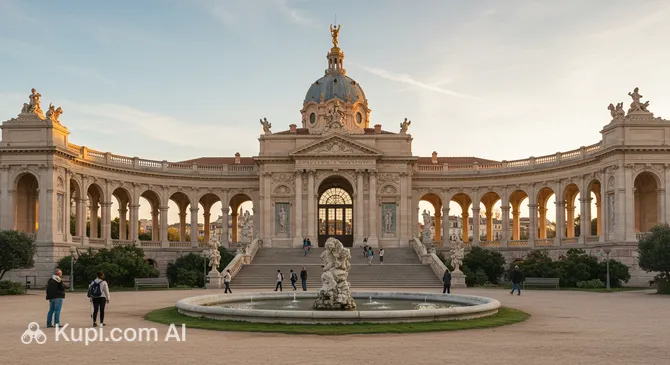
Palais Longchamp is not just a palace, but a majestic architectural ensemble and one of Marseille's most striking landmarks. Created in the 19th century, it symbolizes a vital event for the city—the completion of the Marseille Canal, which brought long-awaited water from the Durance River to the city. This complex is a true hymn to water, embodied in stone and art.
The central element of the composition is the monumental "Château d'eau" ("Water Castle") fountain, considered one of the most beautiful in the world. It is crowned by an impressive sculptural group: a chariot drawn by bulls, driven by three female figures representing the river, fertility, and abundance. Elegant semicircular colonnades branch out from the fountain, connecting the two symmetrical wings of the palace.
Palais Longchamp is also an important cultural center in France. Its wings house two significant museums. The east wing contains the Museum of Fine Arts, featuring a collection of 16th–19th-century paintings and sculptures. The west wing houses the Natural History Museum with its rich exhibitions. Thus, a visit to the palace allows you to combine a pleasant walk with an introduction to art and science.
Traveler photos:
Stretching behind the palace is the picturesque Longchamp Park, which is listed as one of the Notable Gardens of France. It once housed a zoological garden, of which only a few old pavilions remain today. Nowadays, it is a wonderful place for relaxation and leisurely strolls in the shade of century-old trees, where you can escape the hustle and bustle of the city.